


Armatrix builds snake-like robots so humans don't have to crawl into dangerous tanks
The Bengaluru-based deeptech startup makes hyper-flexible robotic arms to inspect confined industrial spaces, and has raised $2.1 million in a funding round led by pi Ventures.


Inspecting the inside of a ship's hull, a fuel tank or a nuclear reactor is one of the most dangerous jobs in heavy industry. It usually means shutting the equipment down, building scaffolding, and sending a person into a cramped, hazardous space where fatal accidents are a common occurrence.
Armatrix, a Bengaluru-based deeptech startup, is building robots to do that work instead. Its machines have snake-like robotic arms, flexible enough to thread through tight, twisting spaces that a rigid industrial robot cannot reach.
The current approach is costly as well as slow. Taking a fuel tank or a reactor offline halts production for as long as the inspection runs, and the industry has long treated maintenance as something to do after a failure rather than before one.
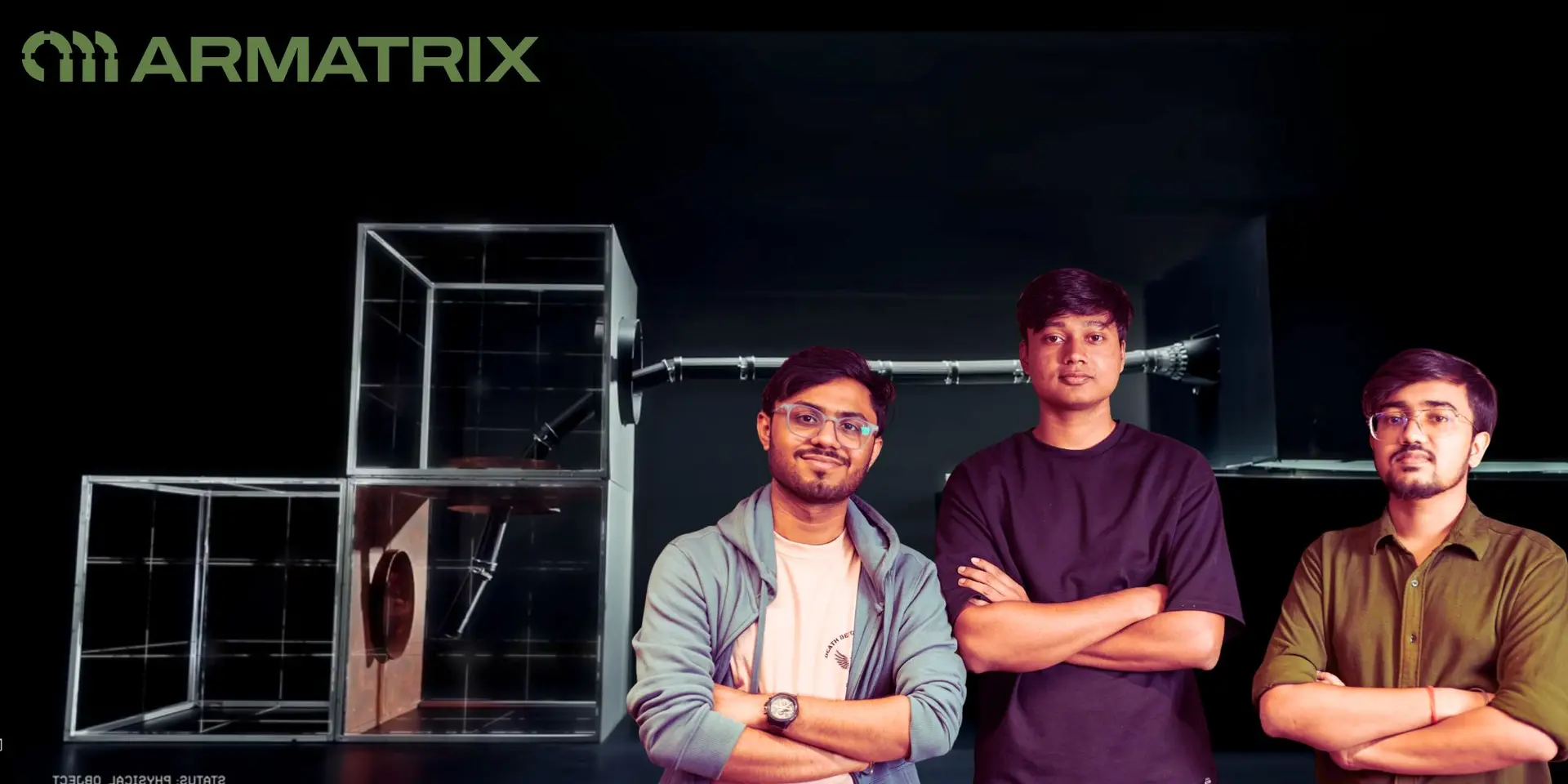
The company was founded in 2024 by three IIT Kanpur engineers: Vishrant Dave, Prateesh Awasthi and Ayush Ranjan. Dave, the CEO, frames the goal as a shift from reactive, high-cost maintenance to a proactive model with no downtime and no human entry into dangerous spaces.
An arm that moves like a snake
The core product is a hyper-redundant robotic arm: three to five metres long, 50 to 150 mm across, with more than 22 points of movement. That flexibility lets it navigate through a series of manholes set at right angles to one another, reaching places a person or a conventional arm could not.
The structure is purely mechanical, made of links, joints and cables, with the motors, electronics and computing housed in a separate sealed box away from the hazardous zone. On top of the hardware sits the AI for real-time path planning and digital-twin simulation, so the arm can adapt as it moves through unpredictable industrial layouts.
The arm is built to act, not just look. Its tip takes modular end effectors, tools that can be swapped for different jobs, so the same machine can inspect a surface on one run and carry out a maintenance task on another.
Armatrix has built a working three-metre proof-of-concept arm. It plans to sell in two ways: renting the robots out as a service for most customers, and selling them outright to clients like defence, where security and intellectual-property rules make a rental arrangement impractical.

A large market, still pre-revenue
The startup is targeting shipbuilding, oil and gas, nuclear energy and aviation sectors, where inspection and maintenance still depend on human entry into confined spaces. The market is large: global spending on robotic maintenance was about $41 billion in 2023 and is projected to reach $150 billion by 2032.
Few companies anywhere build robots for this exact problem, and fewer still in India. Armatrix's pitch is that a home-built system can serve Indian shipyards and refineries more cheaply than an imported one, while keeping sensitive defence work onshore.
Armatrix is pre-revenue, still moving from prototype to its first pilot deployments with industrial customers, and employs around 13 people. The near-term plan is to prove the platform on real inspection jobs, then widen into the other operations the arm can take on.
In February 2026, it raised $2.1 million in a seed round led by pi Ventures, with Inuka Capital, Boundless Ventures, Boost VC, Turbostart and gradCapital also taking part. The money is going into finishing the arm, growing the engineering team, and running those first pilots. The founders' larger aim is to build globally competitive industrial robots from India.
(This story has been researched and compiled using publicly available information.)