



Astrobase is building a reusable rocket engine and a launch vehicle in Bengaluru
The company is developing a methane and liquid oxygen engine for launch vehicles carrying three-to ten-tonne payloads, and has managed to get government backing for a high-thrust version.

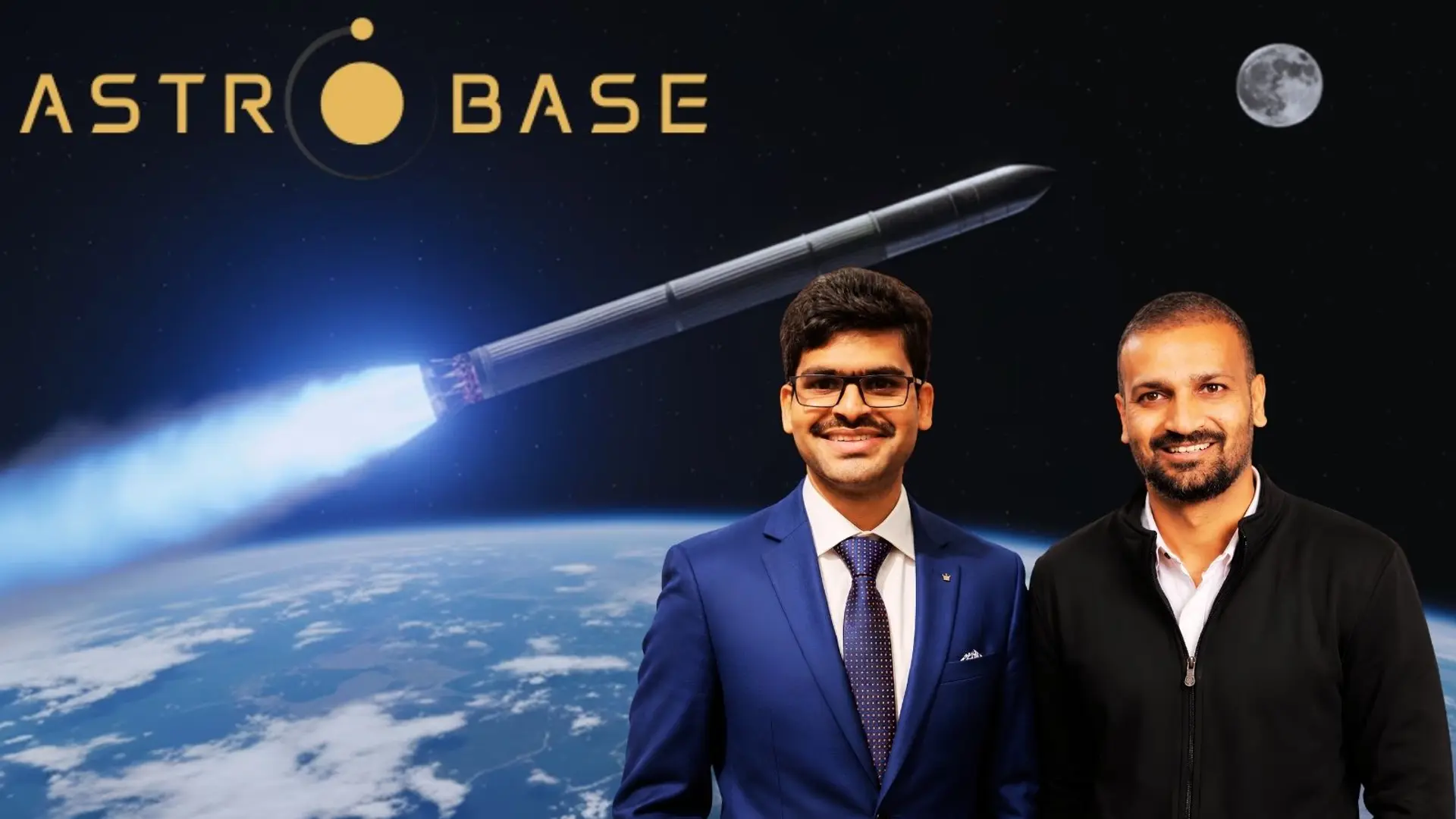

India launches satellites reliably but does not launch many of them. ISRO's record is strong, its cadence is limited, and demand for orbital slots is rising faster than the country's ability to reach them. A handful of private companies have started building launch vehicles to close that gap, mostly at the small end of the payload range.
Space Technologies is aiming at the middle of it. The company was founded in Bengaluru in 2024 by Neeraj Khandelwal, a co-founder of the cryptocurrency exchange CoinDCX, alongside former ISRO scientist Devakumar Thammisetty.
An engine that burns methane
The company's core technology is a rocket engine that burns methane with liquid oxygen, in a configuration known as full-flow staged combustion. It is among the more demanding engine architectures in use anywhere, and is the one most closely associated with reusable rockets.
Methane has become the preferred fuel for reusable vehicles for practical reasons. It burns more cleanly than kerosene, leaves less residue between flights, and makes turnaround simpler. Astrobase plans three vehicle configurations: fully expendable, partly reusable and fully reusable, carrying three to ten tonne payloads, with engine components made using 3D printing.
Its stated focus is autonomous landing and rapid turnaround, the two capabilities that separate a reusable vehicle from an expendable one. The company positions itself as one complementing ISRO rather than one competing with it, starting at mid-sized vehicles and scaling up.
The cycle it has chosen is the hard one. Full-flow staged combustion has been run on a test stand by only a handful of engines anywhere, and just one has ever flown: SpaceX's Raptor. ISRO has not attempted it. Astrobase itself has called it the hardest rocket engine cycle ever built.

Government backing for a bigger engine
In June 2026, IN-SPACe selected Astrobase as one of the first three recipients of support under its Technology Adoption Fund, alongside SatSure and TM2SPACE. The scheme covers up to 60% of the project costs for a startup, capped at Rs 25 crore per project, and the three were chosen by a committee drawn from ISRO, DPIIT, and the Department of Science and Technology.
Astrobase was chosen from 43 applicants, and its support is tied to technical milestones. The project is an 800 kilonewton engine running on liquid oxygen and methane, designed to be reusable and modular, for medium- to heavy-lift vehicles and orbital stages. IN-SPACe backed the company's own design rather than transferring an existing ISRO one.
The test record so far runs through sub-scale hardware. The company says it hot-fired a sub-scale version of the engine successfully at the first attempt in September 2025, and ran its turbopumps in January 2026 with results it describes as ahead of prediction. Testing is done at a 21.5-acre facility it has built at Anantapur in Andhra Pradesh.
On the private side, Astrobase raised roughly $10 million in its first round, led by Banyan, with regulatory filings initially showing around Rs 60 crores. The company says it has put more than Rs 100 crores into propulsion and manufacturing infrastructure.
The company has also begun looking abroad. It announced a first European commercial partnership with Impulso Space at a space industry meeting in Veneto in 2026, covering launch support services for European satellite operators, including payload processing and mission operations.
The roadmap it has set out is specific. Seven of the engines would be clustered under a reusable medium-lift rocket, with a first full-scale integrated hot fire expected during 2026, a hop-test demonstrator in 2027, and a maiden orbital launch targeted for 2029. Independent technical scrutiny of the company's claims remains scarce, and every company that has developed an engine of this class has taken longer than it first planned.
(This story has been researched and compiled using publicly available information.)