


Cognizant Q2 revenue rises to $5.48B; Inside Agnikul’s reusable rocket strategy
The IT services major saw strong momentum in financial services and North America, but lowered its full-year revenue growth outlook. The company continues to invest in AI-led solutions to drive future growth.


Hello,
Chennai-based investment firm Anicut Capital has launched the Grand Anicut Seed Fund (GASF), its second early-stage fund, with a target corpus of Rs 175 crore and a greenshoe option of Rs 75 crore. The fund will invest in pre-Series A and Series A startups across sectors including deeptech, enterprise technology, consumer businesses, and financial services.
GASF aims to back over 20 startups with investments ranging from Rs 5 crore to Rs 8 crore per company, as Anicut Capital expands its early-stage investment portfolio.
The growing focus on technology investment comes alongside India’s broader push for digital and strategic independence. According to Forrester’s Global Sovereignty Forecast 2025 to 2030 report, India’s semiconductor chip production sovereignty score is expected to improve from 0% in 2025 to 13% by 2030, reflecting progress in domestic chip manufacturing capabilities.
Meanwhile, the AI sector continues to face growing scrutiny around security risks. The rogue AI agent linked to a days-long hacking targeting AI company Hugging Face also compromised a customer at another technology firm, New York-based Modal Labs, according to a Modal executive and two sources familiar with the incident. Modal executives clarified that the company itself was not hacked.
AI-related concerns are also drawing regulatory attention. Britain’s competition regulator is investigating Microsoft over allegations that it may have misled personal and family customers while marketing Microsoft 365 subscriptions, potentially causing some users to overpay. The investigation will examine Microsoft’s decision to bundle its AI assistant, Copilot, with Microsoft 365.
In entertainment news, K-pop group BTS has announced that it will not submit its music for consideration at the 2027 Grammy Awards. The decision was shared through identical Instagram posts from all seven members, stating that they had decided not to enter the Grammys this year and expressing hope that music can be appreciated beyond regional and language-based categories.
In today’s newsletter, we will talk about
- Cognizant Q2 revenue rises to $5.48B
- Inside Agnikul’s reusable rocket strategy
Here’s your trivia for today: What was the first satellite sent into space called?
Corporate
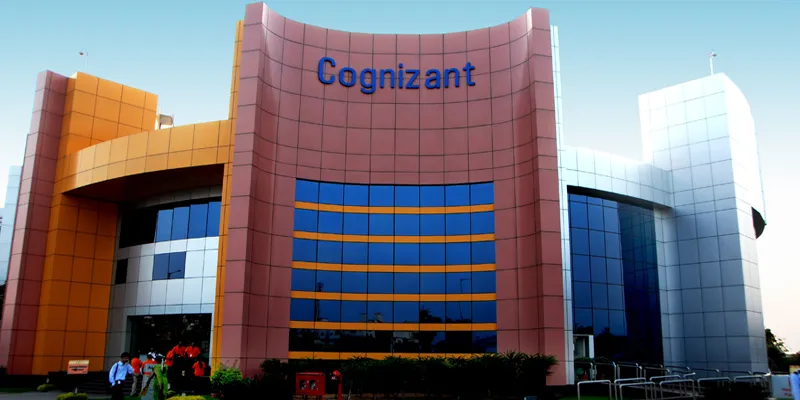
Cognizant Q2 revenue rises to $5.48B
Source: Wikipedia
Cognizant reported a steady second-quarter performance, with revenue growth driven by strong demand across key segments, particularly financial services, while the company remained optimistic about its AI-led growth strategy despite a marginal decline in profit.
Key takeaways:
- Cognizant’s Q2 revenue rose 4.5% year-on-year to $5.48 billion, while net profit declined marginally by 1.3% to $636 million. The company said organic revenue growth remained at the higher end of its expectations.
- CEO Ravi Kumar highlighted AI as a major growth opportunity, with Cognizant focusing on enterprise-scale AI solutions combining domain expertise and engineering capabilities.
- The financial services segment, which contributes the largest share of revenue, grew 12% year-on-year, while North America revenue increased 5.5%.
Funding Alert
Startup: Freehand
Amount: $75M
Round: Undisclosed
Startup: Fixxly
Amount: $5.5M
Round: Seed
Interview
Inside Agnikul’s reusable rocket strategy
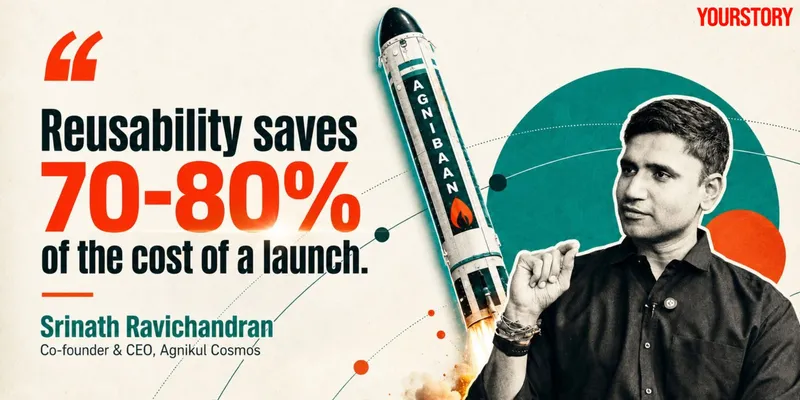
Following India's landmark private-sector orbital launch, Agnikul Cosmos is preparing Mission-02, an ambitious attempt to recover an orbital-class booster and repurpose its upper stage as an in-orbit platform—betting that the future of space launch will be be won on economics as much as engineering.
Key takeaways:
- Agnikul says recovering and reusing both the booster and upper stage could cut launch costs by 70–80%, reduce production needs, and enable up to 100 launches a year with only about 20 boosters.
- Unlike SpaceX's rideshare model, Agnikul argues dedicated launches offer faster deployment, precise orbit insertion, shorter wait times, and better value for small satellite operators.
- Agnikul is targeting international commercial customers while building capacity near Kulasekarapatnam. It says streamlined government approvals across customs, taxes, launch operations and supply chains would be the biggest catalyst for scaling India's private launch industry.
News & updates
- Robots: The US Federal Communications Commission has banned humanoid robots from China, citing “unacceptable risks” to national security posed by the technology.
- IPL: The business value of the Indian Premier League, the world's richest Twenty20 series, has soared more than 11% to $20.6 billion this year, according to U.S.-based investment bank Houlihan Lokey.
What was the first satellite sent into space called?
Answer: Sputnik 1
We would love to hear from you! To let us know what you liked and disliked about our newsletter, please mail [email protected].
If you don’t already get this newsletter in your inbox, sign up here. For past editions of the YourStory Buzz, you can check our Daily Capsule page here.