



Turning battery waste into strategic resources: The next opportunity for Indian industry
As EV adoption accelerates, end-of-life batteries are emerging as a strategic source of critical minerals. Building a robust battery recycling ecosystem will be key to India's resource security, manufacturing resilience, and clean energy future.

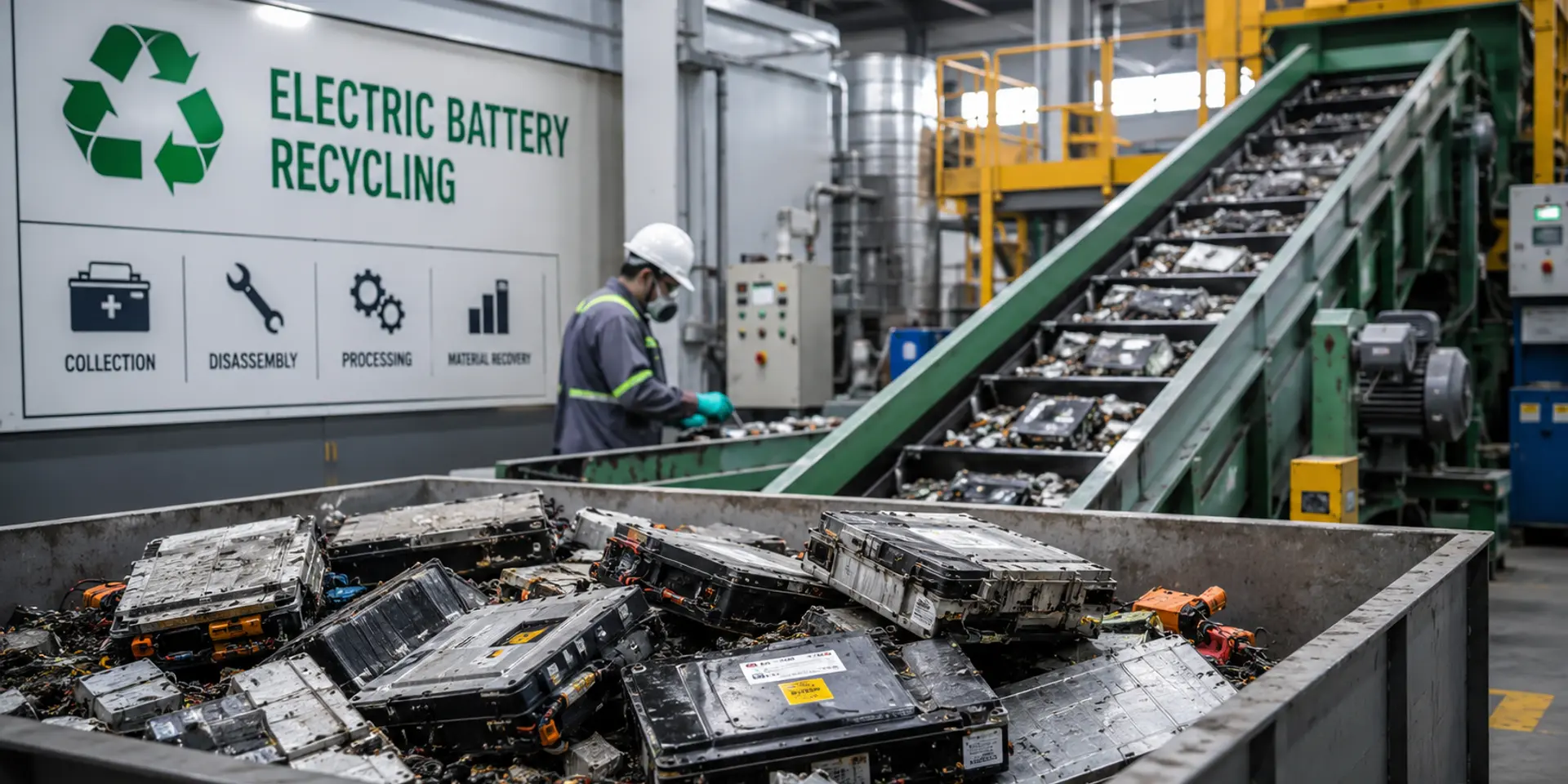

An electric scooter’s battery spends about five years powering daily commutes. But when the battery’s State of Health drops below 70%, most people see a trash dead battery. But the industry sees a treasure trove of critical minerals. At this moment, the exhausted battery stops being an automotive component and transforms into the frontline of a monumental industrial transition.
As EV adoption is accelerating in the country, the fate of that battery determines whether India will be a self-reliant producer or replace import dependence on crude with import dependence on critical minerals.
India is aiming for 30 million EV sales by 2032 (India Energy Storage Alliance, June) and the NITI Aayog estimates that India will generate approximately 128 GWh of battery waste (NITI Aayog and Green Growth Equity Fund Technical Cooperation Facility, 2022) by the end of the decade; the EV segment accounts for nearly half this volume. So what appears to be waste is, in reality, a concentrated urban mine.
How much value truly lies within the dead battery?
End-of-life lithium ion batteries contain the exact materials required to build the next generation of energy storage. The projected 128 GWh of waste can potentially yield a staggering 17,500 tonnes of lithium, 22,600 tonnes of nickel, 2,600 tonnes of cobalt, and 141,800 tonnes of graphite (WRI India, Battery Recycling in India, 2022).
For a country with limited domestic reserves, extracting these minerals is a macroeconomic necessity. A Rocky Mountain Institute report states a circular battery economy represents a $9 billion market opportunity for India. By 2050, a robust domestic recycling infrastructure could domestically supply over 40% of the nation's lithium, nickel, and cobalt needs insulating manufacturing from volatile global commodity markets.
The alchemy of recycling
Recovering critical minerals is far more sophisticated than simply dismantling the battery. Every battery pack differs in chemistry, design, physical condition and remaining charge, making safe handling the first engineering challenge. After controlled discharge, batteries are mechanically dismantled and shredded in a controlled environment to separate plastics, copper and aluminum foils.
The resultant output from the shredding process is a dark fine powder known as “black mass”, which contains concentrated active metals that drive the energy transition. Advanced refining techniques can extract lithium, nickel, cobalt and graphite as metal or salts, with a recovery efficiency of over 90%. At the end of the day, the metals within battery packs are still metals, and hence can transform into different forms of those metals. Refined metals can be re-fed into multiple different manufacturing streams including batteries repeatedly, with recycling.
Retaining value and chasing scale
Real economic value lies in refining black mass into metals or salts that can be used by industry, not in producing black mass. Until recently, black mass was exported mostly effectively transferring significant value overseas. Domestic refining retains value within the country’s own manufacturing ecosystem and strengthens battery, chemical and advanced materials industries.
Engineering the breakthrough
Operating a recycling facility demonstrates that metallurgy alone is not enough for commercial success but also process design. Technologies with multiple chemical extraction stages have increased reagent consumption, waste generation and operating costs. Lithium Iron Phosphate (LFP) becoming the preferred chemistry, commercially viable recycling will depend on chemistry-agnostic technologies that reduce process complexity while operating efficiently at scale.
The chemistry issue
Despite the technical success of recovering critical minerals, LFP batteries present a commercial challenge. Unlike premium Nickel Manganese Cobalt (NMC) batteries, which are packed with highly valuable metals, LFP batteries contain zero nickel and cobalt. While lithium, iron and phosphorus can be recovered, today's commodity prices fail to cover the cost of processing. The science of recycling is sound but the economics can be punishing. If left entirely to free-market forces, recyclers will naturally cherry-pick the NMC batteries and abandon the LFPs, leading to mountains of unprocessed, toxic waste.
To save LFP packs from becoming a stranded asset, the industry requires Viability Gap Funding (VGF) or differentiated, chemistry-specific incentives tailored to make the processing of low-value chemistries financially sustainable.
The final hurdle
Securing feedstock is a huge hurdle. With an estimated 70% to 90% of India's battery waste disappearing into the unregulated informal sector, where unsafe extraction causes environmental damage and massive material loss; the Battery Waste Management Rules (BWMR) 2022 introduced the Extended Producer Responsibility (EPR) at a much needed time to direct waste to recyclers, but enforcement remains critical. Enabling traceability across a battery’s lifecycle, till retirement can ensure batteries remain within the formal circular economy,
Ultimately, the transition of battery waste into strategic resources is the defining industrial challenge of the electric mobility era. Batteries are a source of raw materials that underpin India’s clean energy transition and industrial competitiveness. By scaling advanced refining, supporting economically challenging chemistries like LFP and strengthening EPR enforcement and battery traceability, battery recycling will transform into strategic industrial capability.
(Manikumar Uppala is the Co-founder and Chief of Industrial Engineering at Metastable Materials)
(Disclaimer: The views and opinions expressed in this article are those of the author and do not necessarily reflect the views of YourStory.)