



Cellarim Labs makes cosmetic ingredients in India without fermentation
Cellarim Labs converts renewable bio-waste into cosmetic ingredients and has raised Rs 6 crore to move from laboratory batches to pilot-scale production.


Hyaluronic acid is a key ingredient in most serums and moisturisers, prized because it can hold many times its own weight in water, which is what gives these products their hydrating effect.
It's typically made either by fermenting bacteria in large tanks or through chemical synthesis, and Indian beauty brands import most of their supply from abroad. That dependence leaves formulators exposed to shipping delays and inconsistent purity between batches.
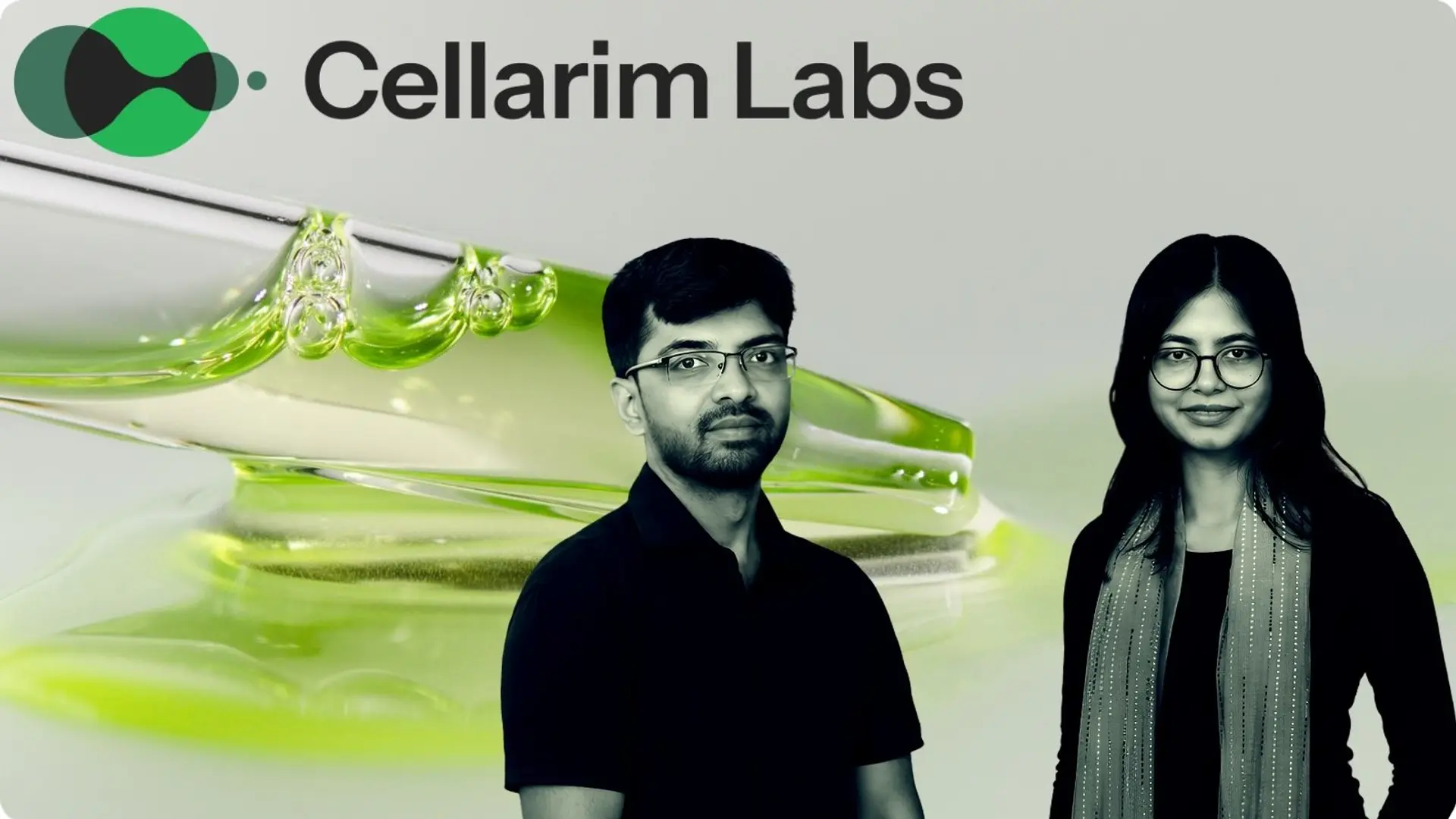
was set up in Bengaluru in 2023 to change that. Nisa Mehreen, the CEO, and Hitesh Rafalia founded the company. Mehreen holds an MBA from IIM Trichy and had earlier worked at a circular economy startup. They began with a small bioreactor in a laboratory at IKP in Bengaluru in mid-2023.
The company describes its platform as India's first cell-free biomanufacturing system, and says it is among a small number worldwide to have developed the approach independently. It sells to other businesses rather than directly to consumers; its ingredients end up in other companies' products, sold under their own brand names.
Enzymes without the cell
Conventional biomanufacturing uses living organisms. Bacteria or yeast are fed, grown and coaxed into producing a molecule, then the molecule is separated out from everything else the cell made. It works, but it is slow, and purification is a large part of the cost.
Cell-free manufacturing skips the organism entirely. Instead of growing cells, the process uses enzymes directly in a reaction vessel to convert a feedstock into the target molecule. Cellarim uses renewable bio-waste as that feedstock and says it designs its enzymes with the help of AI tools.
The first product out of the platform is NeuHyal, a hyaluronic acid range spanning molecular weights from 10 to 5000 kilodaltons (kDa), a unit used to measure the size of a molecule. That is a 500-fold spread between the smallest and largest in the range. Size changes how the ingredient behaves in a formulation: heavier molecules are thicker and sit on the surface; lighter ones go into products meant to work below it. A range lets a formulator choose rather than take what is available.
According to the company, the process yields over 95%, uses 90% less water, and produces 95% fewer emissions than fossil-fuel-based production. It also says the method is 80% more economical than precision fermentation. These are the company's own figures, and have not been independently tested.

Rs 6 crore, and a pilot plant
The company raised Rs 6 crore in a seed round announced in December 2025, co-led by 3i Partners and Venture Catalysts. Momentum Capital took part, along with angel investors including Jashan Bhumkar and Gayathri Kuppendra Reddy.
Before that, it had raised a convertible note from 100X.VC in late 2024, after going through the fund's cohort and demo day. Company databases put its total funding at roughly $830,000.
The money is going into a pilot-scale biomanufacturing facility, commercial production of NeuHyal, and expanding B2B supply to beauty and cosmetic brands. The company is also building what it calls an AI-driven biofoundry, where a partner brand could bring a target molecule for design, testing and production.
Cellarim has a core team in single figures. Its next step is the pilot plant the seed round is meant to fund, which has not been announced as operational.
(This story has been researched and compiled using publicly available information.)