



Flo Mobility builds robots that haul construction materials. L&T and Godrej use them
The Bengaluru-based startup's autonomous robot carries up to 1.5 tonnes across building sites. It raised $2.5 million in a pre-Series A round.


Construction is one of the least automated industries in the world. It employs more than 270 million people globally. For every 10,000 of those workers, the industry uses about 15 to 20 robots. Car manufacturing, by comparison, uses more than 600 robots for the same number of workers.
A large share of construction labour goes into moving things. Bricks, cement and steel travel from a delivery point to wherever they are needed, floor by floor, mostly by hand and wheelbarrow.
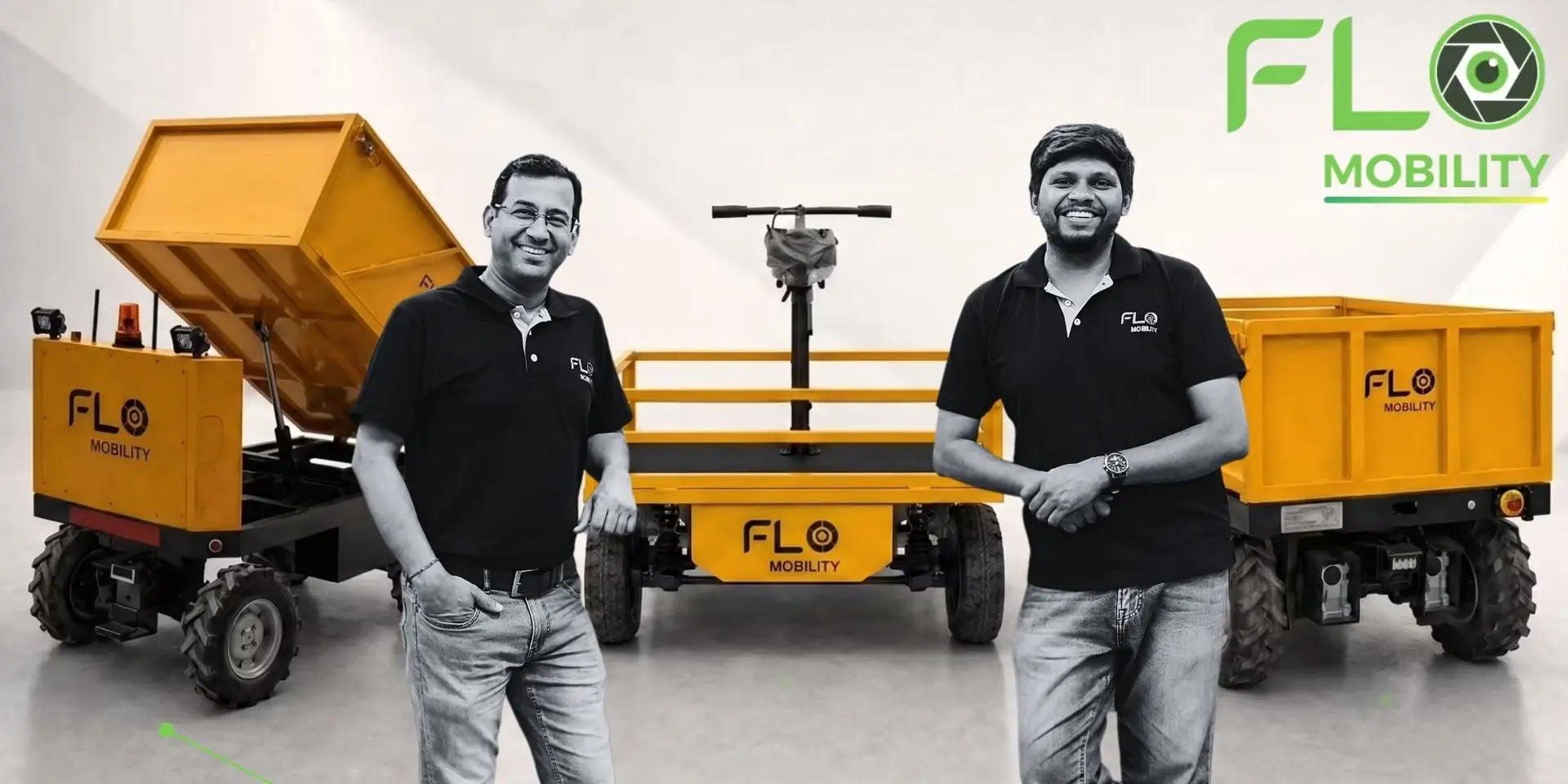
, a Bengaluru-based startup, builds robots for that job. It was founded in 2021 by Manesh Jain, its CEO, and Pratik Patel, its COO.
Jain frames the work as filling a labour gap rather than replacing workers. “Our robots do not replace the skilled labour that builds India's cities; they free that labour to do the work that matters,” he says.
The labour argument is practical as well as diplomatic. Indian builders report difficulty finding and keeping site workers, and the people they do have spent much of the day carrying things instead of building.
A robot for an unfinished building
Its main product is the Flo Hauler, a battery-powered autonomous robot that moves materials around a site. It carries loads of up to 1.5 tonnes.
The difficult part is the environment. A warehouse floor is flat, mapped and predictable. A construction site is none of that. The ground is uneven, the layout changes weekly, the weather is unpredictable, and the work moves between floors as the building goes up.
Flo Mobility builds its own hardware and pairs it with AI models for navigation, perception and fleet management. The robots are offered on subscription rather than sold outright, which lowers the upfront cost for a builder testing the idea.
Fleet management is the part that scales. One robot on one floor is a demonstration. A site running several at once, routed around each other and people, is a working system.

Sixty robots, ten states
The company says it has deployed more than 60 robots across 25 sites in 10 Indian states. Its customers include Larsen & Toubro, Godrej Properties, Embassy Group, Sobha, Capacite Infra and KEC International.
Those are among India's largest builders, and they are cautious buyers. A robot that fails on site costs a developer more than it saves. Repeat deployments across many projects are a better signal than any single pilot.
Customers using the system have reported about 45% cost savings, 50% faster material movement and a
67% drop in workplace accidents. These figures come from the company.
In May 2026, Flo Mobility raised $2.5 million in a pre-Series A round co-led by Mela Ventures and Arali Ventures. ARTPARK, VentureGarage, JITO Incubation & Innovation Foundation and DevX Ventures also took part. The company had earlier raised about Rs 6.5 crore, taking its total to roughly $3.3 million.
Viju George, a partner at Mela Ventures, said the construction sector needs products that pay for themselves in months rather than years.
The money is going into manufacturing, the autonomy software, more deployments in India, and an expansion into international markets, starting with the Middle East. The company currently employs about 25 people.
The Middle East is a logical first stop. Construction there runs at scale, labour is imported and expensive, and developers are already used to buying technology for their sites.
(This story has been researched and compiled using publicly available information.)