



Green Aero is building hydrogen-powered jet engines for drones, aircraft and ships
The IIT Delhi-incubated company is developing turbine engines for defence and civil aviation, in a category where India has long depended on imported hardware.

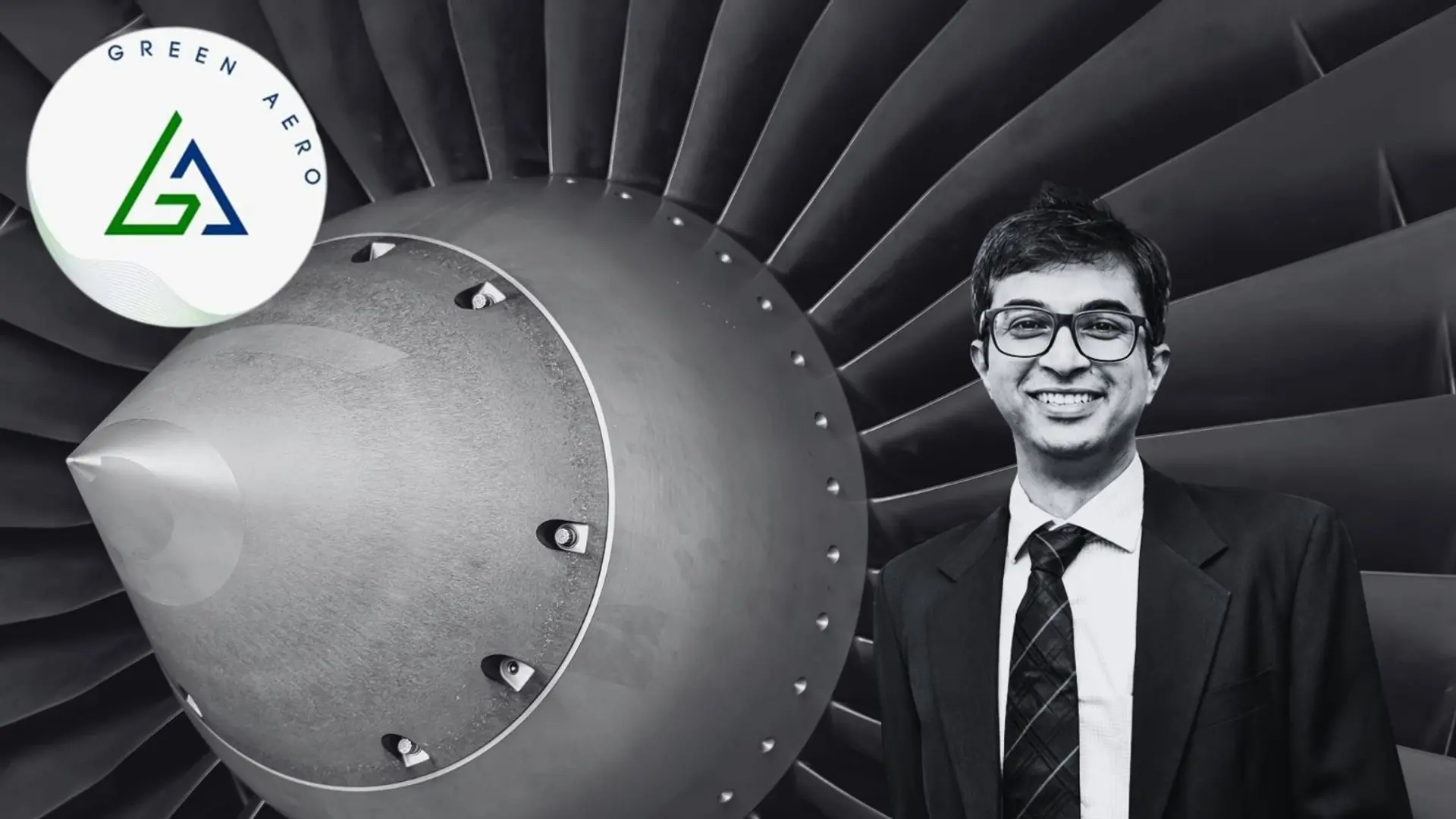

India builds aircraft, drones and naval vessels, and buys most of the turbine engines that power the high-performance ones. Engine development is slow, capital-heavy and closely held, which is why the supplier list worldwide is short. It is one of the more persistent gaps in the country's aerospace industry.
was founded in late 2023 to resolve this. Founded by Dr Prithwish Kundu, a former research scientist at Argonne National Laboratory, part of the US Department of Energy, who has also worked with NASA and the US Army. The company is incubated at IIT Delhi.
Its work runs on two tracks. One is conventional turbine engines built for higher thermal efficiency than what is available now. The other is propulsion that runs on hydrogen, aimed at civil aviation over a longer horizon. Kundu has said the company is targeting efficiency at roughly twice that of current global engines, and describes the strategy as indigenising propulsion for civilian and defence aviation at the same time.
The Blue Dragon
The company's most visible result so far is a hydrogen-powered aero engine core, called the Blue Dragon, which it has test-fired. Green Aero describes it as the first such core built in India.
Hydrogen is attractive as an aviation fuel because burning it produces water vapour rather than carbon dioxide. However, it is also difficult to work with. It burns hotter and faster than kerosene, needs to be stored either very cold or under high pressure, and takes up far more volume for the same energy. Combustor design is where most of that difficulty lands.
Alongside the engine work, a company listing at a 2026 startup showcase describes fuel-agnostic jet propulsion, supercritical carbon dioxide turbine systems, and hydrogen-compatible engines below one kilonewton of thrust. The same listing refers to signed long-term contracts worth about $3 million and total funding of $1.8 million.

From a test core to a product
Green Aero raised about Rs 14 crore, $1.6 million, in a seed round announced in July 2025. The round was led by pi Ventures with Antler participating. The money was utilised for an in-house test facility, engineering and operations hiring, as well as engine development.
At the time of the round, the company said it would bring a first small-category engine to market within twelve months, and lay groundwork for larger, high-thrust engines suited to supersonic flight. That twelve-month window has now passed, without a public launch announcement. A June 2026 showcase listing still describes the propulsion platform as in development.
Kundu has said the company signed agreements it was not able to disclose. Beyond that, no customer, order value or delivery has been made public.
Kundu has also been vocal about what changed around him. He has said private players were barely involved in defence technology five years ago, and credits government schemes including the Startup India Seed Fund and iDEX for opening up the field. He has argued for simpler procurement for private companies and more schemes aimed specifically at hardware.
The market Green Aero is aiming at is broad by design: drones, aircraft and naval platforms on the defence side, and hydrogen aviation on the civil side. Its investor, pi Ventures, has said the company is building aero engines from the ground up in India. Building a certified engine for any one of those platforms is a long programme, and the company is early in it.
(This story has been researched and compiled using publicly available information.)