



5 Lessons from Down But Not Out for aspiring founders
Discover 5 powerful lessons from Down But Not Out that reveal how resilience, courage, and persistence help founders overcome setbacks.

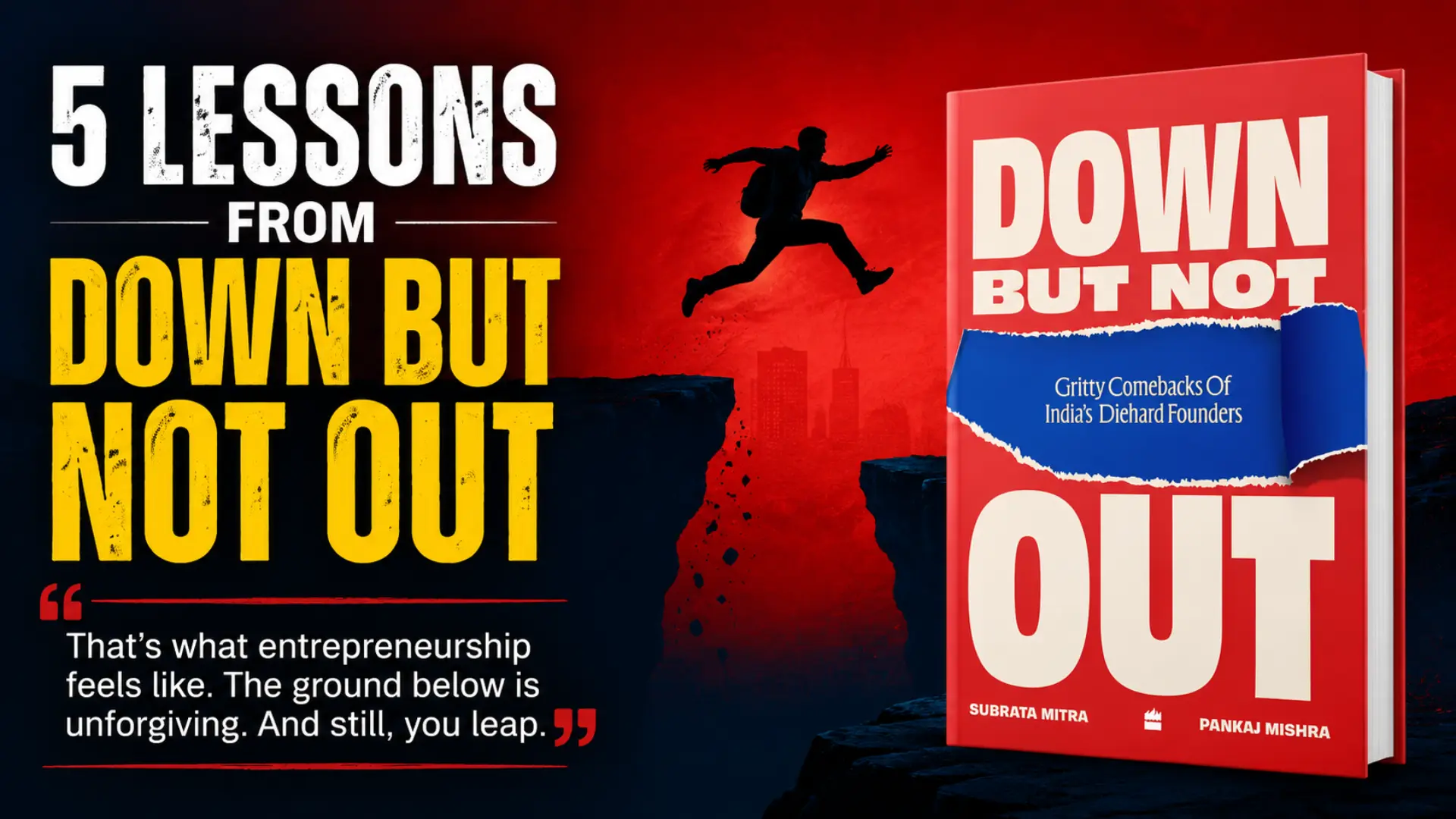

Most business books celebrate the winners. They focus on billion-dollar valuations, headline-making funding rounds, and the moments when founders finally make it. But those stories often skip the hardest part of entrepreneurship: what happens when things go wrong.
Down But Not Out: Gritty Comebacks of India's Diehard Founders by Subrata Mitra and Pankaj Mishra takes a different approach. The book is not about perfect success stories or overnight triumphs. Instead, it explores the reality behind entrepreneurship, the setbacks, failures, doubts, and moments when founders stand on the edge of giving up.
The authors compare entrepreneurship to a trapeze act without a safety net. Founders let go of what is familiar and leap into uncertainty, hoping they will catch the next bar before they fall. Sometimes they do. Sometimes they miss. Yet the most remarkable founders are not those who never fall.
They are the ones who find a way to get back up. Drawing from three decades of India's startup journey, the book highlights the resilience of entrepreneurs who refused to quit despite overwhelming odds. For aspiring founders, its lessons are both practical and deeply human.
5 Powerful lessons from Down But Not Out
1. Success belongs to those who stay in the game
One of the most powerful ideas in the book is that entrepreneurship is often a test of endurance rather than brilliance. Many founders start with great ideas, but only a few survive the inevitable challenges that follow. Markets change, investors back away, competitors emerge, and mistakes happen.
The founders featured in Down But Not Out faced these realities head-on. What helped them succeed was not perfection. It was persistence. The book repeatedly shows that staying in the game long enough gives entrepreneurs more opportunities to learn, adapt, and eventually succeed.
A setback may delay progress, but it does not have to end the journey.
For aspiring founders, this is a valuable reminder: survival itself can be a competitive advantage.
2. Failure is not a verdict on your potential
Modern startup culture often treats failure as something to avoid at all costs. Yet the stories in this book reveal a different truth. Many of the founders experienced failures that could easily have ended their careers. Businesses struggled, plans collapsed, and opportunities disappeared.
At times, they were written off by others. What made the difference was their refusal to view failure as a final judgment. Instead of allowing setbacks to define them, they treated them as experiences that offered lessons. They examined what went wrong, made adjustments, and kept moving forward.
The book suggests that failure is not the opposite of success. In many cases, it is part of the path towards it. Founders who learn from mistakes often emerge wiser, stronger, and better prepared for future challenges.

3. Great companies are built by people, not just ideas
Another important lesson from Down But Not Out is that entrepreneurship is rarely a solo achievement.
Behind every resilient founder are people who help make the journey possible. The book highlights the role of supportive families, committed co-founders, loyal employees, and trusted partners who stood by entrepreneurs during difficult times.
While startup stories often focus on visionary leaders, this book reminds readers that businesses are ultimately built by teams. The first employee who takes a chance on a new company, the co-founder who shares the risks, and the family member who offers emotional support all play a role in helping a venture survive. For aspiring entrepreneurs, building strong relationships may be just as important as developing a great product.
4. Courage means moving forward without guarantees
The trapeze metaphor used in the book captures a reality that every entrepreneur eventually faces.
There are no guarantees in business. No founder can predict exactly how customers will respond, how markets will evolve, or whether a new venture will succeed.
At some point, every entrepreneur must make decisions without complete information. The founders featured in the book understood this uncertainty. They moved forward despite knowing that failure was possible. Their stories demonstrate that courage is not the absence of fear.
It is the willingness to act even when the outcome is uncertain. For anyone considering launching a startup, this lesson is especially important. Waiting for complete certainty often means waiting forever. Progress begins when you are willing to take calculated risks and trust your ability to navigate whatever comes next.
5. Resilience is the founder's greatest asset
If there is one theme that runs through every story in Down But Not Out, it is resilience. The entrepreneurs featured in the book faced financial pressures, personal sacrifices, professional disappointments, and moments of intense uncertainty. Yet they continued to show up day after day.
Their resilience did not come from always feeling confident or optimistic. It came from their commitment to keep going even when circumstances were difficult. This kind of resilience becomes increasingly valuable as businesses grow.
Every company will encounter obstacles, but resilient founders are better equipped to adapt and recover. The book suggests that resilience is not something people are born with. It develops through experience, perseverance, and the decision to continue despite setbacks.
What aspiring founders can learn from these comeback stories
What makes Down But Not Out stand out is its honesty. It does not present entrepreneurship as a glamorous journey filled with constant victories. Instead, it reveals the struggles, sacrifices, and uncertainties that often remain hidden behind success stories.
The founders in the book were not extraordinary because they avoided failure. They were extraordinary because they refused to let failure have the final word for aspiring entrepreneurs, which may be the most important lesson of all. Building a company is not about never falling.
It is about finding the strength to rise again, learn from the experience, and continue moving forward. In a world obsessed with quick wins and instant success, Down But Not Out offers a more enduring message: companies may rise and fall, luck may come and go, but those who keep showing up give themselves the chance to create something remarkable.