



From running a successful social media platform to showing a proprietary robot dog to the PM: The ShareChat founders' second act
The Bengaluru-based General Autonomy builds indigenous robot dogs and humanoids to automate factory work as the founders believe India’s future with automation lies in physical robots and hardware development.

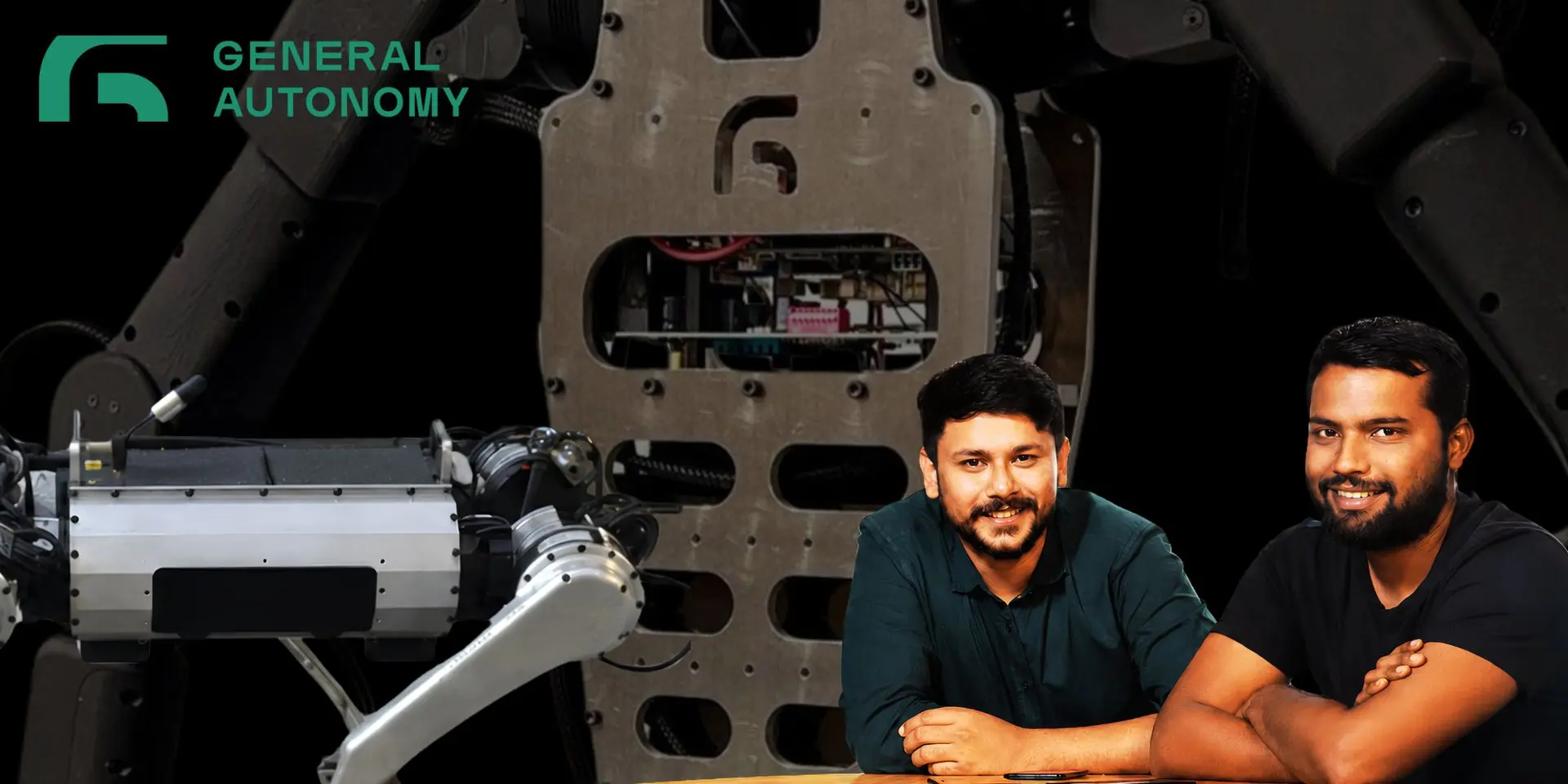

In January 2023, Farid Ahsan and Bhanu Pratap Singh walked away from ShareChat, the social media company they had spent nearly nine years helping build. Soon after, they started something very different: General Autonomy, a Bengaluru-based robotics company building machines for factories.
The pivot from software to hardware was deliberate. Both the engineers are IIT Kanpur alumni, and General Autonomy is their bet that India's next big automation gains will come from physical robots rather than apps.
ShareChat is one of India's largest home-grown social platforms, and the two spent close to a decade scaling it. Leaving that to build robots, a slower and far more capital-intensive business, was an unusual second act.
An Indian robot dog, shown to the PM
General Autonomy's most visible product is PARAM, a robot dog. It is almost entirely India-made: the only imported parts are its NVIDIA processor and some specialised actuators, and the company says it wants to localise even those over time.
PARAM was built on the startup's earlier work on Atom-1, which the company describes as India's first walking humanoid robot platform. The robot dog was developed in about seven months and shown to Prime Minister Narendra Modi at a Startup India event.
Underneath the demonstrations, the company is building a broader robotics stack: robot dogs and humanoid systems meant to take on labour-intensive work in factories and warehouses. In January 2026, it was one of ten deeptech startups picked by Startup India to show its technology at National Startup Day.
The longer-term goal is humanoid robots that can take on the physical factory tasks that fixed machines can't automate. Robot dogs like PARAM are a step toward that: useful for inspection and monitoring now, while the harder humanoid engineering matures.

Pre-revenue by design
Building this is slow and expensive, and Ahsan is candid about it. “It's a costly business to build robots,” he told Inc42. “We are not generating revenue yet. It's a long path to getting there, especially since the supply chain does not exist in India. We have to build a lot more from scratch compared to a typical software company.”
So the company is pre-revenue by choice, funding years of research before any product sale. India's humanoid robotics market is still small, projected to reach about $149 million by 2030, though it’s growing quickly.
Investors have backed the founders regardless. In May 2026, General Autonomy raised about Rs 32 crore in a seed round led by Elevation Capital and India Quotient, its backers from a Rs 25 crore round in 2023, valuing the company now at Rs 280 crore. Blue Asva Varenya Fund, FBC Venture Partners, Spearhead Capital and GIVA cofounder Ishendra Agarwal also joined. The two founders put in their own money as well.
General Autonomy is not alone in the hardware race. It competes with Indian robotics firms such as Addverb, Perceptyne and Invento Robotics, in a domestic market that is small but expected to grow quickly as e-commerce and manufacturing lean harder on automation.
The company now has a team of about 19 people. Its plan is to keep pouring the capital into researching its robot dogs and humanoids, betting that India's factories will need home-built machines, and that the founders who scaled ShareChat can deliver them.
(This story has been researched and compiled using publicly available information.)