



Thrustworks Dynetics wants to supply its engines to India’s rocket industry
The Pune startup builds liquid rocket propulsion systems for launch companies and works with ISRO, IN-SPACe and Godrej Aerospace.

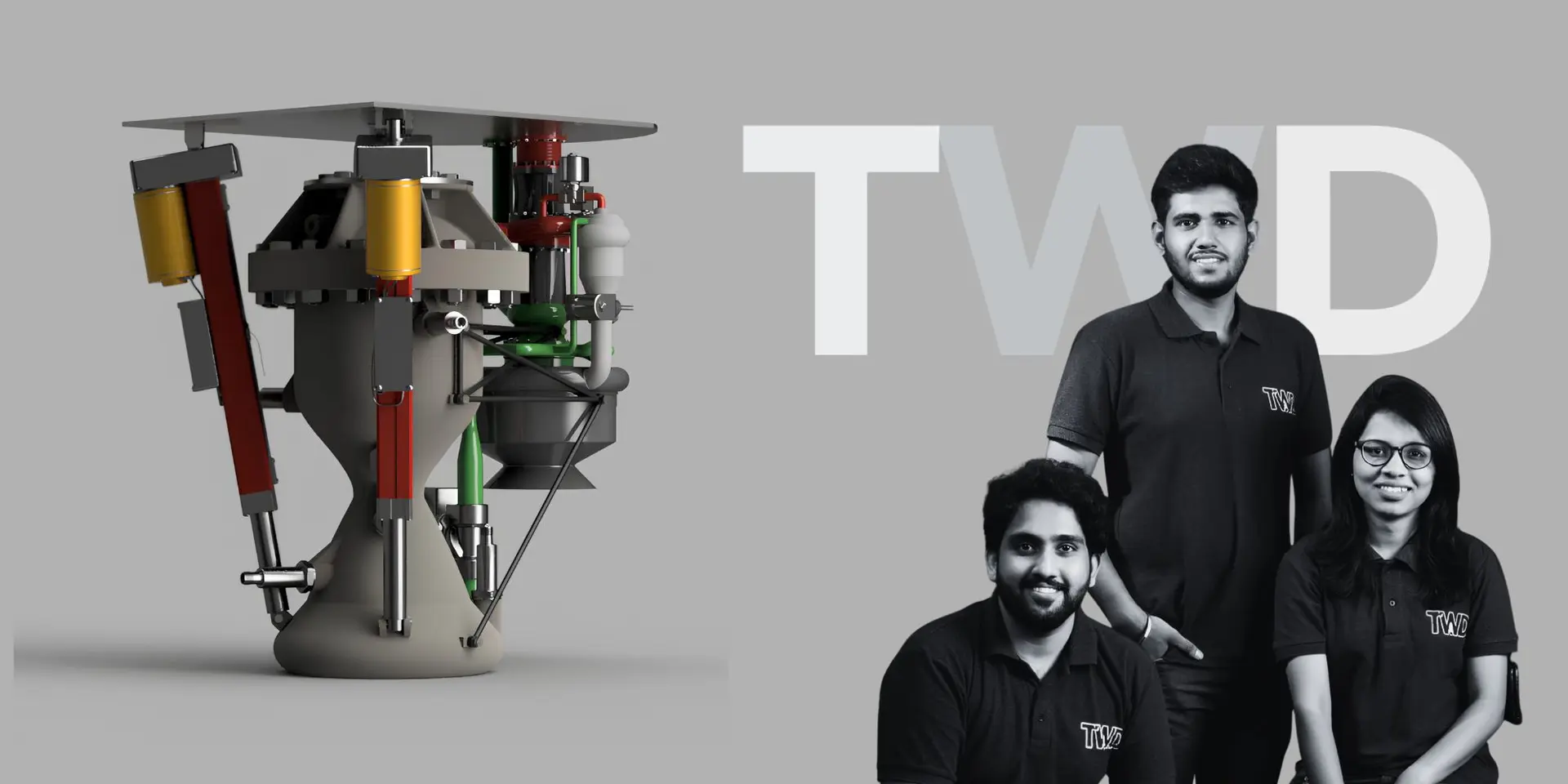

India's private space sector has grown quickly, with a number of companies now building small launch vehicles. Engines are the hardest and slowest part of a rocket to develop. Building one in-house can take a launch company years and consume most of its funding before it ever reaches orbit.
, a Pune startup, is trying to supply that piece instead, so that launch companies can buy propulsion rather than build it.
The company was founded in 2023 by Manan Joshi, along with Kalyani Shinde and Vinith Shenoy. The three had worked together at Bharat Forge Aerospace, where they led a project group working on rocket engine development.
That shared background is relevant in propulsion, a field where buyers tend to favour vendors with a proven track record over newer, unproven ones. Bharat Forge Aerospace is part of one of India's larger engineering groups. The experience the three gained there gives the company credibility with established aerospace buyers.
Engines, and the means to test them
The company's main product is ANYA, a liquid rocket engine platform designed to be modular, so that a customer can take a configuration suited to its vehicle rather than commissioning a custom-built engine.
Alongside the engines, Thrustworks has built its own test infrastructure, including a mobile test bed for engine firings. Test capacity is a real constraint in India, where facilities are limited and access to them is often the thing that delays a programme.
Owning that capacity changes the pace of the work. A company that relies on someone else's facility has to test whenever a slot becomes available. A company with its own facility can test whenever it's ready, over a full development cycle; that difference adds up.
The company is now setting up what it describes as an integrated rocket facility, bringing design, manufacturing and testing onto a single site. The argument for it is time. Moving between separate facilities for each stage is a large part of why engine development runs slowly.
The wider aim is to shorten how long a customer waits for an engine. The company says a modular platform can cut development timelines from years to months, which is its central commercial claim.

Selling to the people building rockets
Thrustworks positions itself as a supplier to the wider aerospace industry rather than as a launch company. Its collaborators include ISRO, IN-SPACe, Bharat Forge, Godrej Aerospace and INOXCVA.
"We position ourselves as enablers to the larger aerospace industry by providing customisable, scalable and modular liquid rocket engines in order to reduce product development time for our customers from years to months," said Manan Joshi, Co-founder of Thrustworks Dynetics. "This funding will accelerate our journey in developing India's most advanced propulsion systems while strengthening our integrated test and manufacturing infrastructure."
In October 2025, the company raised Rs 7 crore in a seed round led by Jamwant Ventures, with Piper Serica and SINE-IIT Bombay, where it is incubated. The money is going into the integrated facility, further propulsion research and more testing capacity.
The team remains lean, and the products are still in development rather than in service. What the company has is a specific position: not competing with India's launch startups, but selling to them.
India's space policy has opened launch and propulsion to private companies over the past few years, and IN-SPACe was created to authorise and support that activity. Thrustworks is among the smaller firms trying to build a business in the supply layer that the opening created.
(This story has been researched and compiled using publicly available information.)