



Atlassian
View Brand PublisherAt Unleash, Atlassian showed what it takes to move enterprise AI from demo to production
From agent-generated workflows and incident investigation to security, cloud migration and product management, experts at the event discussed the various systems, safeguards and engineering discipline needed to advance enterprise AI beyond demo to dependable use-cases


AI demonstrations often end at the moment of success: an agent answers a difficult question, generates code or completes a task in seconds.
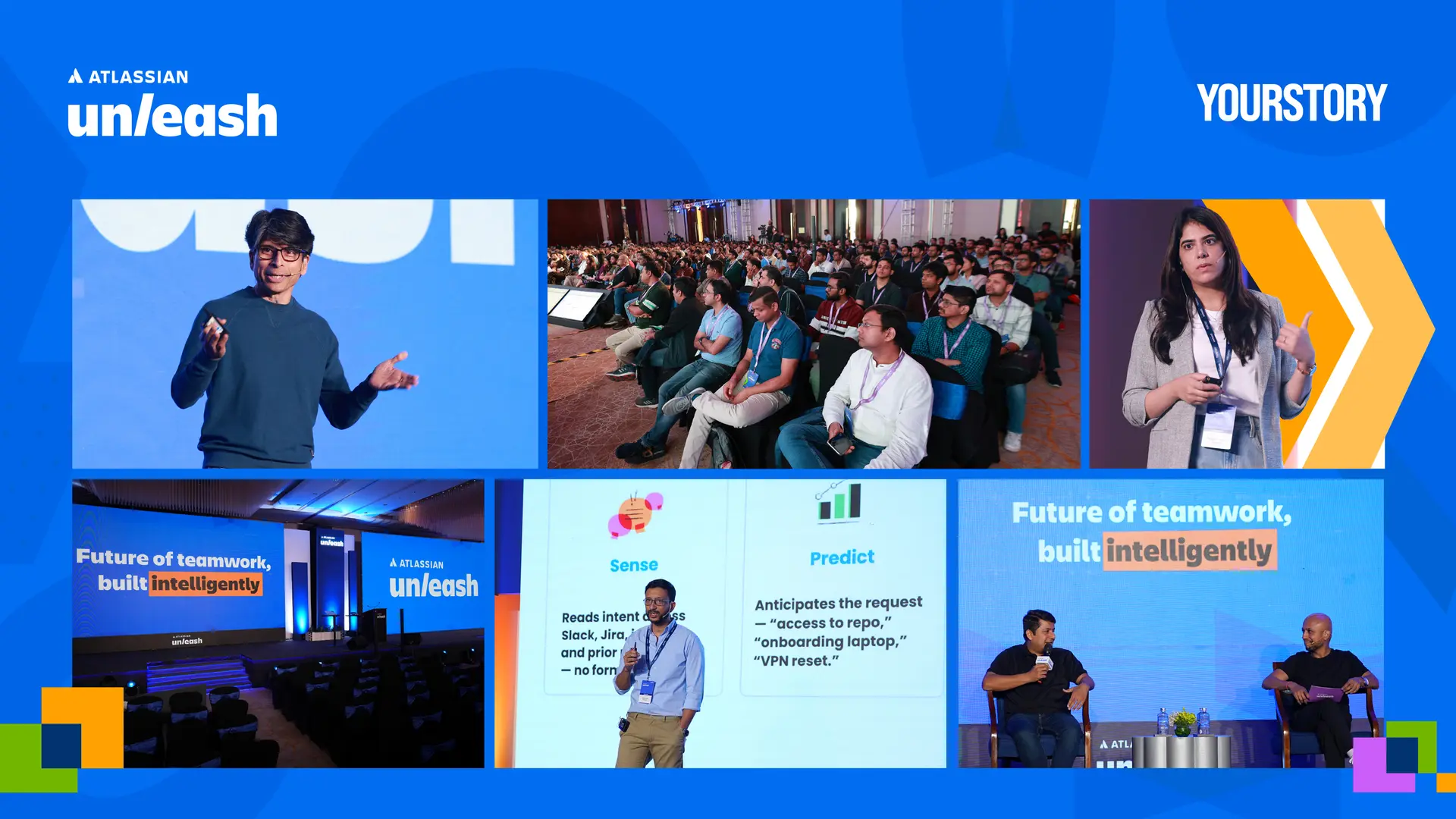
At Unleash, an invite-only tech summit by Atlassian, in association with YourStory, the conversation moved beyond the demo to an even harder question: what does it take to make AI dependable in production?
The output must be accurate. The agent must operate within the right permissions. Its actions must be visible, secure and recoverable. And the system must work not just on stage, but repeatedly across products, users and complex enterprise environments.
That journey from prompt to production ran through the day’s engineering masterclasses, product talks, and hands-on workshops. Atlassian teams unpacked the systems around Rovo and its wider AI stack, from bounded contexts and durable workflows to incident analysis, security intelligence and the infrastructure needed to keep AI reliable at scale.
The model may generate the output, but everything around it decides whether an organisation can trust the result.
Why reliable agents need boundaries, not bigger prompts
Karthik Chandrasekaran, Senior Software Engineer at Atlassian, presented an agentic system built to handle ad-hoc reporting requests.
Such requests once required support engineers to find the right APIs and database structures, write code, run it, and then make changes based on customer feedback. The process could take hours or days and represented an estimated annual cost of around $500,000 of engineering hours.
However, Atlassian's system allows an engineer to describe the report in natural language. An agent then generates executable code, which is validated before being run through a durable workflow engine. The final output is assembled into a report and delivered to the requester.
But the important engineering decision was not simply to use an LLM to write code. It was to limit what the model could access and generate. Instead of giving the agent broad API specifications, the team created closely scoped tools within a controlled environment — applying automated checks that place deterministic guardrails around probabilistic output.
The takeaway was straightforward: production-grade agents often need tighter operating environments, not larger prompts. The same discipline applies when agents are asked to diagnose failures.
Sathish Kumar, Senior Principal Engineer at Atlassian, discussed how AI can support root-cause analysis during software incidents. An investigation may involve code changes, feature flags, metrics, logs, traces, service dependencies and historical knowledge. Without a defined scope, an agent can quickly lose signals in the ensuing noise or draw weak conclusions.
The AI SRE approach presented at Unleash combined code intelligence, observability data, and service topology to form and test hypotheses against available evidence.
The aim was not to take engineers out of incident response but to help them get to the right problem faster.

When scale turns security into a prioritisation problem
As AI speeds up software creation, security teams face the same pressure from another direction: more changes, more services and more decisions competing for limited attention.
Lohit Mehta, Senior Principal Product Security Engineer at Atlassian, and Achyutha Onti Srinivasan, Senior Product Security Engineer at Atlassian, described how the company is moving from manual review queues towards an AI-assisted security assessment platform.
Atlassian has more than 6,000 engineers working across over 1,000 microservices, with approximately 3,000 projects moving through the organisation every quarter. The platform draws signals from business priorities, service posture, customer exposure and engineering activity. AI is then applied to this grounded information to generate summaries and speed up assessment workflows.
The model, however, is not treated as the source of truth. Deterministic service data and human judgement remain central to decisions with security implications.
Securing the third-party ecosystem
As AI accelerates how apps are built and updated, another factor arises: the volume of code entering the marketplace, and in turn, the surface area for risk.
Sundar Chakraborty, Senior Product Security Engineer at Atlassian, showed how the same layered approach applies to the partner and marketplace ecosystem.
He detailed the company's strategy to strengthen security across the Data Center Marketplace through partner verification, application signing and an automated scanning pipeline covering software composition analysis, static testing, secret detection, and malware analysis. The pipeline runs more than 10,000 scans every day and has surfaced over 6,700 vulnerabilities, including more than 5,100 classified as critical or high severity. This demonstrated why marketplace security cannot rest on a single control. Trust has to be built at several levels — from the identity of the partner to the provenance and contents of the application itself.
Building the enterprise rails for machine-speed work
Several sessions focused on the systems that must keep working after the visible AI interaction ends.
As agents begin generating code, tasks and documentation at machine speed, the infrastructure beneath them must absorb greater volumes of automated activity without compromising performance, correctness or recoverability.
Priyansh Jain, Senior Software Engineer at Atlassian, and Ammi Reddy Chirla, Principal Engineer at Atlassian, shared how the company addressed bottlenecks in moving large Jira Data Center customers to the cloud.
Changes to the migration pipeline produced a six-fold increase in throughput. But that speed exposed another constraint: data errors that could force customers to clean their source systems and restart lengthy migrations. The team redesigned the process to classify and repair certain errors while the data was in transit, without altering the source. The approach targets 50% to 60% fewer migration failures and could save an enterprise customer between 22 and 30 days.
Karthikeyan Murthy, Principal Engineer for Jira Scalable Issue Search at Atlassian, delved deep into the architecture serving more than 1.5 billion Jira Query Language requests each day across over 350,000 tenants.
The system breaks queries into an intermediate representation and routes them through specialised services, allowing new clauses and fields to be added without destabilising the core search path. For Atlassian's largest tenants, the architecture has delivered performance that is up to 2× faster, while continuing to support large numbers of users, issues and concurrent requests.
These served as a reminder that enterprise AI is not defined only by visible features. If agents increase the speed and volume of work, the search, data and migration systems beneath them have to evolve too.
Using AI to make more room for product judgement
The product track examined how the craft itself must change when AI shortens the distance between an idea and a working prototype.
Tulasi Menon, Head of Product, AI Strategy at Atlassian, argued that while repetitive product tasks are shrinking, the responsibility to define what "good" looks like is becoming more important. She outlined an AI product lifecycle built around sensing, shaping, validating, shipping, and continuously learning. AI can compress market research and competitive analysis, while modern tools can turn ideas into working prototypes within hours or days.
But speed alone does not make a better product. Product managers must still identify the right problem, set the quality bar, and decide what evidence would justify shipping or abandoning an idea. Menon also warned against using AI to create polished but empty artefacts — whether lengthy product documents or impressive prototypes that do not help teams make decisions.
Shipping, however, is not the end of the lifecycle. Teams need evaluations, real-world traces, quality rubrics and feedback loops that expose failures and improve the product over time.
This was brought to life by Alok Agrawal, Head of Product at Atlassian, and Abhinaya Sinha, Group Product Manager for Jira Service Management at Atlassian. The duo demonstrated how product managers are using Rovo and Rovo Dev to gather customer feedback, synthesise information, prepare updates and create early prototypes.
The more important question was not how many tasks AI could complete. It was what product managers could do with the time it gave back. Participants used Rovo Studio to configure agents for specific product workflows, moving beyond one-off prompts towards repeatable tools grounded in organisational context.
Other sessions extended the same production-first approach across Atlassian's engineering stack, from schema-defined persistence and agentic analysis of long-running business flows to AI-assisted product security reviews.
Together, they revealed Atlassian’s broader approach to enterprise AI. The company is not treating an agent as a model placed on top of an existing workflow. It is building the context, permissions, validation, orchestration, security and recovery systems required to make that agent useful in practice.
The demo may show what an agent can do. Production reveals whether an organisation can depend on it.