



A solar panel that rolls up, from a laboratory at IISc
ABX3 PV has shown flexible perovskite modules at national technology events and describes itself as building the full manufacturing process rather than only the cell.

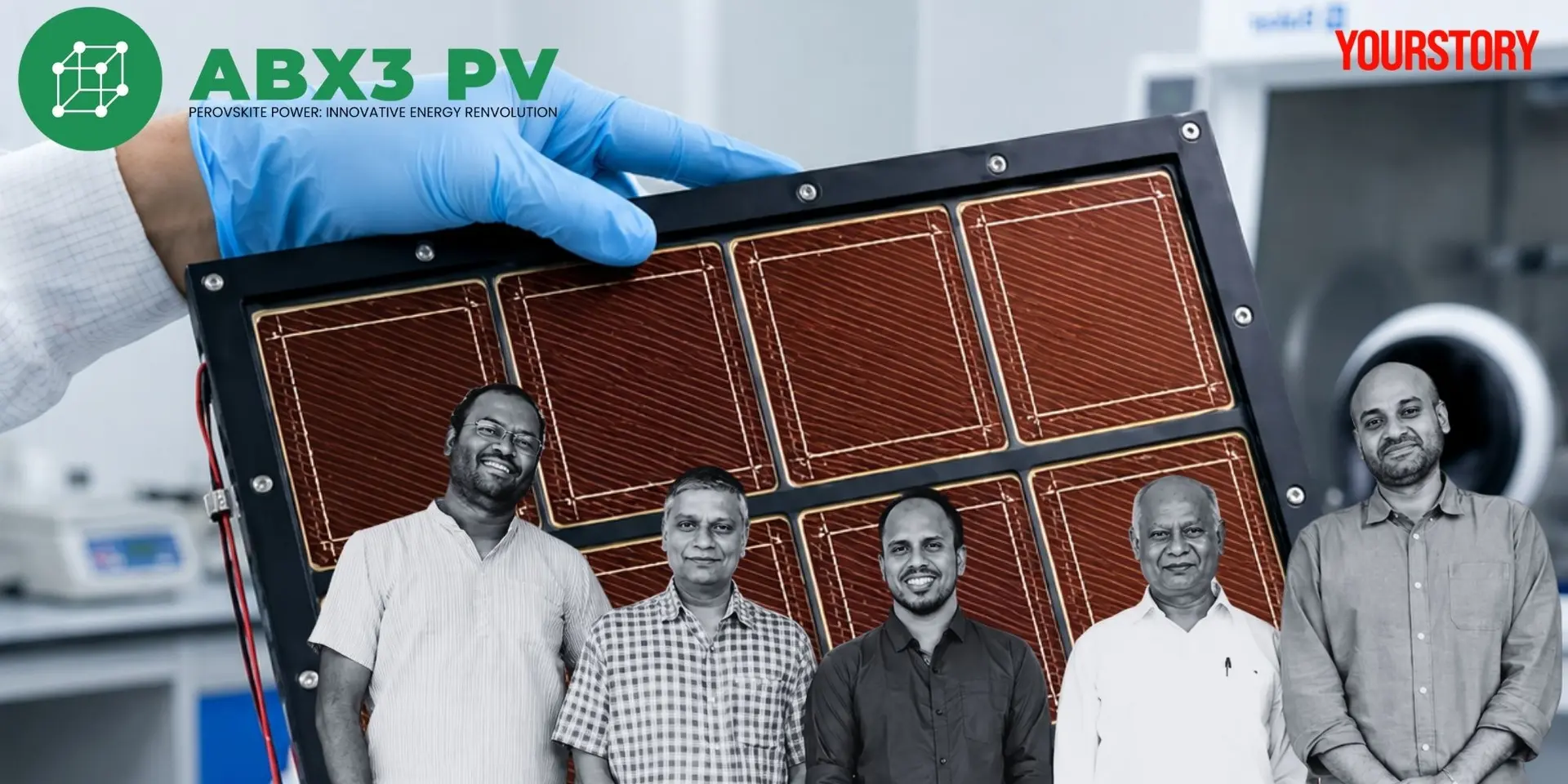

A conventional solar panel is a sheet of glass with silicon inside it. It is rigid, heavy and made at high temperatures in a furnace, which is why panels go on roofs and in fields and almost nowhere else, and why installing them means building a structure to hold them.
Perovskite changes what is possible. The material can be deposited at low temperature from solution, which means it can be laid onto a flexible sheet rather than requiring a rigid wafer, and a panel that bends can go onto a curved roof, a vehicle, a piece of equipment or a surface that would never take glass.
works on that. Founded in Bengaluru in 2023 and incubated at the Foundation for Science Innovation and Development at the Indian Institute of Science, the company develops perovskite solar modules in both rigid sheet and flexible form.
The name is a chemistry reference. Perovskites share a crystal structure written as ABX3, where A, B and X stand for different components that can be substituted to tune how the material behaves, which is the property that makes the family so adaptable.
The process, not just the cell
Its stated position is about manufacturing rather than materials. The company describes itself as an end-to-end technology provider for making perovskite modules, which means the process, the equipment and the methods, as well as the cell design.
That distinction matters more in perovskite than in most fields. Laboratory perovskite cells have broken efficiency records repeatedly, and almost none of that has reached production, because the techniques that produce a small cell in a laboratory do not transfer to a manufacturing line.
The company describes its approach as environmentally oriented, with attention to sustainable manufacturing and recycling, and lists its team's expertise as extending beyond photovoltaics into green hydrogen, ammonia and direct carbon capture.
It points to applications beyond the roof and the field: building surfaces, vehicles, portable devices and space systems, all of which are cases where weight or shape rules out a conventional panel.
The company lists backgrounds from Oxford, Cambridge, UC Berkeley, Bar-Ilan, Technion, Milan, Rome, NTNU Trondheim, Helmholtz Zentrum Berlin, and IISc, which for a company of this size is a deliberately international bench, led by its co-founders Dr. Laxman Gouda, Prof. Aditya Sadhanala, Prof. Sushobhan Avasthi, Prof. Praveen C. Ramamurthy, and Dr. V. S. Gangadhara Rao.

Awards, and very little else
Company databases record revenue somewhere between zero and Rs 10 crore for the year ended March 2025. ABX3 PV, backed by FSID and INCeNSE at IISc Bangalore, has secured over $11 million in Letters of Intent, according to the Bharat Innovates platform. The company is scaling up to a 500 kW commercial manufacturing line for drone and satellite applications, matching its deep-tech investment roadmap.
Its work has been noted in IISc's own newsletter. It has shown its flexible module at national technology events, including a startup showcase at the Bangalore Tech Summit and an event hosted by IIT Hyderabad, both in 2024.
What the company has not published is an efficiency figure, a module specification, a customer, a production timeline or a funding amount; its most recent dated announcements are from 2024.
(This story has been researched and compiled using publicly available information.)