


Hyper Horizon builds small autonomous submarines that map the sea without a pilot
The Bengaluru-based company makes compact underwater vehicles for survey and surveillance, designed to be cheap enough to deploy in numbers rather than one at a time.

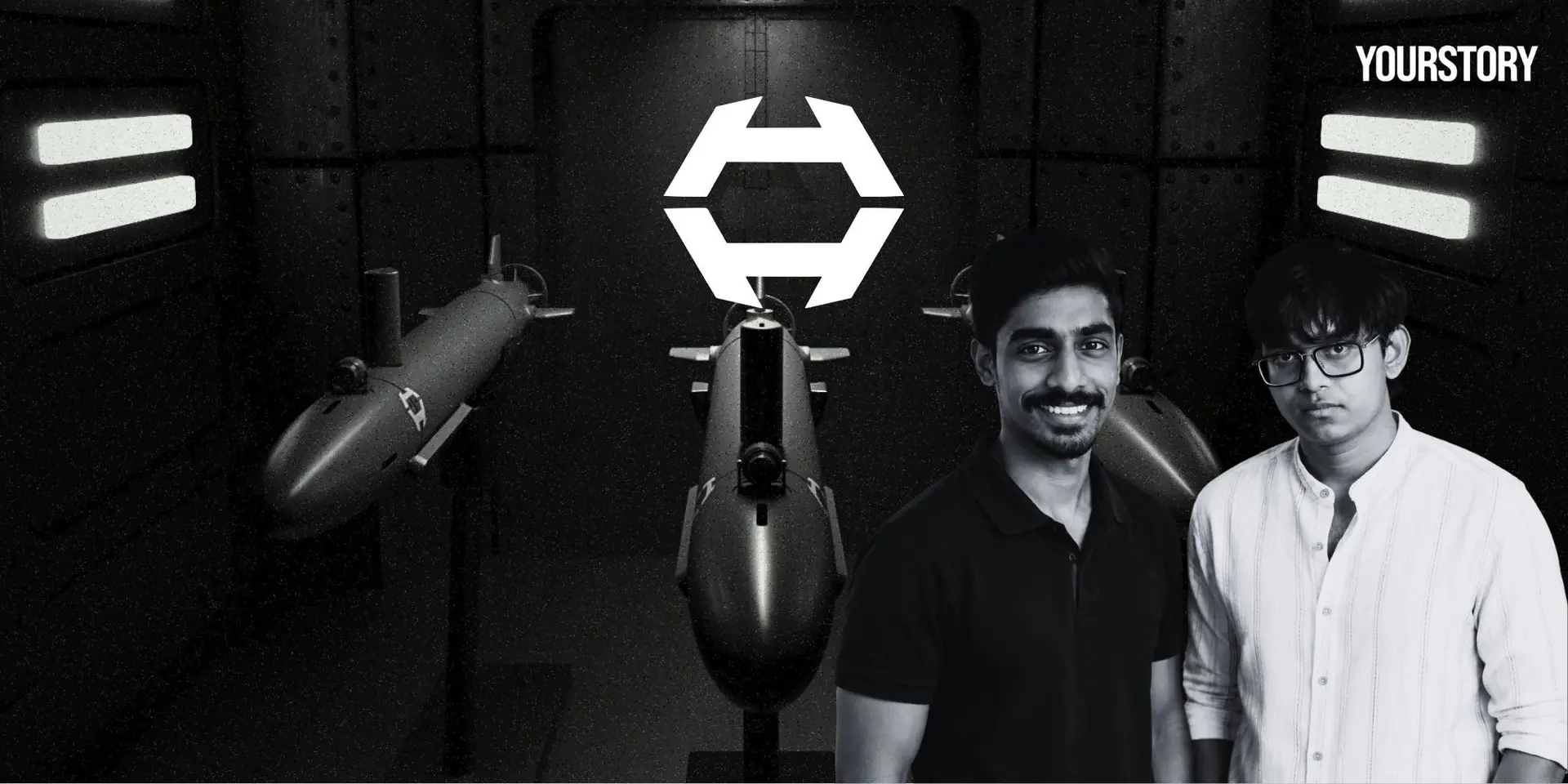

India has made steady progress above the waterline: satellites, drones, aircraft. Below it, less. Autonomous underwater vehicles, machines that can navigate, survey and map without a cable to the surface or a human at the controls, have largely been imported. That price point shapes what gets done. A single expensive vehicle is deployed carefully, for high-value work, by trained crews. A cheap one can be sent somewhere routinely, or somewhere it might not come back from.
was founded in 2023 by two engineers, Vishaal M Kabilan and Sibi M, to build the second kind. The company works from Bengaluru and describes its aim as shifting underwater autonomy from exclusive and expensive to distributed and affordable.
Small enough to carry
The vehicle it has built is an endurance-class autonomous underwater vehicle under 1.8 metres long, less than 15 centimetres in diameter, and weighing under 20 kilograms. Those numbers matter: a machine that two people can lift and launch from a small boat is operationally different from one that needs a crane and a support vessel.
What it carries is a full survey package. A Doppler velocity log measures speed over the seabed, which is how the vehicle knows where it is without satellite signals, since GPS does not penetrate water. Side scan sonar images the bottom.
An ultra-short baseline system lets an operator track the vehicle acoustically from the surface, out to about a kilometre, with radio and wireless links available when it comes up. Underwater, acoustics are the only way to communicate at any distance.
The company describes its strengths as autonomy, control algorithms and modular architecture rather than the hull, which is the usual shape of this business: the vehicle is a platform, and the value lies in what it does autonomously.
Testing has been done in demanding conditions, including a high-altitude lake in Ladakh where cold and thin air stress both the electronics and the navigation. The company has said the work is intended to support India's ability to design and produce its own underwater systems at scale.

Revenue without funding
Company records show revenue of Rs 1.19 crore for the year ended March 2025, and no funding round has been recorded. Databases list its competitors as Saronic and Saildrone, both American, and Sagar Defence Engineering, the Indian unmanned marine company that is also profiled in this series. Between them, those three describe the range of the market: two very large foreign firms, one well-funded Indian one, and Hyper Horizon operating at a fraction of the scale.
What is not public is a customer, an order, a delivery or a funding round. The company has one product line, a documented test record and revenue, which for a company of this size is more than most.
The obvious buyers are the Navy, the Coast Guard, port authorities and offshore energy operators, all of which procure slowly and in volume. Reaching them is the step that usually decides whether a company like this becomes a supplier or stays a workshop.
(This story has been researched and compiled using publicly available information.)