



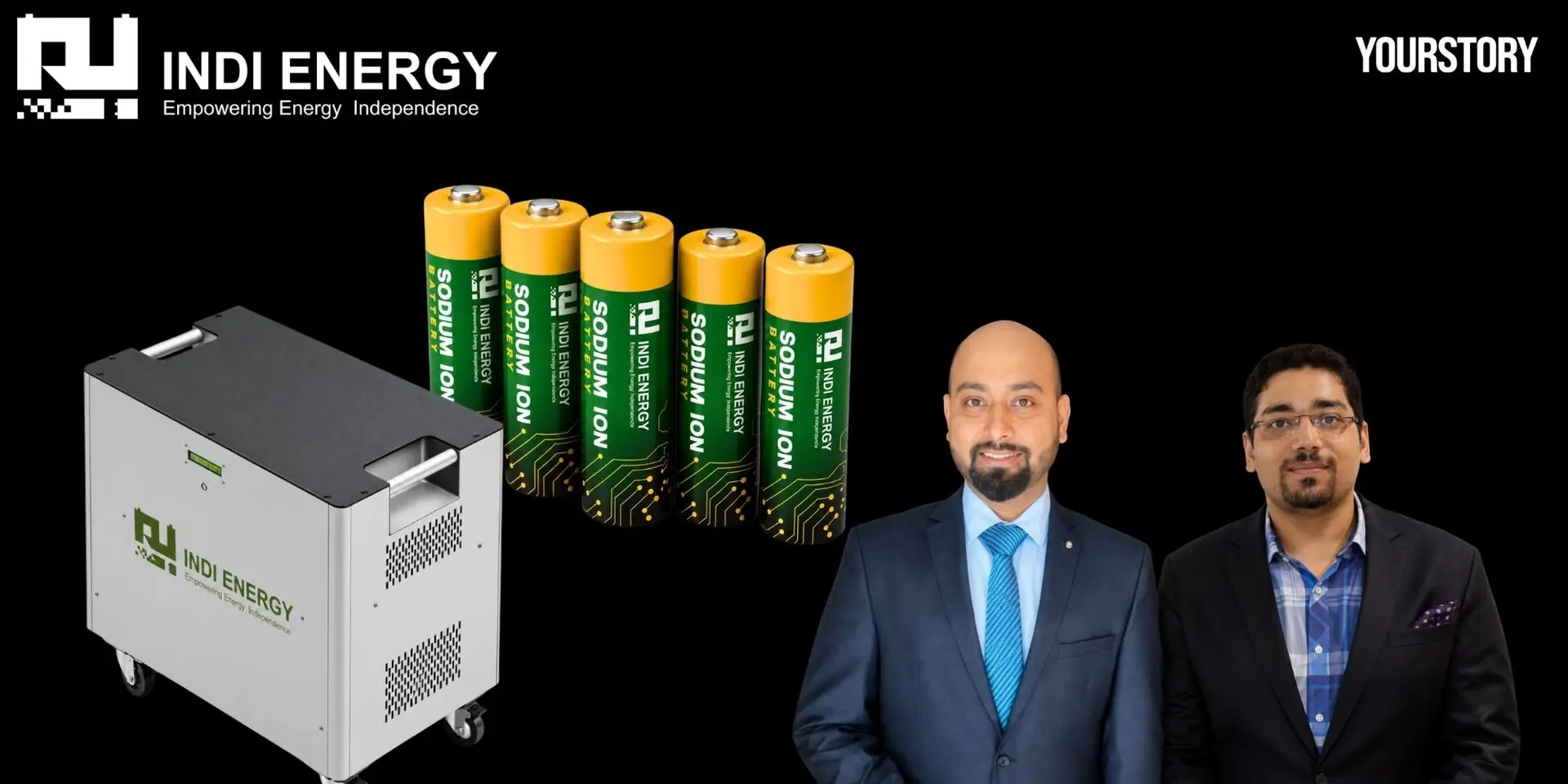
Indi Energy makes sodium-ion batteries with an anode built from farm waste
The IIT Roorkee spin-off produces its own hard carbon, cathode and electrolyte, and is aiming at the lead-acid batteries that still power much of India.


Every October, farmers across north India burn crop residue to clear their fields, and the smoke settles over Delhi for weeks. The stubble is a waste product with no better use, which is why burning persists despite the fines and the campaigns against it.
It is also carbon. Heated the right way, biomass turns into hard carbon, the material that serves as the anode in a sodium-ion battery, the layer that sodium ions move in and out of as the cell charges and discharges.
was founded in Roorkee in 2019 to make that connection commercially. Its founders are Akash Soni, the CEO, along with Yogesh Kumar Sharma, Asit Sahoo and Nagesh Kumar, all from IIT Roorkee, and the company works from the institute's TIDES Business Incubator.
Making the parts, not just the cell
The company's approach is to build the components rather than assemble imported ones. It produces its own hard carbon, branded BioBlack and derived from biomass, along with its own sodium-ion cathode and electrolyte, and combines them into pouch cells.
That vertical position is the point. India's battery manufacturing depends heavily on imported cells and materials, and a company that makes the anode, cathode and electrolyte itself is not exposed to that supply chain in the same way.
The market it names is not electric cars. Sodium-ion cells hold less energy per kilogram than lithium, which matters in a vehicle and matters less in a solar installation or a street light.
The company has aimed instead at lead-acid batteries, which still dominate Indian applications from e-rickshaws to inverters to solar street lights. Lead-acid is cheap, heavy, short-lived and toxic to recycle badly, and it is the incumbent a cheaper sodium cell has the clearest shot at.
On its own figures, the cells reach energy efficiency of 90 to 95% with a cycle life above 2,000 cycles, and handle fast charging without thermal runaway. Soni's account of the origin is that he returned from working on lithium batteries in China in late 2018 to build something in India.
Awards, and a slow road to volume
Recognition came early. Indi Energy won the National Startup Award 2022 in the energy storage category, presented by the commerce minister, and has also won DRDO's Dare to Dream 3.0 challenge. Both are government programmes, and between them they place the company among the Indian battery ventures the state has chosen to back at an early stage.
Funding has been modest. Company databases record about $1.59 million across three rounds from a large number of investors, including Mumbai Angels, BIG Capital and Finkurve Financial Services. Inc42 records the last round in July 2021, though database entries on the round history do not fully agree.
The company has a pilot production plant and has described moving towards mass production. No commercial launch, customer or revenue figure appears in the public record, and nothing substantive has been announced since 2024.
That gap matters in a field moving quickly. Sodium-ion cells were a laboratory proposition when Indi Energy started and are now in production at scale elsewhere, which compresses the window in which being early in India counts for anything.
Indi Energy's position rests on owning the materials rather than the cell alone, which is a durable advantage if the cells reach volume and an academic one if they do not.
(This story has been researched and compiled using publicly available information.)