


Karetic Energy is building iron-air batteries to store power for days rather than hours
The company is developing long-duration storage using iron and air, aimed at the multi-day gaps that solar and wind leave and that lithium cannot economically fill.

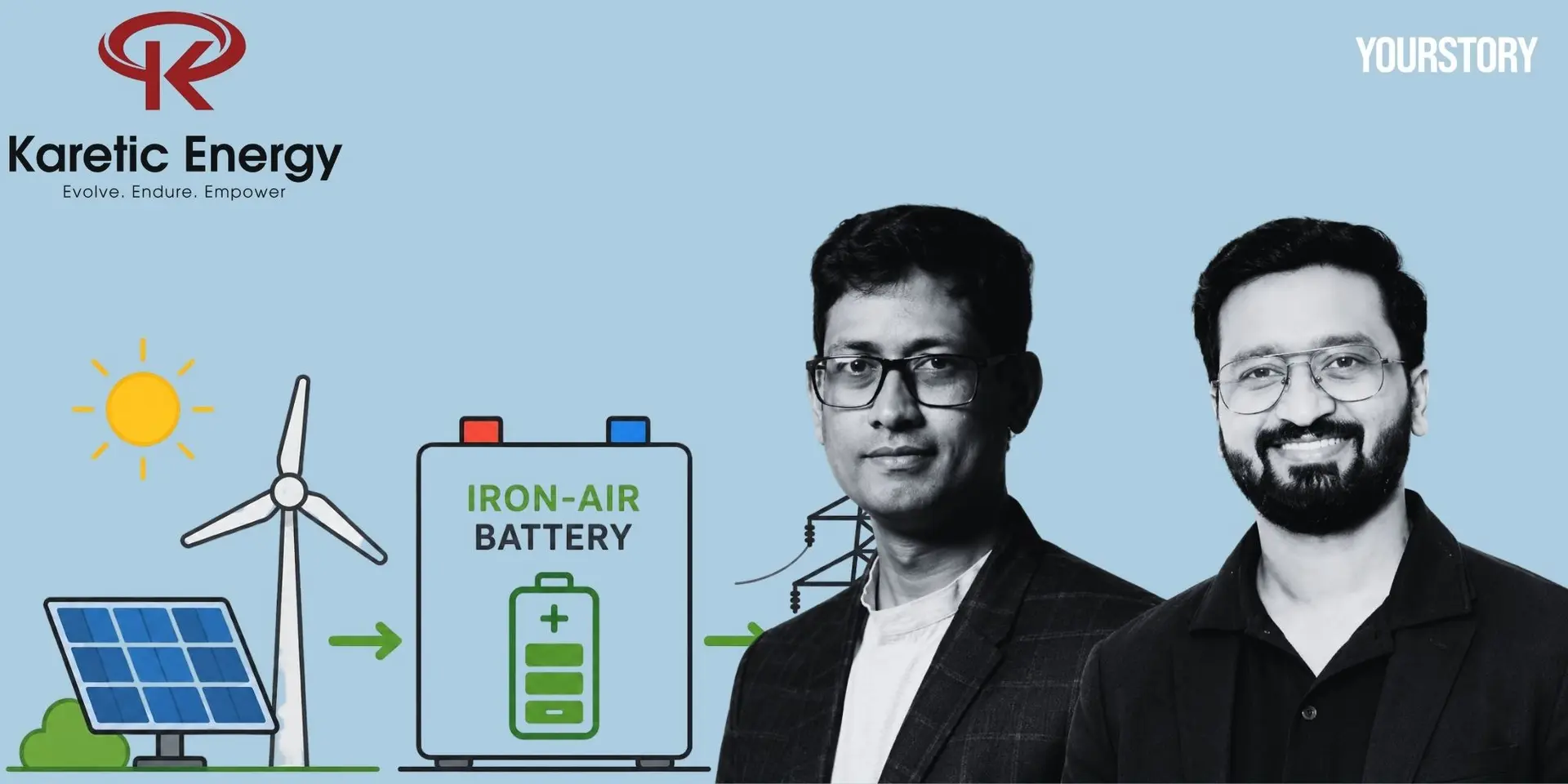

A grid running on solar and wind has a timing problem that gets worse as it gets cleaner. Storage covering a few hours handles the evening peak. It does not handle a still, overcast week, and lithium batteries at that duration stop making economic sense long before they stop working.
Iron-air chemistry is one of the answers being tried worldwide. The cell charges and discharges by rusting iron and then reversing the rust. Iron, air and water are abundant and inexpensive materials.
is working on it in India. Founded by Dr Suryanarayana Vikrant Karra and Prabhakar Kumar, the company describes an iron-air battery platform using rare-earth-free, non-flammable aqueous chemistry, aimed at long-duration storage at grid scale.
Two of those words carry commercial weight. Rare-earth-free means the supply chain does not run through the small number of countries that refine those materials. Non-flammable is a safety property the company claims for its chemistry, and safety is what governs where a large battery can be installed.
Rust, reversed
The engineering difficulty in iron-air is not the idea but the side reactions. When you push current through an iron electrode in water, some of the energy goes into splitting the water and producing hydrogen instead of doing the work you wanted, and the iron surface tends to passivate, forming a layer that stops the reaction.
The company says its answer is an iron-particulate bed architecture that suppresses both: hydrogen evolution and surface passivation. On its account, that has delivered continuous discharge cycles of 100 to 145 hours in laboratory conditions, at what it describes as significantly lower capital cost than lithium-ion.
A hundred hours is four days, which is the specific gap the company describes: multi-day flexibility that short-duration storage cannot economically bridge.
The applications it names are utility-scale storage, industrial microgrids and renewable farms, with the systems described as modular and pilot-ready. Its stated positioning is that the platform is ready for utilities to trial rather than still in the laboratory, though the performance figures it quotes are laboratory ones. Those two things are not the same, and the gap between them is what a pilot exists to close.

A million dollars, and nothing in the field
Karetic Energy reports about $0.7 million in funding and a further $0.3 million in grants. It was selected for Bharat Innovates 2026, the government programme that took Indian deep-technology companies to Nice, France, in June, where it presented itself as looking for utility partners and integration opportunities.
What has not been announced is a pilot, a customer, a partner or an independent test result. The company is about eighteen months old, and what exists publicly is a laboratory result and a technical description of how it was achieved. For a storage technology, the distance between that and a utility trial is measured in years.
(This story has been researched and compiled using publicly available information.)