



Leumas rents out robotic factory lines to brands that do not want to build a factory
The Bengaluru-based company runs modular, software-controlled production lines for wellness and pharmaceutical products, sold as on-demand capacity rather than as machinery.

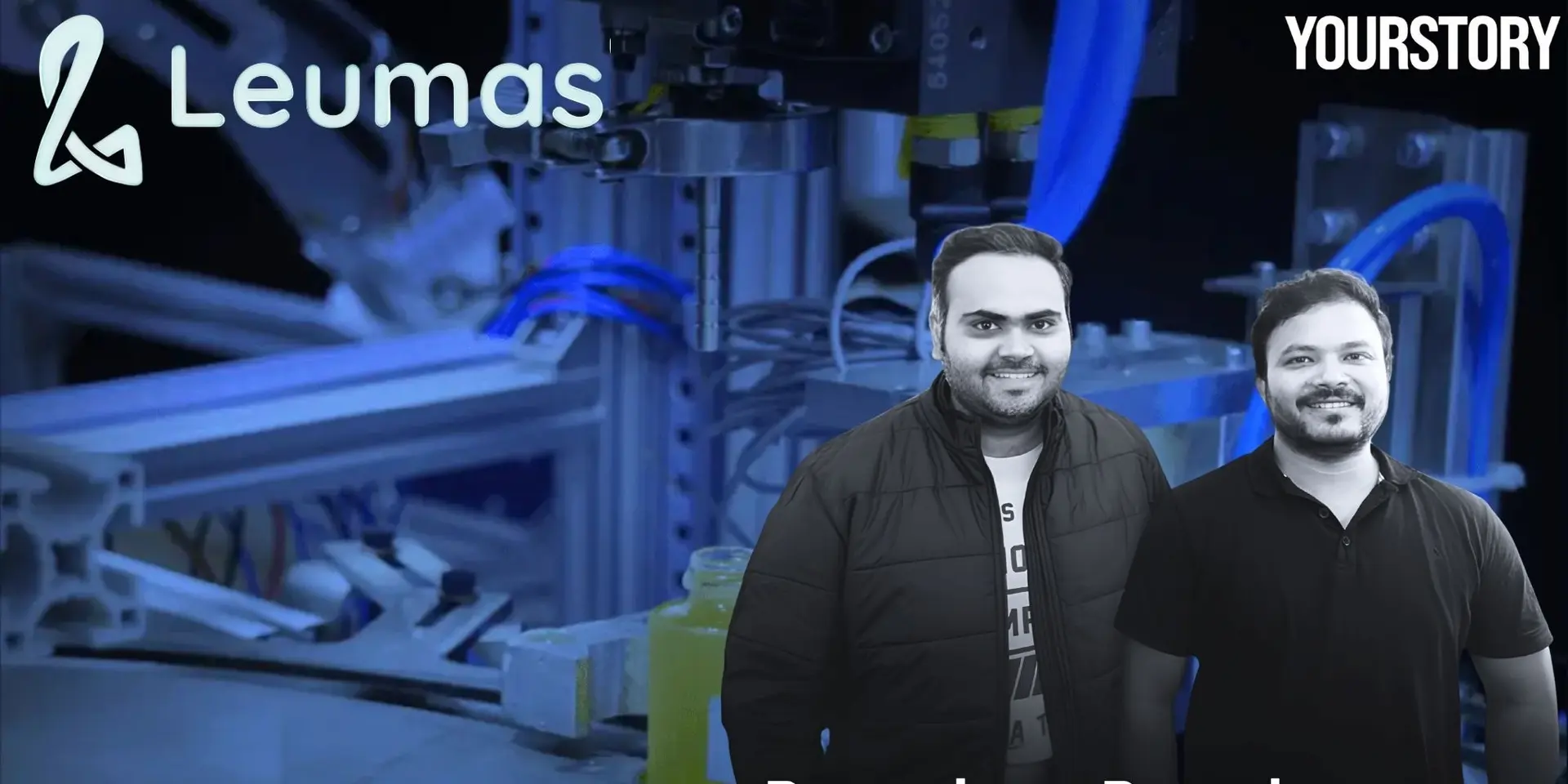

Building a factory costs more than the product will earn for years. Using a contract manufacturer means fitting into somebody else's schedule and minimum batch size, which for a brand testing a new line is usually far more units than it wants.
offers a way to skip that trade-off entirely. The company builds modular robotic production lines and offers them as capacity, so a brand can manufacture small batches on demand without owning a plant. Its founders are Nitesh Kumar, the CEO, and Subhajit Biswas, the CTO, and it operates from Bengaluru.
The company calls its platform 'cyber-physical ': production lines that are reconfigured through software instead of by hand. The lines combine robotics, camera-based quality inspection and autonomous operation.
A factory that behaves like software
The design principle is modularity. A conventional production line is built for a product, and changing it is slow and expensive. Leumas describes lines that reconfigure between batch sizes, product mixes and formats. This allows a brand to run a hundred units of something new without stopping a plant.
This approach has two direct benefits. First, traceability is built in because a software-controlled line records what it did, which matters in pharmaceuticals where regulators require it. Second, the lines can run continuously with little human presence, which the company describes as unmanned operation.
The offer comes in two forms: on-demand manufacturing, where a brand buys capacity as needed, and dedicated production suites set up for a single customer. Both give a brand access to a line without owning one.
It serves the nutrition, cosmetics and pharmaceuticals sectors, which share a regulatory burden and which share a heavy regulatory burden and a tendency to launch many products in small batches. Direct-to-consumer brands in particular launch and retire lines faster than a conventional plant can retool.
The company says it has co-developed the technology with wellness brands over the past year and has helped scale more than 120 products across India, the United States and the Middle East and North Africa. It has also signed agreements with pharmaceutical and food research institutions to build dedicated factory capacity, which would give it access to formulation expertise as well as production volume.

Two rounds, and a market to convince
Leumas raised $2.2 million, about Rs 19 crore, in a seed round announced in June 2025, led by Capital 2B with Capital-A and Anicut Capital participating. It had earlier raised Rs 7 crore in a pre-seed round in 2023 from the same group of investors.
The money is for research and development, expanding the manufacturing infrastructure, and launching pilot factories built for wellness and pharmaceutical brands.
Leumas is targeting the outsourced manufacturing market, which the company and its investors say will exceed $400 billion globally by 2030, a projection with no independent source behind it.
Leumas has not published a customer name, a revenue figure, or the number of lines it operates. Its 120-product figure reflects activity, not scale, and the pilot factories the round was meant to fund are still planned, not running.
(This story has been researched and compiled using publicly available information.)