



India has one demographic cycle left: A blueprint to turn youth unemployment into 10 lakh new entrepreneurs
Building India's Next 10 Lakh Entrepreneurs, a new policy framework, proposes a National Entrepreneurship Mission built by connecting the startup, MSME, research and credit schemes India already runs

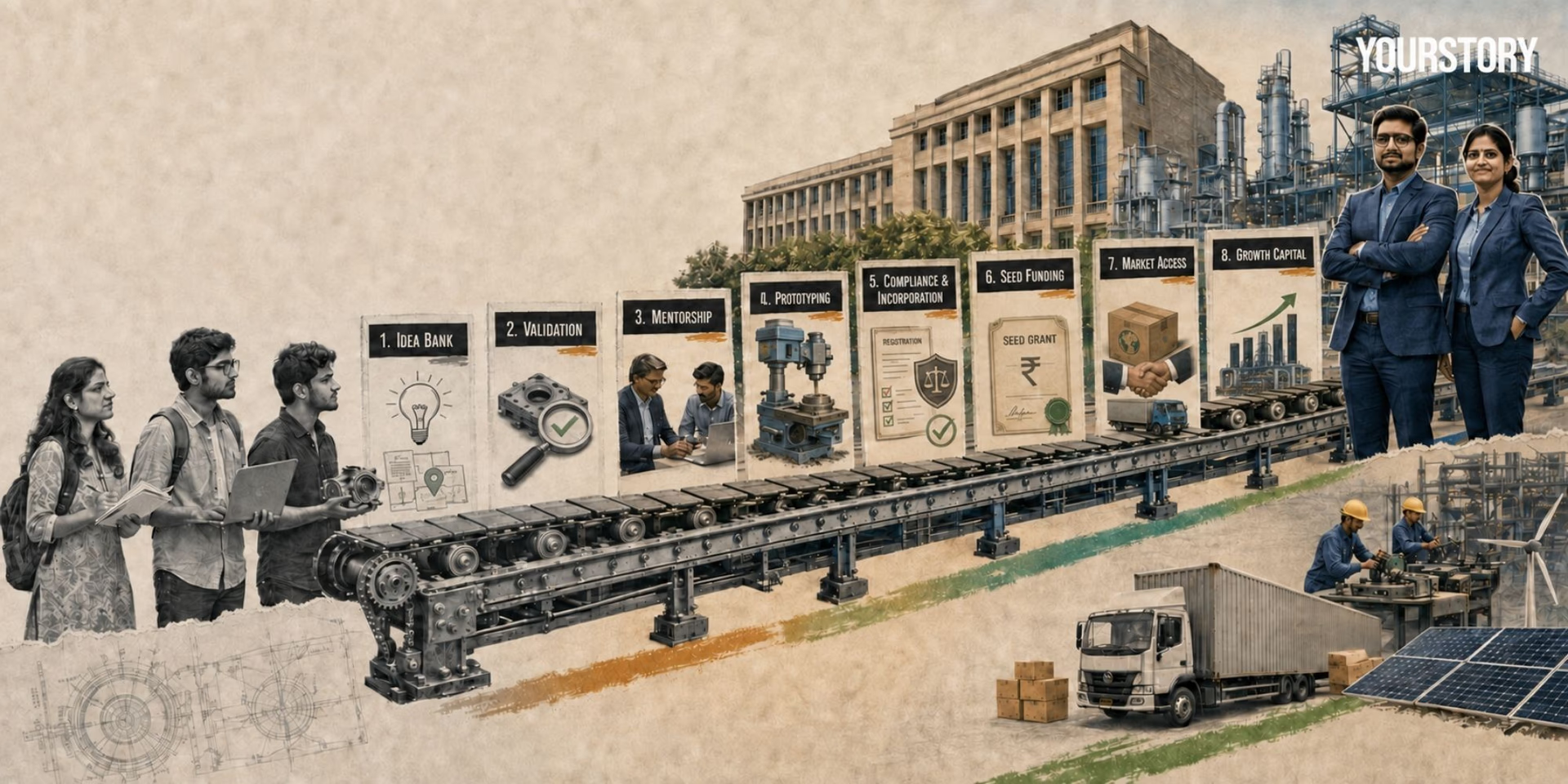

Win a national ideathon in India on Friday and there is nowhere to go on Monday morning.
That sentence, more or less, is the problem a new policy framework sets out to fix. Released on August 17, 2026, it proposes a National Entrepreneurship Mission to create 10 lakh new enterprises and 30 to 36 lakh direct jobs over five years, not by launching another scheme but by connecting the startup, MSME, research, skilling and credit schemes India already runs.
Titled Building India's Next 10 Lakh Entrepreneurs, it has been written by Shradha Sharma, Founder and Chief Executive Officer of The Bharat Project and YourStory Media. Across twelve sections it sets out an operating architecture, a table mapping which ministry and fund does what inside the Mission, a 15-month roadmap from Cabinet approval to national rollout, and a measurement framework. It is among the first implementation-ready frameworks of its kind, and it argues the Mission needs no significant new expenditure, because the money is already committed, only scattered.
The diagnosis is that India has built an intervention for nearly every stage of a founder's journey and almost no bridges between them. A startup that receives a seed grant is not assigned a mentor once the money lands. A venture that reaches revenue has no structured route to its first big customer. Everything exists. Nothing connects. And the founders who make it today do so by stitching the system together themselves.
What the National Entrepreneurship Mission would put in place
The proposal rests on six components.
One, a lifelong Entrepreneurship Passport built on the existing BHASKAR ID rather than beside it, carrying milestones, disbursals, repayment behaviour, revenue, jobs and closures.
Two, an Entrepreneurship Opportunity Map for every district, answering what the district produces, what it imports that could be made locally, and which businesses can realistically be built there with Rs 1 lakh, Rs 5 lakh, Rs 25 lakh or Rs 1 crore.
Three, a national Idea Bank seeded from those maps, for the aspirants who want to build something but do not yet know what.
Four, an assigned mentor as a condition of disbursal for every publicly funded venture, with a multilingual AI co-pilot handling routine guidance and compliance questions routed to empanelled professionals rather than answered.
Five, structured demand: a statutory set-aside on GeM rather than a guideline, a geographic sub-goal for non-metro districts, and an annual published scorecard grading every central ministry and public sector undertaking against a first-customer target.
Six, outcomes verified against GST and EPFO records instead of self-declared returns.
The targets are stated rather than implied. Of the 10 lakh enterprises, 6 lakh surviving and earning revenue at the end of year three. At least 60% from non-metro districts. One lakh graduating into DPIIT recognition. Opportunity Maps live in all 800-plus districts.
Why the arithmetic is urgent rather than merely important
India needs to create close to 12 million jobs a year and is generating eight to nine million. Government posts and corporate payrolls together cannot close a gap that size, the framework argues, which leaves entrepreneurship as the only channel with the scale to do it.
The numbers behind that are not comfortable. The Periodic Labour Force Survey Annual Report 2025 puts unemployment among those aged 15 to 29 at 9.9%, roughly three times the 3.1% recorded for all persons aged 15 and above, with urban youth at 13.6%. State of Working India 2026 projects the 15 to 29 cohort shrinking from about 367 million in 2026 to 245 million by 2036. The demographic dividend is not arriving. It is here, with about one cycle left to run.
Set against that, the ecosystem at the top is world class. Over 2.2 lakh startups held DPIIT recognition as on 31 March 2026, reporting 23.36 lakh direct jobs, with more than 55,200 recognised in FY26 alone. Below the top it narrows hard. A 2023 study of 165 failed Indian startups found financing at 27% of recorded causes and sales and marketing at 25%, the two things Indian policy funds separately and never bundles.
The money is there too. The Rs 1 lakh crore Research, Development and Innovation Fund has begun deploying through the Technology Development Board and BIRAC, and Fund of Funds 2.0 took effect on 13 April 2026 with a Rs 10,000 crore corpus. None of these shares a founder record with any other. A deeptech founder can be eligible for four of them and aware of one.
What is the difference between a registry and a rail
A registry issues an identity, holds a profile and lets people find each other. A rail lets something travel on that identity, so eligibility, milestones and outcomes move rather than sit still.
Aadhaar is the framework's illustration. It mattered not because it listed citizens but because subsidy, eligibility and authentication began to move on it. BHASKAR, launched by DPIIT in September 2024, issues a unique ID to every ecosystem stakeholder and, the paper says, had crossed 7.4 lakh registered users by mid-2026. But Startup India's own guidance confirms DPIIT recognition still runs in parallel with it. An identity was created, and it became one more thing to register for.
The Passport proposal is therefore not a second registry. It is an instruction that seed fund applications, recognition and mentorship read from and write to the identity that already exists, which the paper calls a governance decision more than a technical one.
Appraisal will test the harder claims, including a running cost of about Rs 1.67 lakh per surviving enterprise and a permanent funding source for the district layer, which the framework warns will quietly not happen unless it is named. But the least dramatic proposal may prove the most consequential. Once survival, revenue and jobs are checked against GST and EPFO filings, every scheme that follows can be held to a number it cannot simply declare about itself.
The full policy framework is available to read and download here.