



Vayudh builds nano surveillance drones for the Indian armed forces
The defence arm of IIT Delhi's BotLab Dynamics develops small reconnaissance drones and swarm systems and has raised $10 million to scale manufacturing.

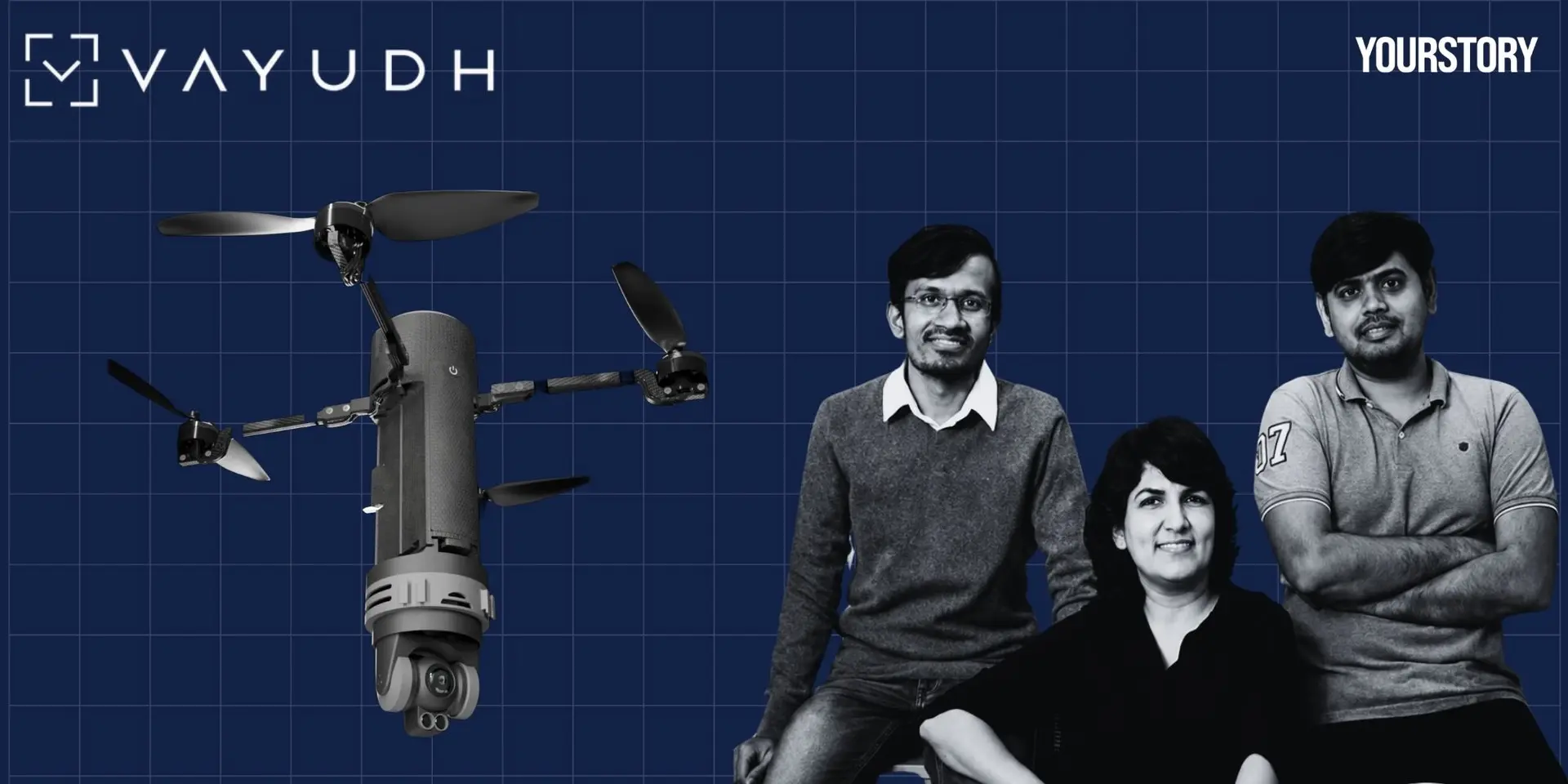

A soldier who needs to know what is around the next ridge has limited options. Sending a patrol is slow and exposes people. A large drone is visible and audible from a distance, which defeats the purpose when the point is to look without being seen. The useful machine in that situation is one small enough to carry in a pack and quiet enough not to announce itself.
builds them. It is the defence arm of BotLab Dynamics, the IIT Delhi company known for putting a thousand drones over Rashtrapati Bhavan at the Beating Retreat ceremony in 2022 and for the record-setting light shows that followed.
Both sides of the business run on the same underlying work. BotLab was incorporated in 2016 by Tanmay Bunkar, Anuj Barnwal and Dr Sarita Ahlawat, and the swarm control software that coordinates hundreds of drones into a formation over a stadium is closely related to what is needed to coordinate them over terrain.
From a failed demonstration to a nano drone
In 2019, the company took a challenge from the Indian Air Force at Pokhran, and by its own account, the fleet that had flown perfectly in Delhi failed in the desert, where heat and dust killed the hobby-grade components it was then using. It could not complete the task, in front of senior defence officials.
The response was to build the parts itself. The company now makes its own flight controllers, GPS units and electronic speed controllers rather than buying them in, which is the difference between a machine that works in a demonstration and one that works in the field. It is also what lets it claim its drones are built in India rather than assembled here from imported components.
Its main defence product is Atri, a nano-class drone for surveillance and reconnaissance, developed with support from an iDEX grant awarded in 2023 to build what the programme described as India's smallest surveillance drone. The company describes Atri as designed for precision reconnaissance in high-risk environments, and says it can be deployed quickly to scan routes that forces need to watch.
Alongside it sits Vayusim, a training simulator the company built for defence users, with terrain modelling and weather simulation, so that operators can practise without flying. Vayudh says its systems have logged more than 300,000 autonomous flying hours, a figure that covers its commercial drone shows and industrial surveys as well as defence work.

Rs 83.5 crore, and a drone shown to two heads of state
Vayudh raised $10 million, about Rs 83.5 crore, in a round announced in April 2025 and led by Dharana Capital. Deepinder Goyal, the founder of Eternal Ltd, the parent company of Zomato, took part, alongside Ajay Aggarwal of Action TESA, Sumit Jalan, LetsVenture and Navam Capital. The company had earlier raised from Florintree Advisors.
Vamsi Duvvuri of Dharana Capital, describing the investment, pointed to rising Indian defence spending and the push for indigenous manufacturing as the opening the company is working in, and called its swarm technology field-tested.
The money is going into research and development, manufacturing capacity and getting systems deployed with the armed forces. The company employs around 200 employees, and its earlier defence work included demonstrating heavy-lift drones in Tawang for the Army Design Bureau and showing its swarm systems to senior defence leadership.
Atri was shown to Prime Minister Narendra Modi and French President Emmanuel Macron at VivaTech in 2026. What the company has not disclosed is an order value, a delivery volume or a named customer, so the commercial position behind the visibility remains closed.
(This story has been researched and compiled using publicly available information.)