



OpenAI Co-Founder Andrej Karpathy Joins Anthropic
AI researcher Andrej Karpathy has joined Anthropic to help build a team focused on using Claude to accelerate pre-training research.

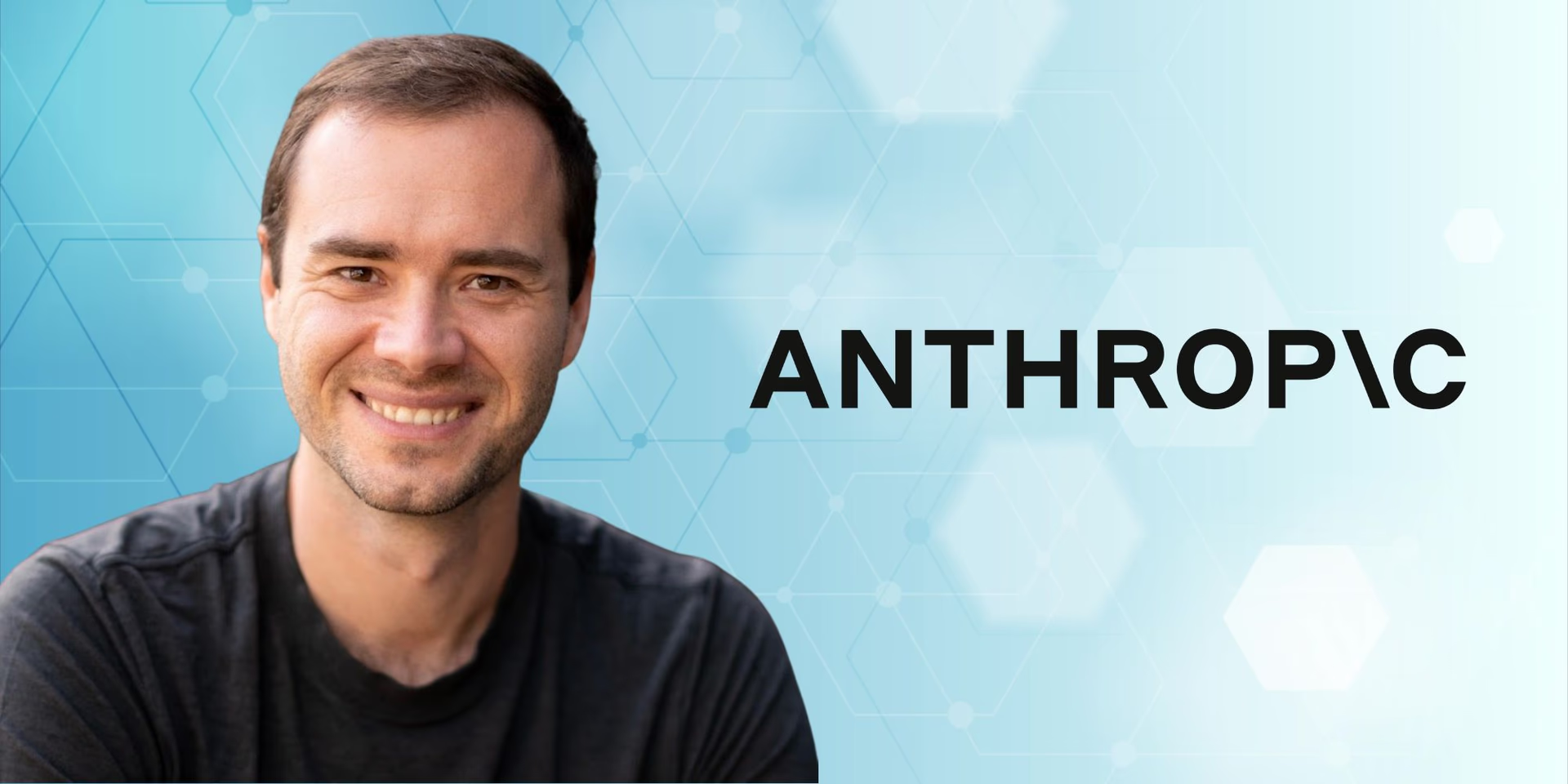

Another major AI researcher has switched labs in the race to build more capable language models. On May 19, 2026, Andrej Karpathy announced that he had joined Anthropic, the company behind Claude.
According to reports, Karpathy has already begun working within Anthropic’s pre-training division led by Nick Joseph. His role will focus on improving how Claude models are trained and using AI itself to accelerate future AI research.
The move is significant because Karpathy is widely seen as one of the most influential engineers in modern AI. His experience spans research, large-scale deployment and AI education, giving him unusual credibility across the industry.
Why does pre-training matter so much?
Pre-training is the foundational stage of building a large language model. During this phase, models ingest enormous amounts of text and code to learn patterns, reasoning abilities and general knowledge. It is where systems like Claude develop their core capabilities before later refinement through fine-tuning and safety alignment.
Unlike fine-tuning, which adjusts a model for specialised tasks, pre-training shapes how the system fundamentally understands language and information. It is also one of the most resource-intensive parts of AI development.
Frontier models require vast computing infrastructure, carefully selected datasets and highly optimised training processes. Even small efficiency improvements can reduce costs and accelerate research timelines significantly. That is where Karpathy’s work could become particularly valuable.
Using Claude to improve Claude
Anthropic says Karpathy will help build systems that use Claude itself to speed up pre-training research.
In practical terms, this could involve automating experiment design, identifying model failures faster, generating synthetic training data and improving the feedback loops researchers use during large-scale training runs.
The idea reflects a growing trend across the AI industry: using AI systems to help build better AI systems.
As model development becomes more expensive and competitive, companies are increasingly searching for ways to improve research productivity rather than relying only on larger computing budgets. Faster iteration cycles and better tooling could become just as important as raw compute power.
Karpathy’s path through the AI industry
Karpathy’s career has closely followed the rise of modern AI. He was one of the early founding members of OpenAI before joining Tesla in 2017. At Tesla, he led computer vision work for Autopilot and Full Self-Driving systems until 2022.
He later returned briefly to OpenAI before launching Eureka Labs, an education-focused initiative exploring how AI assistants could support learning. Outside industry circles, Karpathy is also known for making complex machine learning concepts accessible to wider audiences through educational content like his “Neural Networks: Zero to Hero” series.

What to watch in the months ahead
Karpathy’s hiring suggests Anthropic is investing heavily in improving the quality and efficiency of its research pipeline. The company has recently expanded both its model development and safety efforts, including strengthening its frontier security and red-team operations.
Together, these moves indicate that Anthropic is trying to scale Claude’s capabilities while maintaining tighter control over reliability and safety. The biggest impact of Karpathy’s work may not appear through flashy demos or sudden breakthroughs. Instead, it may emerge gradually through better reasoning, stronger reliability and smoother performance across future Claude releases.
As AI competition intensifies, those quieter improvements could matter most.