



Mid-market advantage: Freshworks CEO Dennis Woodside on staying ahead in the AI race
In an interaction with YourStory, Freshworks CEO Dennis Woodside maps out how the Chennai-born SaaS firm has doubled down on AI, pricing Freddy AI Copilot seats low, and positioning its AI agents as a mid-market alternative.

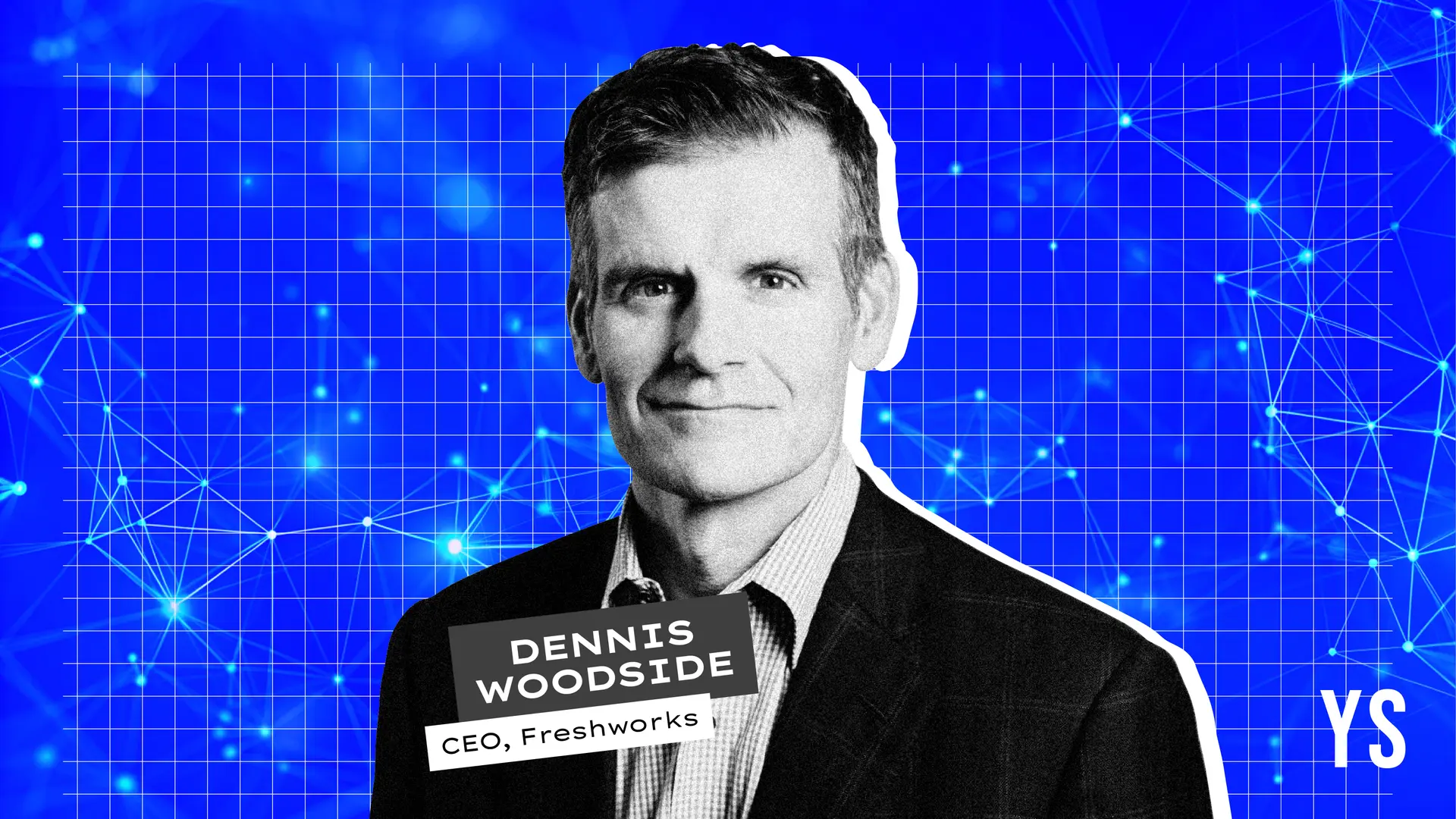

It’s been a little over a year since Dennis Woodside took the steering wheel at , and he’s been swerving the Chennai-founded company into the fast lane of the software-as-a-service (SaaS) industry as artificial intelligence (AI) seeps into every business process. Like any other SaaS firm, AI has become central to Freshworks’ playbook too.
After taking the reins as CEO from Girish Mathrubootham, Woodside has configured the organisation chart to align with its AI-integrated services. Its product and engineering teams now sit inside an all-AI unit as the firm places a bet on specialised, low-friction automation, separating it from a crowded SaaS pack.
Today, nearly half of the firm’s large deals have an AI factor. Woodside foresees burgeoning customer expectations of purpose-built agents focused on specific functions like handling returns, credit checks, or even flight reschedules. To do this, the firm aims to ship a library of pre-built agents within the next six months.
Started as a help-desk vendor platform, Freshworks now focuses on being AI-first. Its AI-led approach helped push Q1 2025 revenue up 19% to $196 million.
In an interaction with YourStory, Woodside explains how his approach to any new technology remains the same, why pricing Freddy AI Copilot seats at $29 a month makes sense, and the reasoning behind positioning Freshworks’ agents as the mid-market alternative to incumbents like ServiceNow and Salesforce.

Freshworks enhances Freddy AI with new agentic capabilities to automate enterprise workflows
Edited excerpts:
YourStory [YS]: It’s been a year since you took the role of CEO at Freshworks. What changes have you implemented in product, strategy, and leadership?
Dennis Woodside [DW]: One of the biggest accomplishments for us as a company is that we're truly now an AI-first company. If you think about our story, our product investment, it's all about AI.
We have 2,700 customers paying us for our Freddy Copilot and around 1,600 paying us for our AI agent product. Last week was a big step for us as we launched the AI Agent Studio, which allows any company to build an agentic AI agent on their own—in a way that is both 24/7 available and delights the end customer.
Everybody inside Freshworks is now thinking about AI. Half of our large deals have an AI component. Every customer conversation I am a part of starts with AI.
Secondly, we're making a lot of good progress in serving mid-market customers. While we started as an SMB business for the most part, we've always had larger customers.
For instance, TaylorMade Golf is a sports equipment company of around 5,000 employees. While people have heard of them around the world, they don't have unlimited resources. They need software that's going to work, is uncomplicated, and works right out of the box. The big enterprise players, such as ServiceNow and Salesforce, care about much bigger companies. Their software is complicated, requires a lot of customisation, and a lot of money to keep it up and running.
That's not what a mid-market customer needs. That's our core customer base we're building for, and it has helped us create a much stronger narrative about what we are trying to achieve.
YS: Freshworks reported $196 million in revenue for Q1 2025. How much of this growth can be attributed to AI and agentic capabilities?
DW: We monetise AI directly. We charge $29 per seat per month for Copilot, and we charge per session for an AI agent.
Every customer wants to bring AI into their workplace. They're looking at the AI roadmap as part of the decision criteria on whether to choose us or ServiceNow, or Atlassian—AI is core to that.
It is driving our revenue growth, both directly and indirectly, and allowing us to grow in an environment that's challenging. We grew 19% year-over-year last quarter, despite all the tariff noise and all the things that are going on in the world economy.
Freshworks crosses $300 million ARR for 2020
YS: Freddy AI now resolves service requests rather than just responding to them. Was there a specific market gap or trend the company was responding to?
DW: What we are doing that's unique is providing agentic AI software that's easy for a mid-sized or a small business to use and doesn't require a huge amount of customisation.
If I run a customer support team with 2,000 employees, I could go to Salesforce or ServiceNow and buy a very heavy system, which would require me to customise the product quite extensively. What we understand from customers is that it can take nine months to a year before you see value.
What we provide for the 73,000 customers we have is the same proven value that we earlier delivered with Freshdesk and Freshservice.
AI Agent Studio allows our customers to either create their own agents or use our pre-built ones. We envision a world where our customers will likely have dozens of agents—some may even have hundreds, each handling specific tasks. This can be returning an order, doing a credit check on a prospective customer, or changing a flight.
We can create, build, and monetise for our customers, who are going to create a world of service very different from what we're seeing today ... where AI agents sit alongside human agents doing a lot of the rote tasks.
YS: New breakthroughs in AI are occurring almost every day. How do you ensure staying on top of it?
DW: We’ve consolidated our AI teams for product and engineering into a single team. The products we’re building for Freshdesk are AI products, or very similar to the products that we’re building for Freshservice, which is now going to get consolidated.
Everybody in the company has to be conversant in AI, understand the application of AI, and how it can actually benefit your business. Our team is fully dedicated to AI in terms of development and staying on top of things.
Internally, we’ve asked every function to have a plan for how they’re employing AI to improve the productivity of their team, and take the rote work off the plate of our employees. That has ultimately resulted in real productivity gains.
Increasingly, we are moving employees from customer support teams and shifting them gradually into other roles like premium support as they’re very knowledgeable about our product. We are taking them from a reactive mode of answering questions to help train our customers and get value out of the products ahead of time.
We can make sure we’re cutting-edge by being cutting-edge consumers of AI ourselves internally. For example, we get 10,000 applications every single week. Our recruiting team has built an AI that helps us identify the best applicants, which has pushed our ability and time to hire.
We are working towards becoming IPO ready in the next 12-18 months: LeadSquared’s Prashant Singh
YS: Has AI changed what you look for in new hires? Are entry-level roles becoming harder to land?
DW: Our hiring profile has shifted as our business has shifted.
Firstly, we’re serving bigger companies. The mid-market requires a slightly different experience than when you’re focused on small businesses, which means that we’re bringing people into the organisation who work at companies that have served bigger end customers.
Our business is increasingly global. Around 45% of our revenue comes from North America, and 40% is from Europe. We are also focusing on hiring a lot of people who are close to our customers. We need to be near the customer; the mix of hiring has changed over time.
YS: Several AI-native firms are achieving massive revenue growth and landing major acquisitions. What does this new wave mean for the traditional SaaS sector?
DW: It’s always easy to say “SaaS is dead” or “the pricing model is dead.” But talk to real customers, and they won’t agree. They like the seat model; it gives them a lot of certainty.
But that model is going to evolve, and there’s going to be more nuance to it. There are going to be other ways of pricing products. However, that software is fundamentally going to be delivered as a service.
The advantage that these startups have is that they can move fast and be very focused. Some startups have come to market with compelling products. The problem is, it’s very hard to build a very large business over a period. And if you don’t have customers, you’ve got to go find customers and convince them to try your product. That takes time and money. You don’t see a ton of companies completely breaking out in the space of support and IT.
Our advantage is that we are heading towards $1 billion in revenue. We have close to 2,000 technical employees, and we have repurposed many of them to focus on AI.
Our customers will interoperate in the environment that they’ve already bought from day one. That’s a huge advantage for us in the long run.
With any new technology, there’ll be a winnowing down of startups. There’ll be one or two winners in every category. Those companies will get meaningfully big. Some will get acquired, others will become independent companies. And we can take advantage of that because if we want it, we can find a team that’s doing something really unique and buy it.
YS: Where does your competitive moat lie? Is it in the technical knowledge or in your agility to respond to newer challenges?
DW: I think it’s a combination of the technical talent and knowledge that we’ve accumulated since the start of the company. The trust that our customers have already placed in us is hard to win.
That gives us the opportunity to go to them when we have new products like AI Agent Studio, introduce the product to them, and get their feedback to improve it.
We see close to a million interactions of some sort every single day between an end customer and our products ... that data is super helpful in creating the right kinds of products and solving the next set of problems.
YS: How do you see agentic AI changing customer and internal service workflows in the next 2-3 years?
DW: I think we’re still very early in agentic AI. Everybody can understand how the world could work, but there are still very few examples of customers fully taking advantage of the technology and fully embedding it into their customer operations and employee operations.
It’s our job to educate our customers and help them understand why this is important. We need to make clear why it can benefit their business and then help them make that step.
Within the next six months, we’re planning to release a whole slew of AI agents that are pre-populated into the AI Agent Studio that customers can just use right out of the box.
A year from now, we’ll probably have tens, if not a hundred, AI agents that are pre-populated with an orchestration layer. What’s going to be harder is driving the usage and adoption of those products. That’s going to take more time.
YS: You bring an athlete's perspective to your personal leadership style. How does that mindset help you to surf the AI wave?
DW: Technology is like any sport—it’s always changing. I’ve been a cyclist for a long time, and I do triathlons. There used to be very limited data that would come from a bicycle.
You could get speed and RPMs (Revolutions Per Minute)—that’s what your bike computer would tell you. But now you can gain data on power, or whether your right leg is stronger than your left leg, or on heart rate ... It’s all integrated in a single device.
If you don’t keep up, then you’re not going to be competitive. That’s true with our industry too. There’s just a lot more to learn. At the end of the day, humans buy from humans. It’s equally important that I spend time with customers and partners running real businesses and try to give them value out of the technology that we build.
Edited by Kanishk Singh