



Google I/O 2026 Recap: Gemini, AI Agents, Android and More
Google just showed what its AI-first future looks like. At I/O 2026, the company unveiled major Gemini upgrades, smarter AI agents, Android innovations, creator tools, and big Search updates.

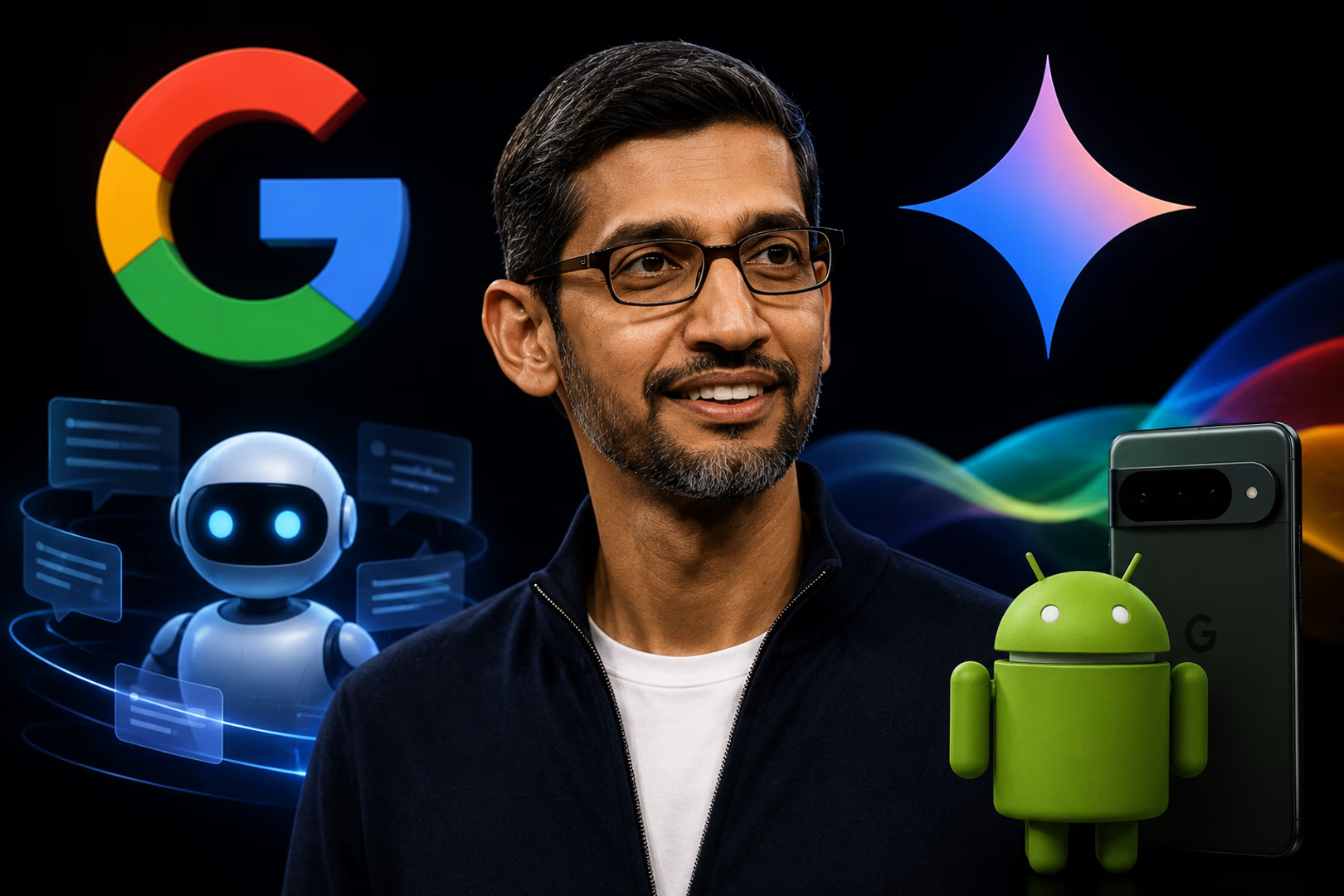

Google is going all in on AI! At Google I/O 2026 on May 19, Sundar Pichai described this shift as the beginning of the “agentic Gemini era”, where AI systems do not just respond to prompts but operate as supervised assistants capable of planning, reasoning and taking action across products and workflows.
The keynote revealed Google’s broadest AI push yet, spanning new Gemini models, always-on agents, Android integration, video generation and much more! Here's everything you need to know!
Gemini becomes Google’s AI layer
Google used the keynote to showcase the scale at which Gemini is now operating across its ecosystem. According to the company, monthly token processing across Google products has jumped from 9.7 trillion in May 2024 to more than 3.2 quadrillion, marking a 7x year-on-year increase.
More than 8.5 million developers now build with Gemini models every month, while APIs process roughly 19 billion tokens per minute. Google also said over 375 Cloud customers each handled more than one trillion tokens during the past year.
Consumer adoption is growing rapidly, too. The Gemini app reportedly expanded from 400 million to over 900 million monthly users within a year, while Google now operates 13 separate products with more than one billion users globally.
AI agents move into everyday workflows
One of the keynote’s biggest announcements was Gemini Spark, Google’s new always-on AI agent. Spark operates continuously through dedicated Cloud virtual machines and is designed to handle multi-step tasks in the background while still requiring user approval for high-stakes actions.
Trusted testers gain access this week, with a broader US beta planned for Google AI Ultra subscribers next week. Google is also bringing these agent capabilities directly into Android through a new interface called Android Halo, which displays live updates and progress from AI agents.
Search is evolving as well, with proactive information agents designed to surface useful results and assist users in completing tasks rather than simply returning links.
Gemini expands across YouTube and Workspace
The keynote highlighted how deeply Gemini is being embedded into Google’s core products. On YouTube, a feature called Ask YouTube allows users to jump directly to relevant moments inside videos using conversational prompts. Wider rollout in the US is expected later this summer.
Inside Workspace, Docs Live introduces voice-driven document creation where users can speak naturally while Gemini structures and edits content in real time. Similar voice-powered AI features are also coming to Gmail and Keep.
Google Search is receiving one of its largest AI overhauls yet, with generative layouts, persistent dashboards and AI-powered “mini apps” designed for longer-running tasks and deeper interactions.
New Gemini models and video AI
Google introduced Gemini 3.5 Flash, a faster model aimed at combining frontier-level intelligence with lower latency and improved efficiency. The company claims it already outperforms Gemini 3.1 Pro across many benchmarks while generating output much faster.
Google also unveiled Gemini Omni, a multimodal video-generation system capable of turning text, images and video prompts into editable AI-generated clips. Omni Flash will roll out through the Gemini app, Google Flow and YouTube Shorts, with developer APIs arriving later.

Safety, chips and infrastructure
Google emphasised transparency and provenance tools throughout the keynote. The company said SynthID has now watermarked more than 100 billion AI-generated images and videos, while Content Credentials verification is expanding across Google products. Companies including OpenAI, Kakao and Eleven Labs are also adopting SynthID standards.
Behind the scenes, Google unveiled its eighth-generation TPUs, TPU 8t and TPU 8i, designed for AI training and inference. TPU 8t reportedly delivers nearly three times the raw compute performance of the previous generation while improving energy efficiency.
Google I/O 2026 made it clear that the company no longer sees AI as a standalone assistant feature. Instead, Google is positioning Gemini as the intelligence layer running across search, Android, Workspace, YouTube and cloud infrastructure.
The focus is shifting from AI that simply talks to AI that plans, reasons and completes work under human supervision. The next phase of AI competition may not be about who has the smartest chatbot. It may be about who builds the most useful AI operating layer for everyday life.