



Majorana 2: Microsoft Just Used AI to Build a Better Quantum Chip
Microsoft says its new Majorana 2 quantum chip is 1,000 times more reliable than its predecessor. Here's how AI helped accelerate the breakthrough.

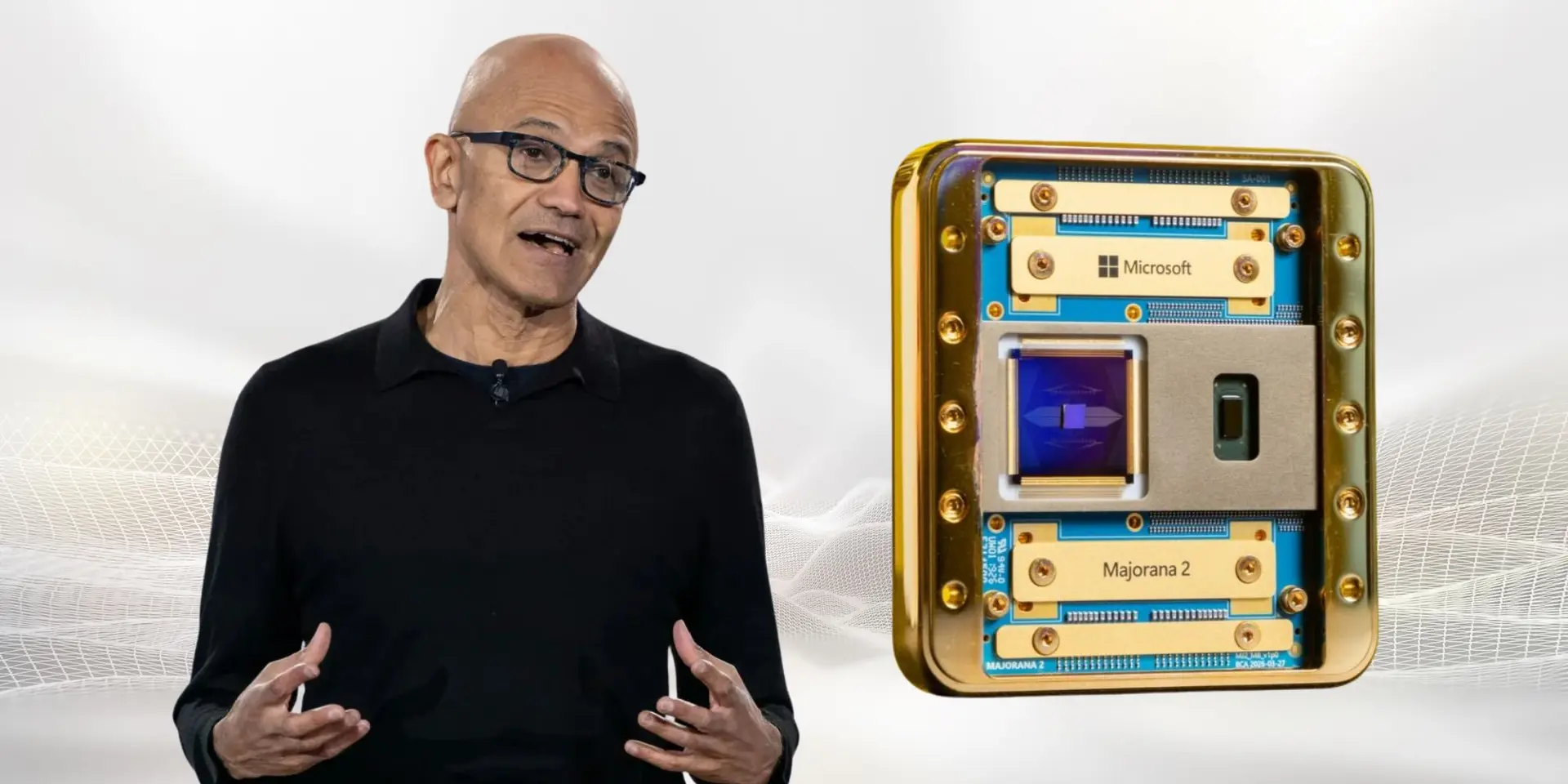

Quantum computing is one of technology's biggest bets, but it has long struggled with a fundamental problem: reliability. Now, Microsoft claims it has made a breakthrough with its new quantum chip, Majorana 2, and artificial intelligence played a significant role in getting there.
The company recently unveiled Majorana 2, the latest version of its topological quantum chip. Developed with support from Microsoft Discovery, an agentic AI platform designed to assist scientific research, the chip is built to address one of quantum computing's toughest challenges: keeping qubits stable long enough to perform useful calculations.
A leap in quantum reliability
Qubits are the building blocks of quantum computers, similar to bits in traditional computers. Unlike regular bits, however, qubits are extremely fragile and can easily lose their quantum state, leading to errors.
Microsoft says Majorana 2's new materials design makes its qubits 1,000 times more reliable than those in the previous generation. The company claims the qubits can maintain their quantum state for an average of 20 seconds, with some lasting up to a minute. This is a notable improvement in a field where qubit lifetimes are often measured in microseconds.
The chip also combines reliability with speed and compactness. According to Microsoft, its qubits operate at microsecond speeds while remaining incredibly small, measuring around 1/100th of a millimetre. These advances support the company's ambition to build a scalable quantum computer by 2029, significantly accelerating its earlier roadmap.
How AI became part of the research process
The breakthrough is not just new hardware. Microsoft says agentic AI helped researchers manage the complexity of quantum development. Using Microsoft Discovery, scientists automated measurements, streamlined workflows, improved fabrication processes and analysed vast amounts of experimental data.
Agentic AI systems can carry out multi-step tasks, identify patterns, and suggest actions while remaining under human supervision.
Rather than replacing researchers, the AI acted as a powerful assistant. It helped teams uncover connections across software, hardware, materials science and manufacturing, while also making sense of nearly two decades of research data stored across different systems.

Microsoft and OpenAI are no longer exclusive as they move towards an open relationship
A new approach to materials
One of the most significant changes in Majorana 2 is the use of lead instead of aluminium in its superconducting material. Microsoft says lead offers better protection against disturbances that can destabilise qubits, including interference from cosmic radiation.
Finding the right material combinations is an extremely complex process. AI-supported simulations and analysis allowed researchers to identify promising candidates faster, reducing the need for lengthy trial-and-error experimentation.
What comes next?
While practical quantum computers are still years away, Majorana 2 represents an important milestone. It also highlights a growing trend: AI is increasingly becoming part of the scientific discovery process itself.
Microsoft believes AI can help researchers generate ideas, test hypotheses, and accelerate innovation across complex fields. If Majorana 2 delivers on its promise, it could offer an early glimpse of how AI and quantum computing may advance together in the years ahead.