



Pune deep-tech startup Quanfluence is building a quantum computer in a unique way
Realising that most of the established methods are very expensive, Pune-based deep-tech startup Quanfluence has developed a scalable approach using photonics that makes it stand out.


In the age of AI, computers with far greater computational powers are the need of the hour. Thus, rapid innovation has led to the advent of quantum computers, which follow the principles of quantum mechanics.
The building block of a quantum computer is a qubit, and the world’s strongest quantum computer—Atom Computing’s Neutral Atom Quantum Computer—is composed of 1,180 qubits.
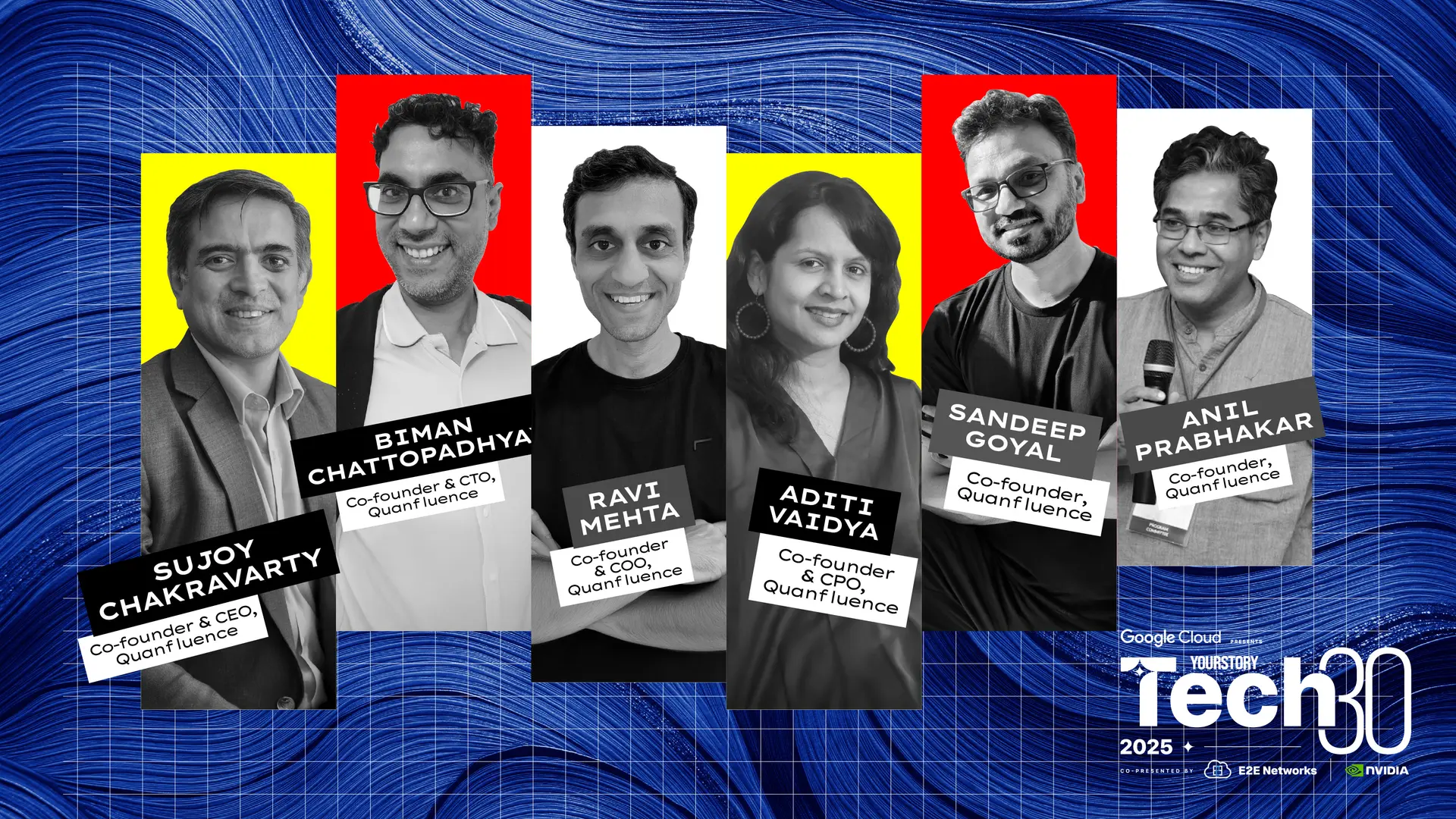
In India, Quanfluence, founded in 2021, is building its own quantum computer. With an office in Bengaluru and Pune, the deep-tech startup was co-founded by a six-member team—CEO Sujoy Chakravarty, CTO Biman Chattopadhyay, COO Ravi Mehta, CPO Aditi Vaidya, Sandeep Goyal, and Anil Prabhakar.
Among the extensive founder team, Goyal and Prabhakar are professors at IISER Mohali and IIT Madras, respectively, and are working with Quanfluence as advisors. Its 18-member workforce mostly operates out of Bengaluru.
“We are still in R&D. Our roadmap is that we will launch our first set of qubits in 2029. However, we have launched our prototype product—Time-Multiplexed Coherent Ising Machine—which took three years to build and can tackle various optimisation problems in areas like machine learning, material science, and artificial intelligence,” Chakravarty tells YourStory.
In 2024, the startup raised $2 million in a seed round led by pi Ventures.

A scalable approach to generate qubits
There are multiple approaches a startup can take to build a quantum computer—from older methods like superconducting (used by IBM and Google) to trapping ions (used by IonQ and Quantinuum).
However, superconducting qubits, for example, need fridges that cost millions of dollars to build—fairly out of the picture for most early-stage startups.
Amidst this, Quanfluence has chosen to generate its qubits using photonics. However, the deep-tech startup’s approach to using photonics differs from its competitors, including the Palo Alto-based PsiQuantum.
“Essentially, we take a laser light, do a bit of quantum processing on it to change it into a quantum state, and then we play around with its electric field. Our qubit is not a single photon but the electric field of a bunch of photons,” explains Chakravarty.
He continues, “The single-photon approach costs more, and the probability of generating a qubit is fairly low. All qubits are generated probabilistically, but with our method, the chances are higher, and it is more scalable.”
Quanfluence’s Time-Multiplexed Coherent Ising Machine is used by eight companies, for which the startup charges a pay-per-use model that costs nearly $2000 per month if used on the cloud.
Its other products, like the Quantum Random Number Generator and Single Photon Detector, are already available in the market.

A friendly perspective on the sector
According to the CEO, only two commercial companies are building quantum computers in India: Quanfluence and the Bengaluru-based QpiAI, which already has a quantum computer with 25 qubits. Both startups use different approaches, with QpiAI using superconducting and Quanfluence using photonics.
In the next few years, the deep-tech startup plans to introduce a few platform use cases (such as AI model optimisation), which would use the quantum and quantum-inspired platforms to provide immediate tangible benefits.
Quanfluence is part of YourStory’s Tech30 cohort—a selection of India’s most promising startups of 2025—unveiled at TechSparks Bengaluru.

Edited by Suman Singh