



NVIDIA’s Jensen Huang says ‘compute equals revenues’ as AI drives strong fiscal
For the full fiscal year 2026, NVIDIA’s total revenue reached $215.9 billion, up 65% from a year ago.

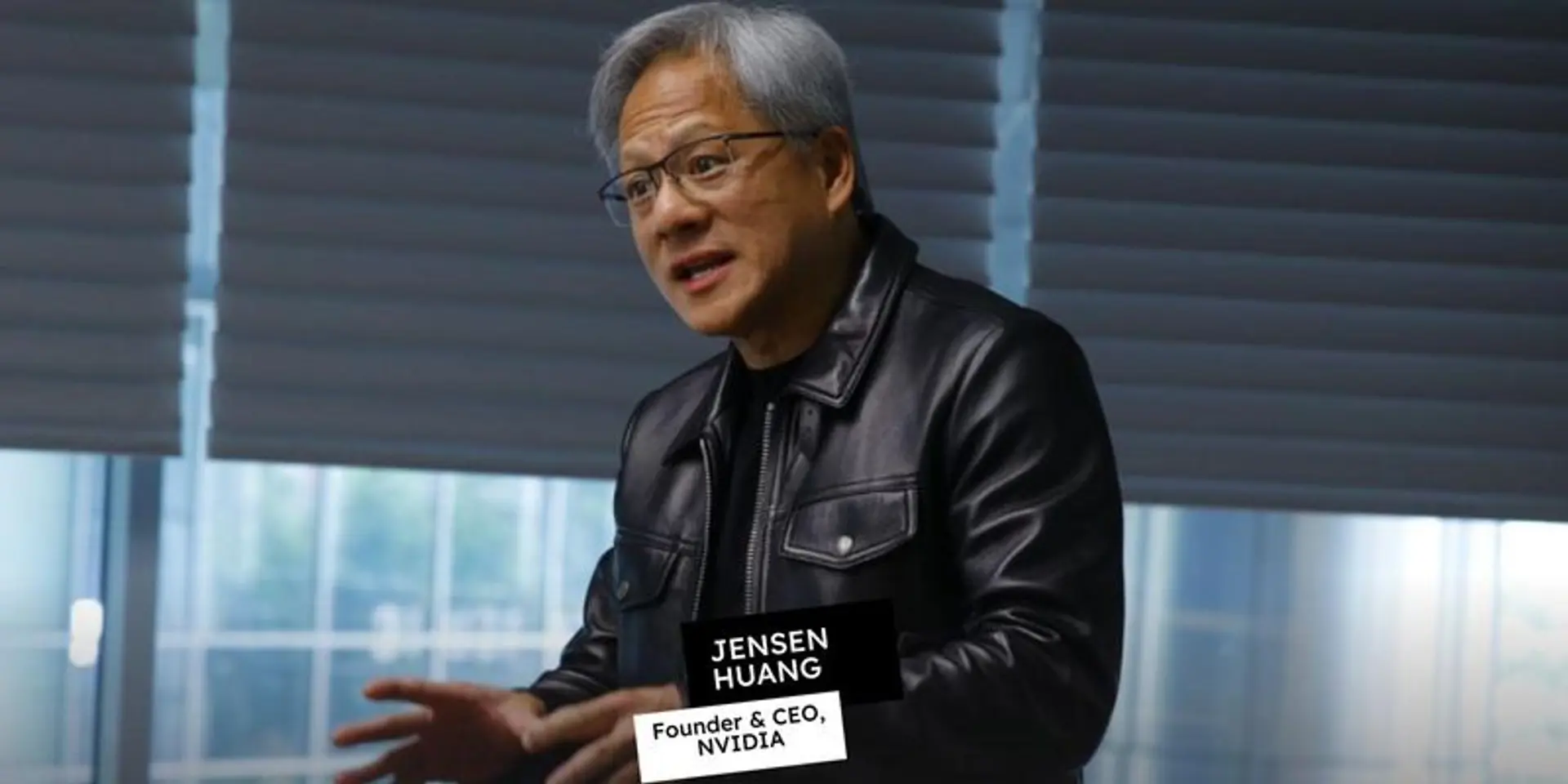

Jensen Huang, Founder and Chief Executive Officer of NVIDIA, highlighted that “in this new world of AI, compute equals revenues,” as the world’s most valuable company posted strong financial results for the fourth quarter and full fiscal year of 2026.
“Without compute, there is no way to generate tokens. Without tokens, there is no way to grow revenues. So in this new world of AI, compute equals revenues,” the NVIDIA chief said during the earnings call.
This perspective suggests that compute capacity is no longer just a business expense but is now the primary engine for generating commercial value.
Financial growth
NVIDIA reported record-breaking financial performance that appears to validate this outlook. For the fourth quarter ended January 2026, the company achieved $68.1 billion revenue, a 73% increase from the previous year.
For the full fiscal year 2026, the company's total revenue reached $215.9 billion, up 65% from a year ago.
These gains were primarily driven by the massive transition to accelerated computing, which uses specialised hardware to handle complex calculations much faster than traditional processors.
The company's net income for Q4 reached $43 billion, a 94% increase year-on-year. This growth was fuelled by the data centre segment, which remains the core of the business.
Data centre revenue for the quarter was a record $62.3 billion, up 75% from the same period last year. Within this segment, compute revenue accounted for $51.3 billion, while networking revenue grew by 263% to $11 billion.
Colette Kress, Executive Vice President and Chief Financial Officer, explained the trajectory of this division during the earnings call, “We have now scaled our data centre business by nearly 13x since the emergence of ChatGPT in fiscal 2023. We look ahead. We expect sequential revenue growth throughout calendar 2026, exceeding what was included in the $500 billion Blackwell and Rubin revenue opportunity we shared last year.”
NVIDIA’s operating expenses for Q4 were $6.8 billion, a 45% increase from the previous year, reflecting higher compensation costs and investments in compute infrastructure.
Looking ahead to the first quarter of fiscal 2027, the company expects revenue to hit $78 billion.
Kress explained NVIDIA’s strategy for maintaining its high profitability levels through the rapid release of new technology.
“The single most important lever of our gross margins is actually delivering generational leads to our customers. That is the single most important thing. If we could deliver generationally, performance per watt that exceeds dramatically what Moore's Law can do, then we can continue to sustain our gross margins,” she noted.
AI inflection
A significant portion of current demand is driven by what Huang calls the agentic AI inflection point. Agentic AI refers to systems capable of autonomous, multi-step reasoning and execution, effectively acting as digital workers rather than simple chatbots.
“Computing demand is growing exponentially, the agentic AI inflection point has arrived. Grace Blackwell with NVLink is king of inference today, delivering an order-of-magnitude lower cost per token, and Vera Rubin will extend that leadership even further,” Huang remarked.
The Rubin platform, unveiled recently, includes six new chips and promises a tenfold reduction in the cost of generating AI tokens compared to the current Blackwell architecture.
While large cloud providers still account for over 50% of data centre revenue, other areas are growing rapidly. Sovereign AI, which refers to nations building their own domestic AI infrastructure to maintain data security and technological independence, more than tripled this year to over $30 billion. Countries like Canada, France, and the United Kingdom are leading this trend.

Furthermore, physical AI, which involves using AI in robotics and self-driving cars, already contributed more than $6 billion in annual revenue.
Huang also shared a futuristic insight regarding AI in space, noting that while the current economics are poor, using GPUs in space for high-resolution imaging is far more efficient than sending petabytes of raw data back to Earth for processing.
The relationship with frontier model makers remains a critical pillar of NVIDIA growth. The company significantly deepened its partnership with Anthropic through a $10 billion investment during the fourth quarter. Anthropic uses NVIDIA systems to train its Claude models, and its Claude Cowork platform has been described by Huang as a revolutionary tool for enterprise adoption.
Similarly, the partnership with OpenAI continues to expand. OpenAI recently launched GPT-5.3 Codex, which was trained and is currently running on NVIDIA Blackwell systems. Huang mentioned that NVIDIA engineers are heavy users of these tools themselves, using both Claude and OpenAI Codex as engineering partners to solve complex coding problems.
Both companies are currently capacity-constrained, meaning they have more demand for AI services than they have hardware to run them. Huang noted that in the case of Anthropic, their revenues grew tenfold in a single year, yet they still face limits because token demand is incredible.
This demand drives the urgency for NVIDIA to maintain a one-year product cycle, moving from Blackwell to the Rubin platform by the second half of 2026. For the world’s most advanced AI labs, hardware procurement is the primary bottleneck to their financial growth.
Despite the record growth, NVIDIA faces some headwinds. Supply constraints are expected to affect the gaming segment in the coming quarters, even though gaming revenue grew 47% year-on-year to $3.7 billion in the fourth quarter.
There is also continued uncertainty regarding China. While small amounts of H200 products were approved for export, NVIDIA has not yet generated significant revenue there and remains wary of the regulatory environment and growing domestic competition in that region.
Huang believes that because modern software is now generative and real-time rather than pre-recorded, the amount of computation needed is a thousand times higher than in the past. This suggests that the current multi-billion dollar investments in AI factories are only the beginning.
“In this new world, inference is revenues, and it is a new industrial revolution. There are new factories, new infrastructure being built, and this new way of doing computing is not going to go back,” Huang noted.
Edited by Megha Reddy