



Amazon India expands menstrual health initiative to reach 2 lakh girls and women by 2025
Amazon India has impacted more than 50,000 young girls and women in over 130 villages and 14 cities through its menstrual health and hygiene initiatives. These include Prayatna sanitary pad manufacturing units run by women, and Gram Mitra and Pragati Mitr programmes for menstrual health.

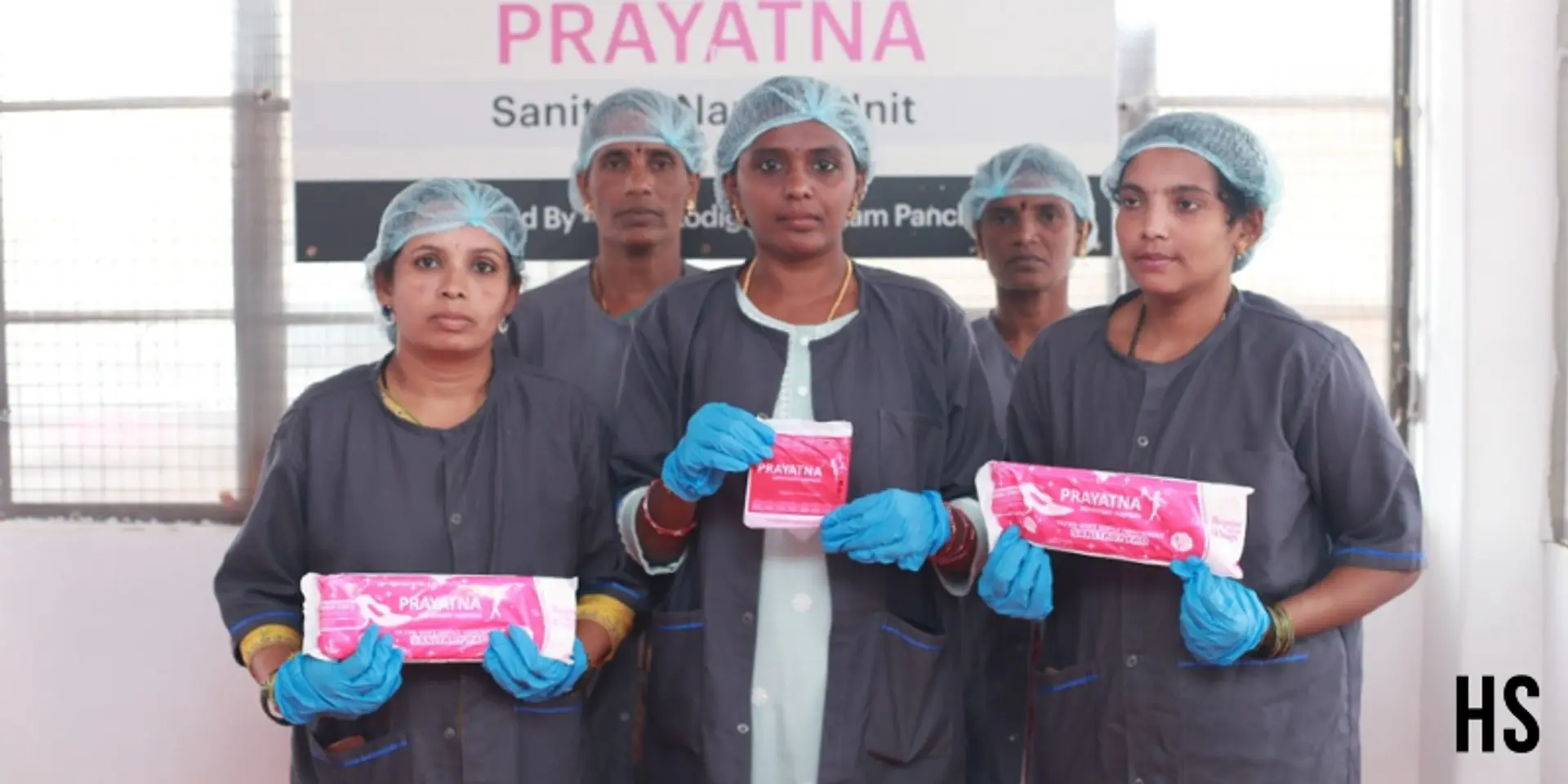

Amazon India has launched the next phase of its women’s health initiative at the Singahalli Community Center in Bengaluru, expanding its efforts to address period poverty.
The initiative enables access to affordable, locally manufactured sanitary products as well as offers education and entrepreneurship opportunities, with an aim to reach two lakh women and girls by 2025.
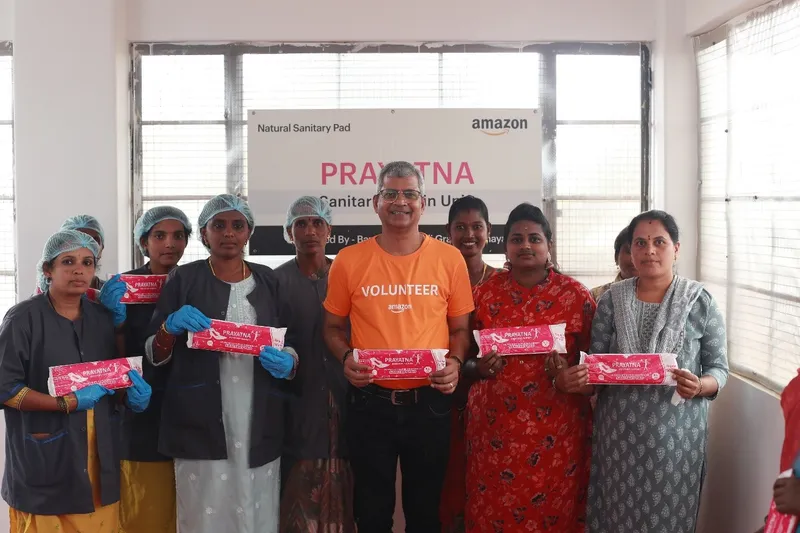
Karuna Shanker Pande, VP, Amazon Logistics India, showcases sanitary pads made by women entrepreneurs at Prayatna, Amazon supported manufacturing unit at the Singahalli Community Center, Bengaluru.
Currently, Amazon operates four sanitary napkin manufacturing units in Bengaluru, Chennai, Hyderabad, and Kolkata. So far, it has impacted over 50,000 women and girls across 130 villages and 14 cities, primarily in underserved communities.
With the programme, Amazon India aims to empower more than 500 women entrepreneurs by 2027, fostering sustainable livelihoods while enhancing menstrual health access.
Dr Karuna Shanker Pande, Vice President, Amazon Logistics, India outlined the critical gaps the initiative aims to address. "What we understand through research is that today, one-third of women and girls are not aware of menstrual hygiene, or even if they are, they don't have access to safe products which they can use," he told HerStory.
“The other big gap is that 75% of girls when they experience their first period are unaware of it or not prepared for it. About 25% of girls routinely miss school when they have their periods,” he added.
Women at the heart of the initiative
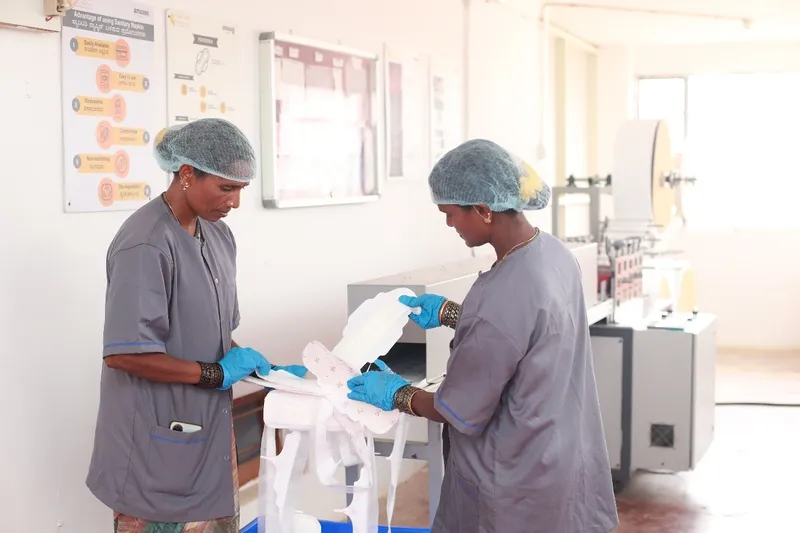
Women entrepreneurs providing a demo at Prayatna
The Prayatna sanitary napkin production units have a combined production capacity of 1,200 biodegradable sanitary napkins per hour, using fully automated, state-of-the-art machinery. All napkins are made from CPCB-approved, 100% biodegradable raw materials, offering a sustainable alternative in areas where plastic waste and lack of access to hygienic products remain major challenges.
Amazon India’s Gram Mitr and Pragati Mitr programmes, launched in 2021, address menstrual health among young adolescent girls and women in communities.
Women entrepreneurs operate the units with support from non-profit partners Vyomini, and She and We, with active engagement from ASHA workers, Anganwadi centres, and local gram panchayats.
These local community ambassadors lead informative sessions in schools, anganwadis (rural childcare centres), and self-help groups. They cover critical topics including hygienic practices during menstruation, the importance of sanitary pads or clean cloth, and focus on diet and nutrition.
They also focus on dispelling myths by challenging misconceptions and taboos surrounding menstruation, fostering open conversations, and connecting women and girls with healthcare resources through ASHA and Anganwadi workers.
The network has 243 trained community champions working door-to-door to challenge menstrual stigma and promote health awareness. They also came up with the name of the initiative—Prayatna.
To date, 60 women have gained direct employment and another 200 are indirectly engaged as sales champions. These women are expected to earn a gross profit of approximately Rs 17,000 per month while also taking care of their household responsibilities and maintaining flexible working hours.
"They work for 2-3 hours in the day and they can dedicate the rest of their time to their families. This flexible work arrangement works well with them,” Pande said.
Participants complete a comprehensive training programme focused on entrepreneurship development. The curriculum includes four key modules: awareness generation and behaviour change, product marketing and sales, machine operations, and financial management.
"It starts from building confidence–operating the machines, managing finances, learning to make a sales pitch and how to make an impact in the community,” Pande added.
From action to transformation
He also gave a compelling example of personal transformation within the community.
Akshatha S, from Korluru, Bengaluru, married young and struggled to pursue her ambitions due to household responsibilities. After participating in the women’s champion training programme, she gained the confidence to explore further.
She now actively creates awareness about menstrual hygiene and sells Prayatna pads. Her outreach methods include organising meetings with women in the community, one-on-one interactions with girls, and also approaching beauty salons and medical stores to market the pads.
The locally produced pads are priced affordably at Rs 4.50 per pad, sold in packs of six.
Partnership for a circular economy
Pande also highlighted the recent collaboration with PadCare Labs to support the integration of menstrual hygiene waste management projects in four Bengaluru locations: BK Halli, Marenahalli, Bagaluru, and Marasuru.
The initiative is expected to process 9,600 kg of material annually, saving 4,800 litres of landfill space, and will reach 17,254 households through partnerships with waste collection NGO partners and training-led nonprofit organisations like She and We.
“The project features 23 ‘Laal Dabba’ containers attached to urban local bodies’ daily waste collection vehicles. The collected waste will be stored in secure boxes with PadCare VAP technology at local material recovery facilities. Sanitation workers will receive training for proper handling procedures, and the PadCare team will collect waste every two weeks,” Pande explained.
The material undergoes recycling through a patented 5D technology, yielding two outputs: recycled pulp for paper products including diaries, and plastic pellets used to create plant pots. Pande said PadCare's recycling technology produces 84% fewer carbon emissions compared to landfilling and 88% fewer emissions than incineration.
Amazon plans to scale its women’s health initiative across India. "Currently we are in the south and the east. In the coming year we are taking it to the northern and western parts of the country as well," he announced.
It represents Amazon's broader community engagement strategy, which has impacted 7.8 million people across three pillars: food security, women empowerment, and social security, he added.
"Wherever our operations are, we are closely connected with the community, understanding their needs and making an impact in a meaningful way," Pande said.
Edited by Kanishk Singh