



From classrooms to cloth pads: How a teenager is redefining menstrual dignity in rural India
At just 15, Aanvi Kanodia started FLOW Pads to provide sustainable menstrual products and employment to rural women. Today, it has distributed over 80,000 reusable pads across India and is still growing.

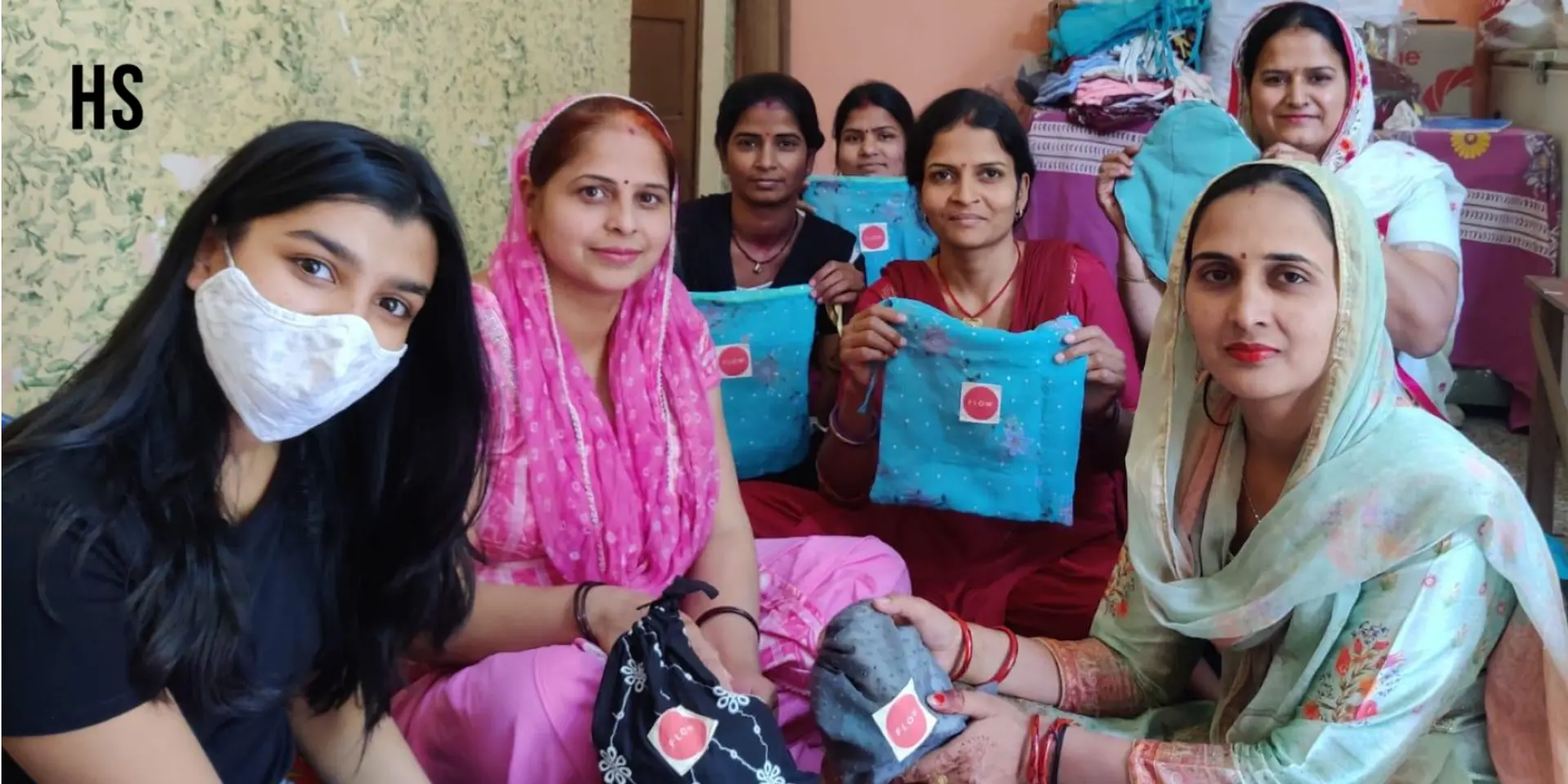

In 2020, when the world paused due to the COVID-19 pandemic, something clicked for Aanvi Kanodia, who at 15 years old, was teaching art at Bagiya—a school run by the Sanshil Foundation in Gurugram.
“I had been teaching the same set of students for a while when I started noticing that certain girls stopped coming to school at a certain point,” she recalls.
Upon asking, Shilpa Sonal, Founder of Sanshil Foundation and the school, told her the girls didn’t come because their periods had started. They weren't allowed to continue school or were asked to miss classes on those days—the reasons ranged from cultural taboos to the inaccessibility of period products.
“It impacted me a lot when I found out. When COVID-19 started, I read an article about how it had become difficult for people to access period products because of their financial situation,” says Kanodia, adding, “That’s when I decided I have to do something about this.”
She launched FLOW Pads in 2020 as a grassroots initiative within the Sanshil Foundation. Today, the initiative has grown nationwide to tackle period poverty and promote sustainable menstrual hygiene.
Building from scratch with empathy and research
Kanodia began exploring solutions with the support of the foundation. However, as a teenager navigating uncharted terrain, the road was hardly smooth. “I knew I had to do something for accessibility of period products, but didn’t know what menstrual products people would be most comfortable with,” she admits.
She conducted a sample survey by inviting 15 women—mothers of the Bagiya students—for a ration distribution. During the session, they were shown different menstrual products: period panties, disposable pads, menstrual cups, and tampons.
“While all other options were too foreign and new, they were comfortable with disposable and cloth pads. Most of them had used a cloth since childhood,” she says, adding that cloth pads also offered environmental advantages.
After designing around 5-7 prototypes and distributing them among the same women, it was feedback time. “One feedback was that the cloth pad looked too much like a pad and made them uncomfortable to dry in the sun. Another feedback was to add buttons so it would be easy to adjust according to their size,” she shares.
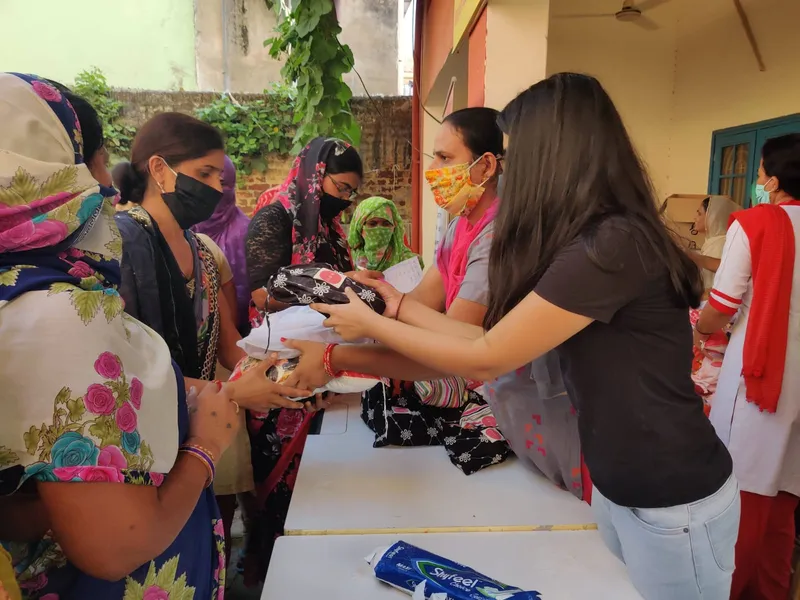
During Covid-19, Kanodia employed women from Jharsa village, Gurugram, and trained them to make reusable cloth pads that met the needs of their girls and women.
Empowering women—one stitch at a time
Kanodia revised her design and produced them at Sanshil’s stitching unit in Jharsa village, Gurugram, where women were trained to make them. “During COVID-19, they did not have any employment, so we decided to employ them,” she says. These women, who previously stitched small items like bags, now had a steady source of income and a purpose.
The impact was far-reaching. “These women told us that working here normalised periods at their homes because of their work. One of these women also said that she would use this income for her son’s education,” Kanodia shares with pride.
FLOW Pads conducts drives twice a month in the rural areas of Haryana and Delhi, and distributes an average of 100 sanitary pad kits a month. Each kit includes two to three cloth pads (usable for up to two years), an instruction manual, and a pictorial guide on how to clean the pads.
The production cost of one kit is Rs 150, and it has so far distributed 25,000 kits, including 80,000 pads.
Scaling up with creativity and grit
FLOW Pads also tapped into sustainability by sourcing fabric waste from industrial units in Manesar, Gurugram. “We got this fabric cut and gave it to women to stitch,” Kanodia says, adding that the pads were lab-tested for safety before distributing them.
What started with Kanodia, her mother, and Sonal has now grown into a team of 20 active volunteers. “My school was online. I told my friends about it, and they were all very supportive. However, no one understood the depth of it until I actually started on-ground work,” she says.
Currently studying at the Indian Institute of Design and Innovation, 20-year-old Kanodia aims to expand her initiative. “I want to devote more time to FLOW Pads and expand it to more cities.”
Not just a product
Beyond distribution, FLOW Pads collaborates with NGOs to conduct awareness drives on menstrual hygiene and actively uses social media (@flowpads) to combat stigma.
This journey has also been deeply transformational for Kanodia. “When I started, I was very hesitant because I was a very shy kid. However, you need to know how to talk and how to talk to the right people. Talking about your cause and the change you want to make is very important.”
She sums it up with pride: “FLOW Pads is my child, and I am so passionate about it. It's really fulfilling, and any change you want to bring eventually changes you as well.”
(The story has been updated to correct a typo and make a change in the number of prototypes.)
Edited by Suman Singh