



Meet Drishana Kalita, who is using puppetry as a tool for social change in Assam
Drishana Kalita and her group PuppetPeople Assam are reviving the state’s traditional puppet art, Putola Naas, turning it into a force for social change. Their puppet performances address social issues and challenges with stories that inform, heal, and empower.

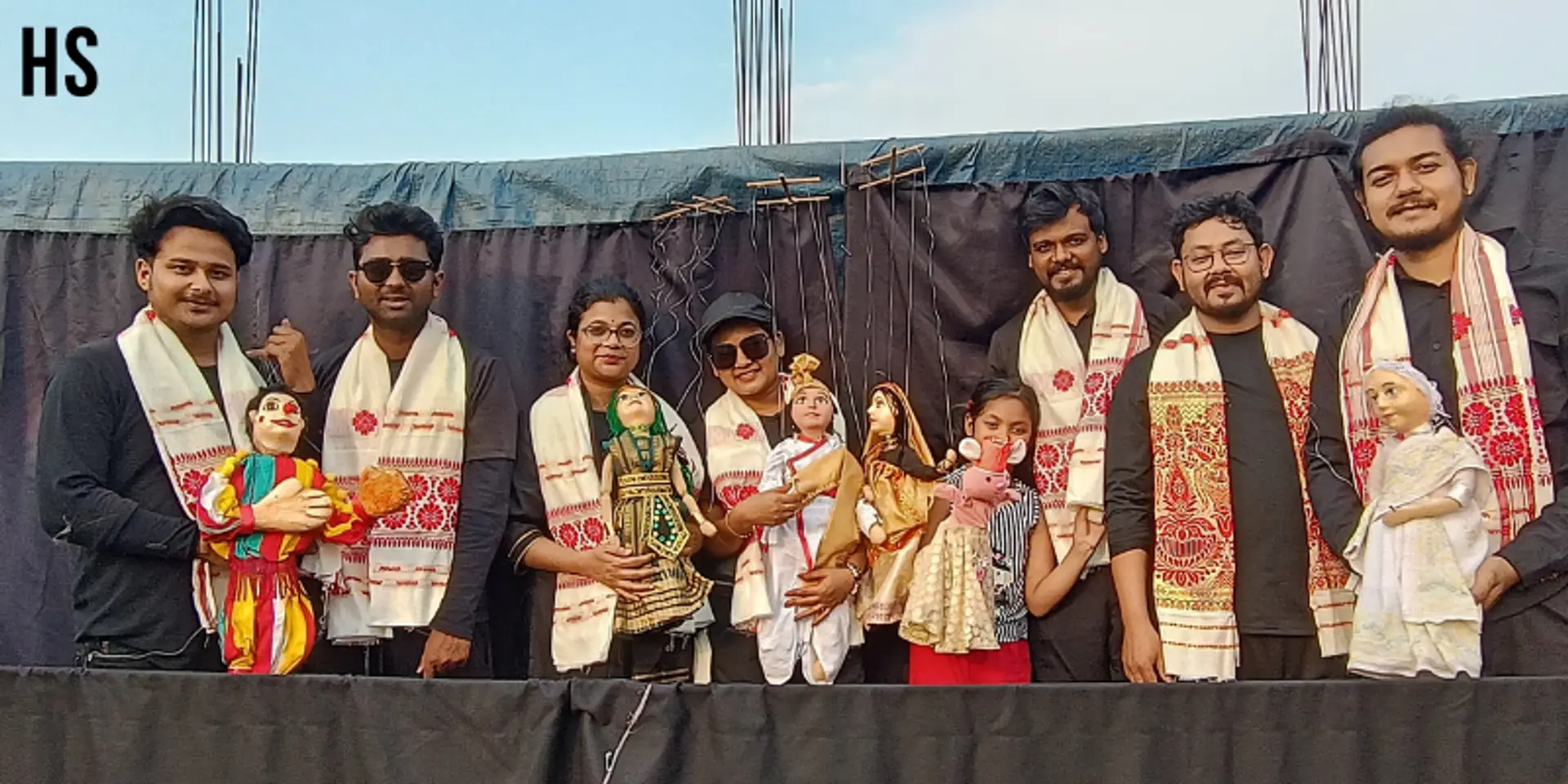

Growing up in Hajo, a small town northwest of Guwahati, Drishana Kalita was fascinated by the traditional puppet shows known as Putola Naas staged during religious festivals.
In Assam, puppetry has traditionally been a male preserve, passed down from father to son. Yet, young Kalita was spellbound by each performance and was determined to break tradition and make the art her own.
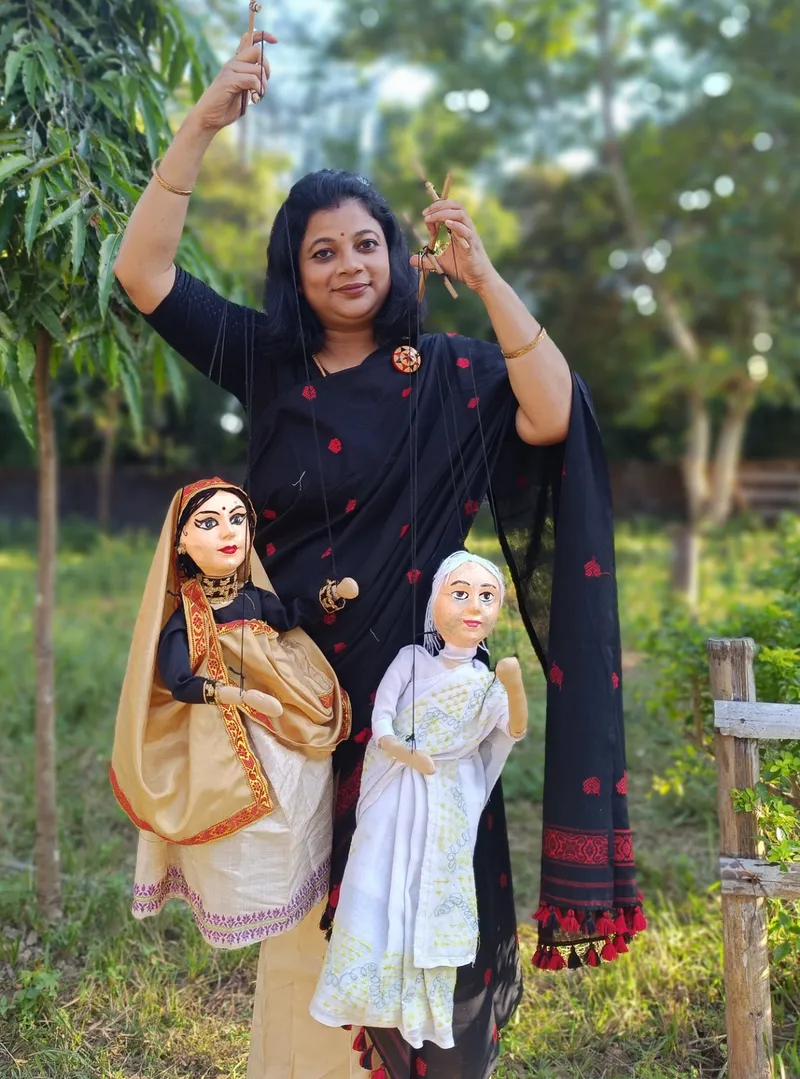
Drishana Kalita
“It was difficult to learn, but that did not stop me from observing every detail and trying to learn from the artists,” she tells HerStory.
A persistent learner and a stickler for detail, Kalita could read four languages—Assamese, Bengali, Hindi, and English—by the time she was six.
Her father was an avid reader, and their home was a treasure trove of books.
The young Kalita devoured works by Premchand, Tagore, Charles Dickens, and Buhi Ai Hadu, a popular collection of Assamese folk tales.
After completing her graduate degree in education and a master’s in mass communication, Kalita moved to Delhi to a corporate career in advertising that lasted seven years.
“I didn’t find any satisfaction in what I was doing, and was not looking at working in a corporate setup forever. I wanted to do something for Assam. My work felt soulless and I was miserable,” she says.
Social change through puppets
Taking a leap of faith, she returned to Guwahati in 2013, and driven by her passion, started PuppetPeople—a small group of puppetry enthusiasts like her.
People were confused and found her decision quite strange. Why would she leave a cushy job and start a Putola Naas group in Assam, which didn’t even seem like a viable career.
Unaffected by the naysayers, Kalita started working on her childhood dream to take Putola Naas to the masses. She didn’t want to just stop at propagating the traditional art form; her mission was to use it as a medium to spread awareness on several gender-related issues.
Social transformation was close to her heart. Growing up in a society where gender-based violence was all too common, Kalita’s own lived experiences and trauma only strengthened her resolve—to educate others, break the silence, and ensure the cycle ended with her generation.
“Only a few lucky people came from peaceful homes. I felt compelled to work towards ending this cycle so that children wouldn’t have to go through such experiences—or at the very least, know how to cope. I wanted parents to understand how deeply their actions affected their children,” she observes.
She also points out that Assamese folk stories for children often contain graphic violence—particularly unsettling scenes of girls being beheaded —which, she believes, normalises brutality and embeds it into the cultural psyche.
“It also glorifies stalking or forced marriages and these are narrated through generations. It impacts the thought process because it’s considered normal and acceptable,” she explains.
Kalita set about rewriting some of these folk stories and including them in the puppet performances to give the heroines both voice and agency. Her biggest support came from the women, and as word spread, more villages began inviting her group to perform.
Connecting with the community
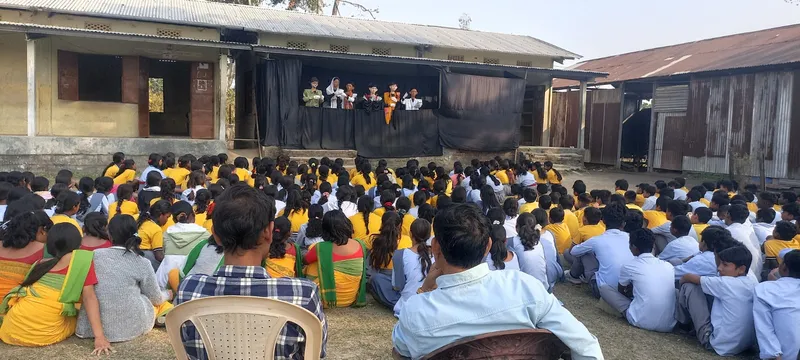
A Putola Naas performance
Soon, information and awareness about stalking, trafficking, alcoholism, substance abuse, menstrual health, and witch hunts began reaching even the remotest villages, carried by Kalita’s powerful storytelling and creative puppetry.
First, Kalita researches the village where her group will perform, engaging with locals to understand their challenges and concerns. She then tailors her storytelling to connect with the community.
The group performed in Sadri, the language of the tea tribes, for the first time, leaving the women in the audience in tears.
“It’s a completely different world in the tea gardens. Women are paid far less than they would earn elsewhere. Without access to bathrooms, they have to relieve themselves in the fields. They live in constant fear of domestic violence. We performed in 10 to 12 tea gardens, and the women were deeply moved. They told me no one had ever focused on their problems before,” she elaborates.
She believes it’s important to involve men in these campaigns to help them realise how their behaviour impacts their families.
In addition to PuppetPeople, Kalita also runs a theatre group that performs street plays, skits, and uses folk music to spread awareness on the same issues. She also organises workshops for young people interested in learning the art form. PuppetPeople is registered as a unit of New Age Actors' Theatre Foundation (NAAT Foundation).
The performances and training workshops are organised free of cost, with logistical arrangements sometimes covered by partner NGOs.
“It’s hard juggling home and travelling all over Assam for the performances. For a long time, I funded it with the money I earned through my consulting job,” she admits.
Recently, the organisation won the Zubaan Fellowship and another grant that has helped it move its office from her home to a small rental space. Donations from well-wishers also help pull the team through.
Impact through storytelling
Kalita says there has been a steady and visible impact. “Children ask a lot of questions, sometimes even storming backstage to see how we manipulate the puppets,” she shares.
She also adds that some change has happened concerning forced segregation of girls and women when on their period.
“Earlier, they were confined to a room for three days, not allowed to bathe and or go to school, and discriminated against in a number of ways. We are seeing some change here, with girls going to school,” she says.
A story carries a powerful message—it inspires girls to face challenges at home with courage and stay focused on their education. It also helps parents reflect on how constant conflict impacts their children. Through the narrative, the audience is gently guided to consider different scenarios, their consequences, and how they might choose a better way forward.
Each performance runs for a minimum of 30 minutes, and can go up to 45 minutes, and the story-telling is tinged with humour, drama, and emotions to make it engaging for the audience.
“There is a clownish character called Tingtong that raises issues about laws like the POCSO Act, Child Marriage Act, and others. He talks funny and enthralls the audience,” Kalita says.
They perform over 50 shows in a year and each is attended by more than 500 people. Different kinds of puppets, including traditional string and rod puppets, are used along with their own designed body puppets.
Kalita admits she has many “grand” visions for her organisation. “Sometimes I think I’m being delusional,” she laughs. But her commitment remains unwavering—she’s determined to take this traditional art form beyond Assam and ensure its artists get the recognition they deserve.
“Putola Naas was once widely loved but lost its sheen in the digital age. Still, it’s heartening to see how much people enjoy our performances,” she says. “I want to use it as a tool for social change—to tell meaningful stories that spark small shifts, which, over time, can lead to deeper transformation.”
Edited by Megha Reddy