



Meet the two Indian finalists of the Aster Guardians Global Nursing Award
Two Indian nursing professionals, Dr Sukhpal Kaur from PGIMER, Chandigarh, and Vibha Salaliya from the Hospital for Mental Health, Ahmedabad, are among the top 10 finalists of the prestigious Aster Guardians Global Nursing Award.

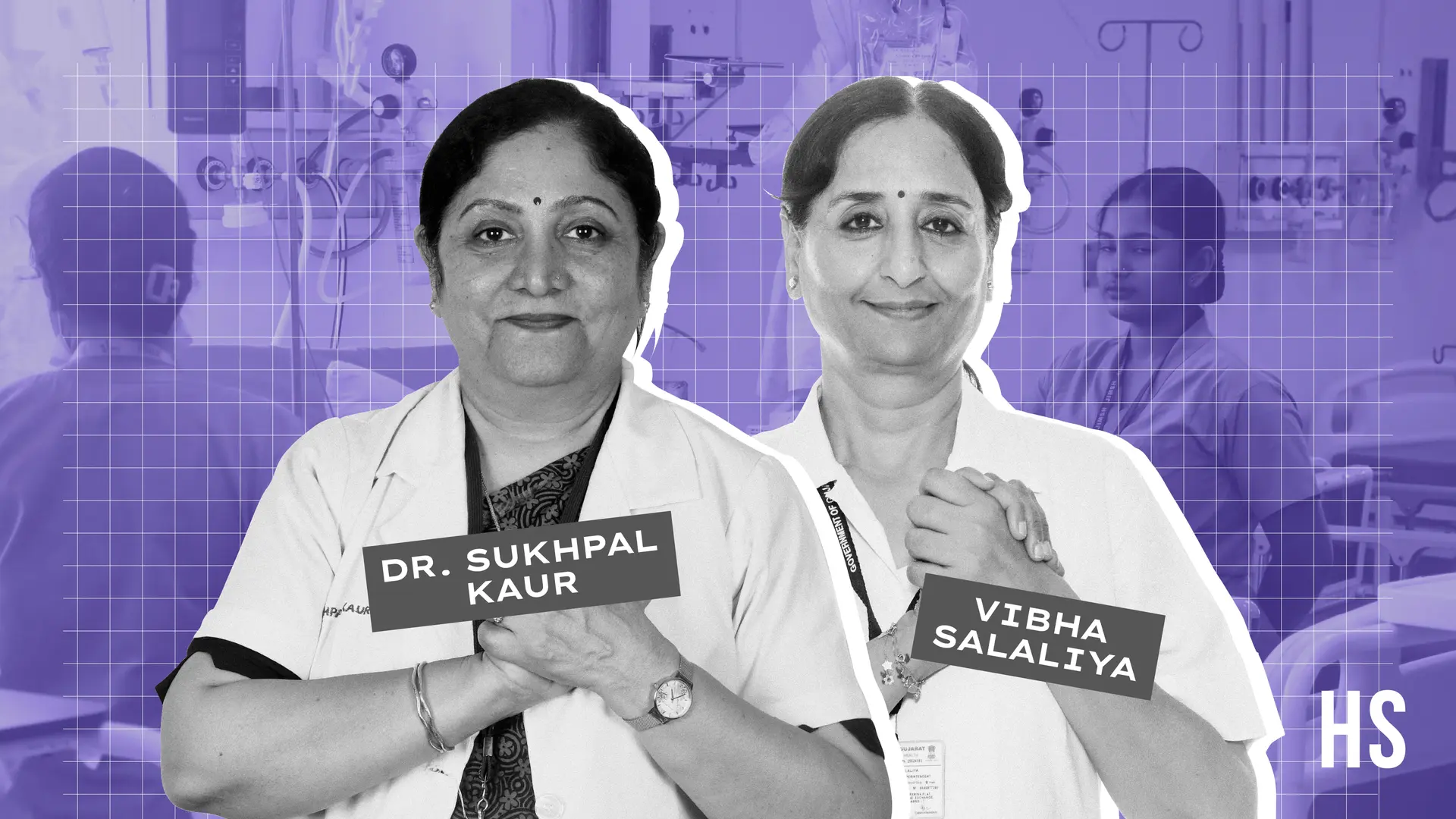

Indian nursing professionals—Dr Sukhpal Kaur and Vibha Salaliya—have reached the top 10 of the Aster Guardians Global Nursing Award, which honours the extraordinary contributions of nurses globally.
Kaur, from the Postgraduate Institute of Medical Education and Research (PGIMER), Chandigarh, and Vibha Salaliya, from the Hospital for Mental Health, Ahmedabad, were chosen from a pool of 100,000+ candidates across 199 countries. This Aster DM Healthcare initiative carries a prize money of $250,000.
Against the backdrop of this competition, Kaur and Salaliya take HerStory through their journeys in a profession that stands as the unwavering backbone of the healthcare sector. They also talk about how nursing has evolved over the years, and what more can be done in India to be on par with global nursing standards.
Transforming nursing education
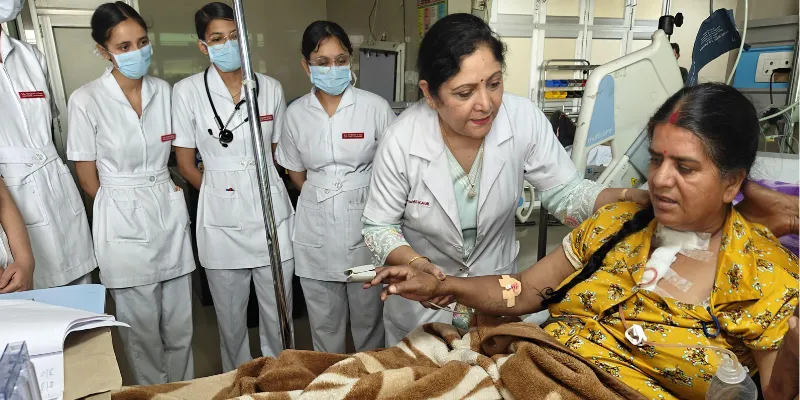
Dr Sukhpal Kaur with a patient
Born in Gurdaspur, Punjab, Dr Sukhpal Kaur’s entry into nursing was serendipitous. “I wasn’t even aware of nursing when I joined,” she admits. But her natural inclination to help and care aligned perfectly with the profession’s demands.
With 34 years of experience, Kaur serves as the Principal of the National Institute of Nursing Education at PGIMER, Chandigarh, where she completed her BSc, Master’s and PhD in nursing.
In fact, she joined the institute as a clinical instructor and was consequently promoted to a lecturer, associate professor, and the Head of Department before becoming a principal.
“There have been many changes in nursing education. New curricula and specialities have emerged. When I did my master's, it was medical-surgical nursing. But now, we are running seven specialised branches at PGI—critical care nursing, cardiothoracic nursing, oncology nursing, nephrology nursing, and others,” she says.
The 58-year-old Kaur is also pioneering nurse-led clinics for head injury patients, where nurse counsellors assess the patient’s problems and teach caregivers. "For all these problems, there is no need to go to doctors. There is continuity of care from the hospital to the home,” she explains.
Notably, Kaur is also spearheading India's first MSc nursing programme in transfusion medicine. She believes technology has significantly improved outcomes. “Initially, we checked vital signs manually. Now, we have monitors that display vital signs directly. This saves time, allowing nurses to focus on other patient care tasks.”
She elaborates, “In education, we have moved from chalk and blackboard to multimedia classrooms, interactive boards, and flip classrooms. This improves interaction between teachers and students. In a flip classroom, students prepare ahead, leading to more engaged discussions.”
However, Kaur says that India is still about 50 years behind. “In the West, nurses are much more empowered.” She underlines the need to develop better policies and include more cadres in the nursing structure.
“Our statutory body, the Indian Nursing Council, and the Trained Nurses Association of India are working hard for equal work, equal pay policies. In government institutions, conditions are reasonable, but in private institutions, nurses are paid less,” she explains.
Today, India has nursing officers, senior nursing officers, assistant nursing officers, deputy nursing officers, nursing superintendents, and CNOs. However, Kaur believes India’s nursing structure needs more cadres. “We need lower cadres to handle basic work, allowing BSc and MSc nurses to focus on more specialised responsibilities.”
Despite the long hours and other professional demands, Kaur says she’d not have it any other way. "It is said that nurses are the backbone of the hospital, but now, I say that nurses are not only the backbone, they are the heart of the hospital. They have to work with compassion, commitment, and dedication that cannot come unless you have a kind heart."
A pioneer in mental health nursing
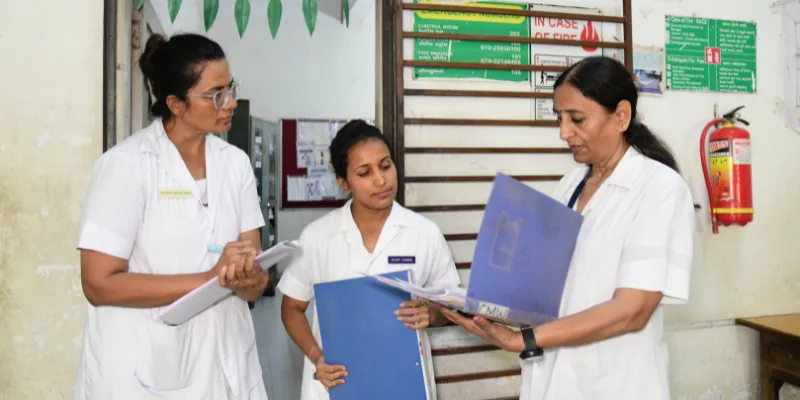
Vibha Salaliya (extreme right) discussing patient recovery with nurses.
Vibha Salaliya (56) has dedicated her career to revolutionising mental health care—an area often overlooked in India's healthcare system. With over 33 years of experience in improving mental health care in Gujarat, she has led efforts to introduce holistic, rights-based approaches to help thousands of people with mental illness regain their dignity, independence, and a sense of purpose.
Working at the Hospital for Mental Health in Ahmedabad, Salaliya found her calling inspired by a childhood memory. “I remember seeing a woman sitting outside our home, ungroomed and unkempt—people humiliated her and called her mad. I felt helpless, unable to help her,” she recalls.
This would be one of Salaliya’s defining moments to specialise in mental health nursing. In fact, she had enrolled for a regular BSc when a chance visit to a hospital where her uncle was admitted steeled her resolve to take up nursing as a profession.
“I saw how the nurses were caring for him. I left my BSc course and enrolled for a BSc in Nursing at the Civil Hospital in Ahmedabad,” she says. In 2010, she enrolled in a speciality course in mental health nursing and was eventually transferred to her present workspace.
“The scenario in mental health is different; it's a challenging job. In medical or surgical nursing, we give treatments as prescribed by doctors. But in mental health, I have to deal with people's emotions, which isn't easy. I had guidance from senior staff and psychiatrists on how to interact with marginalised patients whose families had abandoned them at the hospital,” Salaliya explains.
As a mental health nurse in India to receive the National Florence Nightingale Award, Salaliya has changed how mental healthcare is approached at her institution.
"We shifted from a medical model to a multidisciplinary approach," she explains. "Psychiatric treatment is not just about recovering from medicine. It requires a lot of helping hands—family support, alternative therapies, psychotherapy intervention, and medicine. The four work together."
One of her most significant contributions has been implementing the peer support volunteer (PSV) model. "The concept is training those who have recovered from mental illness for empowerment," she explains, adding, "All the PSVs have a living experience of mental illness. We instilled hope in their mind—you can do this."
These peer supporters help create recovery plans based on patients' hopes and dreams, triggers, and strategies for maintaining mental health—a 43-page comprehensive approach to understanding and supporting patients.
After the National Human Rights Commission found that 70% of mental hospitals in India physically restrained clients—a practice deemed a "gross violation of human rights"—Salaliya developed therapeutic isolation rooms as an alternative—padded rooms in every ward that have a small musical system and a television.
"When the patient has an aggressive or violent episode, first we try de-escalation techniques and therapeutic communication. If successful, we assign a social worker and counsellor for regular follow-up,” she says.
Her clinical innovations—integrating psychotherapeutic approaches, life skills training, family reintegration strategies, and vocational rehabilitation—have drastically reduced hospital stay durations from 90 to 43 days.
Salaliya also intervenes in cases of domestic violence and human trafficking and spearheads efforts along with the Women and Child Department of the state to support women through doorstep services with medication, counselling, and free legal aid.
The Winner of the Aster Guardians Global Nursing Award will be announced at an event in Dubai on May 26, 2025.
Edited by Suman Singh