



Held together by her hands: Migrant mothers and the invisible threads of care
Across villages, cities, and crisis zones, migrant mothers have remained quiet pillars of strength. This Mother’s Day, we explore how these women, often unseen and unheard, stitch families together with resilience that defies geography and systemic odds.

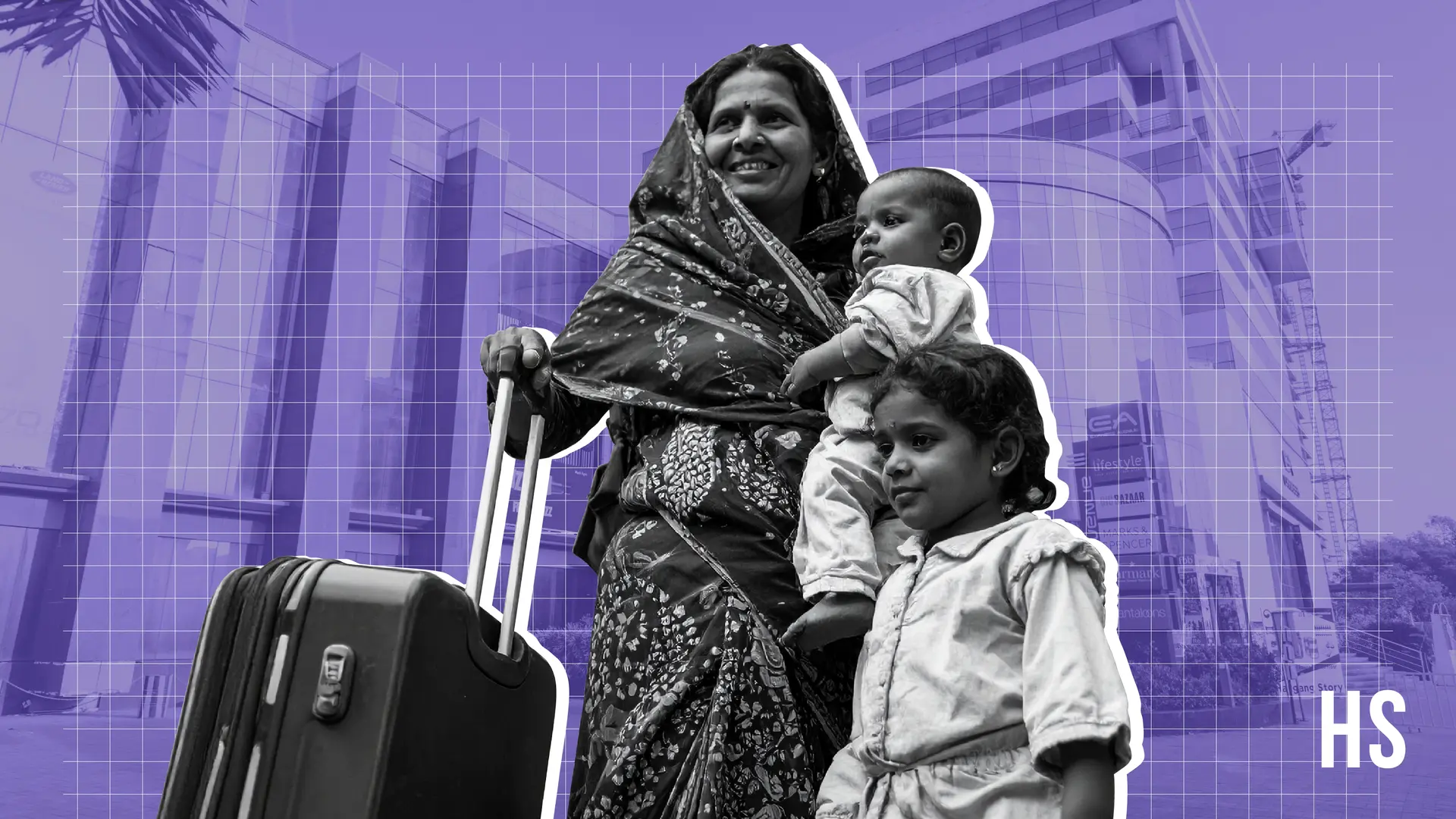

Migration is often portrayed as a pathway to opportunity. However, for many women, especially mothers, it is a decision shaped by crisis rather than choice.
According to the 2011 Census, an estimated 600 million Indians have migrated internally for various reasons, and women accounted for nearly 70% of this mobile population. Besides migrating owing to marriage, many Indian women now move for work, survival, and stability, especially as climate change, rural distress, and economic shocks continue to uproot lives.
Anita Khatun, who migrated from West Bengal’s Murshidabad to Delhi in 2004, lives in Gurugram with her husband and 19-year-old son and works as a domestic help. “It’s difficult to raise children in our village because there are no jobs,” she explains.
While the city offers work, it comes at the cost of distance—from her extended family, language, and the rhythms of her native place. “I want to earn enough to go back and live in my city, my home,” she says, quietly holding on to the idea of returning.
Her family manages to visit Murshidabad once a year, sometimes only once every two years. “My son has grown up in Delhi; he’s more used to this place now. I try to teach him Bengali. He understands and speaks it but can’t read or write it.”
Despite the distance, Anita keeps her roots alive through language, food, and culture, living within a small community of Bengali migrants in Delhi. Her hope, like that of many migrant mothers, is simple yet profound: to give her son a better life while keeping the essence of home intact.

The long-distance relationship
Women employed as domestic help in cities like Delhi, Mumbai, and Bengaluru are raising others' children, while their own remain in far-off towns or villages. Often hailing from states like Jharkhand, Bihar, Rajasthan, or West Bengal, these women become “transnational mothers”—emotionally present but physically absent.
These mothers often migrate owing to desperation—after a failed harvest, the death of a breadwinner, mounting household debt, or domestic breakdown. They must choose between leaving their children behind in the care of relatives or taking them along into insecure urban environments, where shelter, safety, and schooling are uncertain.
Once in cities, they are frequently funnelled into the informal economy, working as domestic help, street vendors, construction workers, or factory labourers, often without contracts, benefits, or childcare support.
Back home, their remittances help build houses, pay school fees, and fund medical treatments. The emotional cost—missing first steps, weddings, and even deaths—however, is rarely acknowledged. Some haven’t seen their children in over a decade, yet continue to send birthday gifts and voice notes across time zones.
Vandana*, 23, left her home in Ranchi as a teenager to look for work. Now employed in Delhi as a cook, she sends money home every month for her 10-year-old daughter’s education. “My daughter lives in Varanasi with her grandmother. Sometimes I really want to meet her, but I only manage to go once every six months—sometimes just once a year.”
Despite the distance and emotional toll, Vandana says, “When people in a new city treat you like family, you feel at home.” Her husband has also shifted to Delhi from Varanasi, looking for a steadier income. “I’m happy that I earn and can make my daughter study—that is more important for me.”
Mothers without borders
While some mothers migrate by choice, others flee with their children in tow, crossing borders to escape war, political persecution, or ethnic violence. For refugee mothers, the journey is often one of survival more than resettlement. In countries like India, Afghanistan, Bangladesh, or Uganda, thousands of displaced women carry the weight of trauma while trying to build safer futures for their children.
According to the UNHCR India Factsheet (2023), India hosts over 2.12 lakh refugees and asylum-seekers, including Afghans, Rohingya, Tibetans, and Sri Lankan Tamils. Many of these families—especially those not formally recognised under Indian law—live without stable legal status, severely limiting their access to housing, jobs, healthcare, and education.
Yet within these constraints, mothers create informal support systems and shared resilience, often anchoring entire communities through acts of caregiving and cooperation.
Farida, an Afghan refugee and single mother of four, came to India in 2016 after fleeing escalating violence in her hometown. “I left Afghanistan to protect my children. I had no other choice.” She found shelter with the help of friends in Bhogal, Jangpura—a neighbourhood with a significant Afghan population.
Earlier, Farida managed to send her children to a private school, but after the economic fallout of COVID-19 collapsed her income, she moved them to the Afghan School in Delhi—a community-run school supported by the Afghan Embassy.
In 2023, following the Taliban's return to power and the withdrawal of international recognition of the embassy, the school shut down, leaving hundreds of refugee children without access to education. “My children are now left without education. That is my deepest worry,” Farida says.
To stay afloat, Farida and a few other Afghan women began selling crochet items. “It is small work, but it helps. I miss my home every day. But India gave me and my children safety, and that means everything.”
A patchwork of survival and strength
Despite their journeys, one thread binds these women—an unshakeable instinct to nurture. From fractured beginnings, they piece together lives torn by displacement and mended by quiet acts of love. Rarely part of headlines or hashtags, they remain the unseen architects of survival—building homes, holding families, and creating stability in unstable conditions.
Sunita*, a migrant from Salumbar in Rajasthan, came to Udaipur in 2011 looking for work and better living conditions. Employed as a construction worker, she now lives in the city with her two children. “I left my hometown hoping for better opportunities and a healthier environment for my kids.”
Though she visits her extended family often, the return she dreams of remains out of reach. “I want my children to grow up around their grandparents, but going back isn’t an option. Here, at least, groceries and services are within reach.”
Sunita, like many migrant mothers, carries the weight of compromise—choosing access and survival over roots and reunion.
*Names changed on request.
Edited by Suman Singh