



Chennai’s women auto drivers’ collective is spearheading a bold movement for dignity and fair wages
Once seen as an oddity on Chennai’s roads, women behind the wheels of auto-rickshaws are no longer a rare sight. Rallying under the aegis of Veera Pengal Munnetra Sangam—a collective of women auto drivers in the city—they are striving for dignity of labour and safety, gaining national recognition.

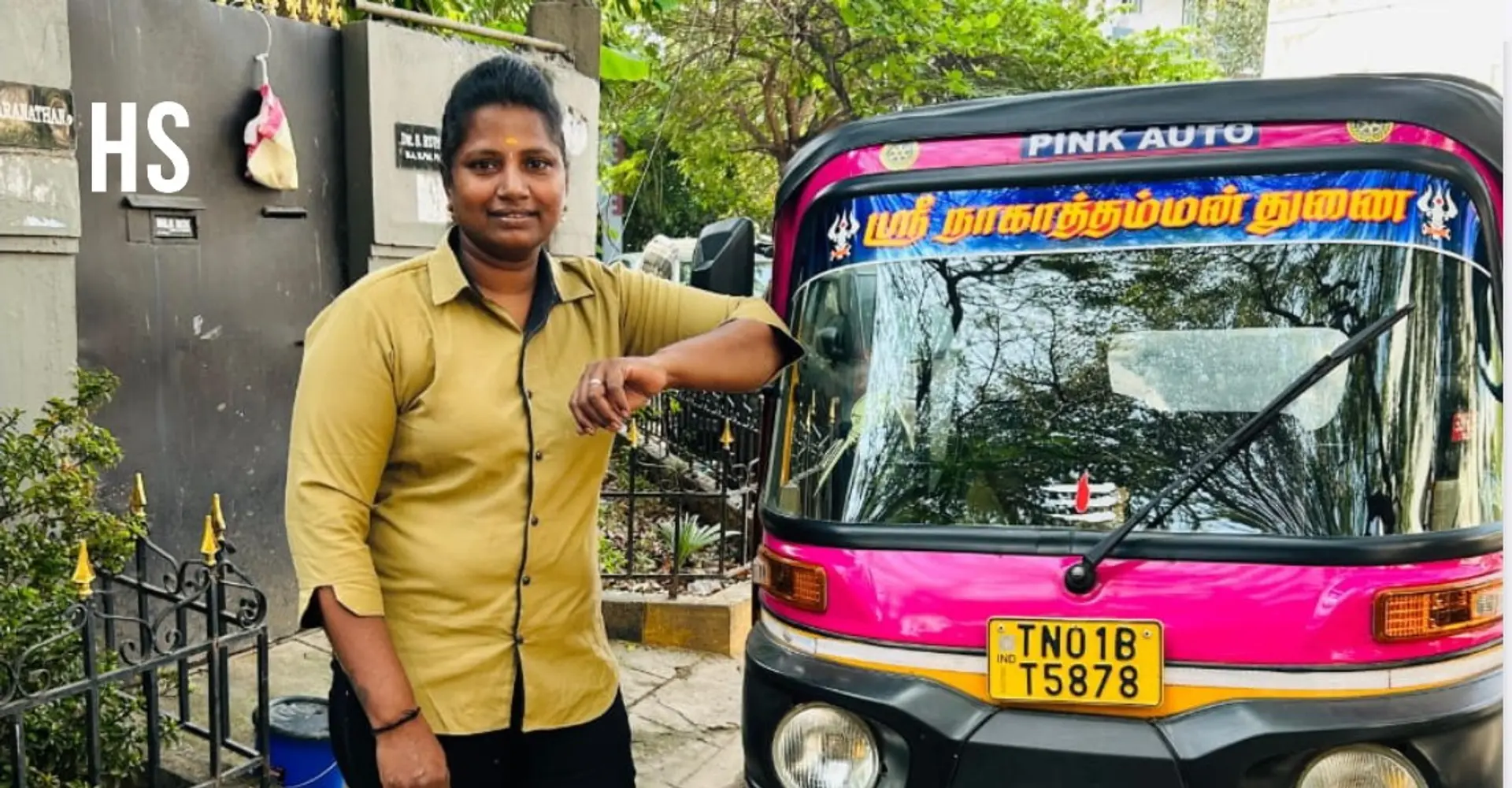

About three decades ago in Chennai, a woman behind the wheel of an auto-rickshaw was seen as an oddity—perhaps they were indulging in a new skill, a hobby, or a fleeting thrill. But, in 2025, for many women, driving an auto is no longer recreational; it is survival. More importantly, it is a form of quiet defiance—against a male-dominated transport sector in a public space that has long excluded them.
It all started when A. Mohanasundari, a 39-year-old former beautician and fast-food stall owner, decided it was time to rewrite the rules of who belongs on the road. A savvy entrepreneur for over 15 years, she turned to driving auto only after the pandemic affected her business.
What began as a stop-gap measure soon became something far more significant. Confronted with the everyday gender bias of the city’s transport ecosystem, Mohanasundari doubled down—to earn, to push back, and to eventually found the 45-member-strong Veera Pengal Munnetra Sangam, which roughly translates to ‘association for the progress of heroic women’.
This collective of Tamil-speaking women from Chennai—autorickshaw, cab, and delivery vehicle drivers—emerged from over 5,000 entries to win the top prize at IIM Kozhikode’s Women Start-up Programme 3.0 in November 2024, walking away with Rs 50,000 and national recognition.
It was the only team permitted to pitch in Tamil, thanks to support from Vijay Gnanaprasad, a community organiser who’s been closely involved with the group since early 2023.
“The expectation was that I’d show up and speak for them in English, but I stayed away deliberately,” says Gnanaprasad. “It was important the jury saw them as they are—on their terms.”
Before it became a registered society and won public accolades, Veera Pengal Munnetra Sangam was a loose network of women connected informally through WhatsApp.
“At every junction where I met women drivers, I stopped for a chat, shared concerns and grievances, exchanged numbers, and added them to the group,” says Mohanasundari.
The group began with six women. As they swapped tips on navigating routes, securing good fares, and managing school drops and station pickups, they slowly built a repository of knowledge that came in handy during their trips. Today, some of them earn over Rs 2,000 a day.
But the journey has been far from smooth.
“I began driving an auto in 2021 after hearing that male drivers were earning up to Rs 50,000 a month, building homes and sending their kids to college,” recalls Mohanasundari. “But the day I showed up at the Ayanavaram auto stand where I live, I was told to leave. The men said it wasn’t a job for women. Some even threatened me to quit.”
The resistance only galvanised her. During the pandemic, when the women began volunteering to transport relief materials, they realised the deep inequities they were up against. Male drivers had access to government schemes thanks to strong unions.
“We were newcomers, illiterate in many cases, and often not taken seriously,” says Mohanasundari. “Navigating the bureaucratic maze was exhausting—we would wait days at government offices and return empty-handed.”
That’s when the group, with Gnanaprasad’s help, began organising themselves in earnest. What started as WhatsApp conversations was formalised in April 2024, when Veera Pengal Munnetra Sangam was registered as a society with the Tamil Nadu government.
The group now has an associated lawyer for police and legal issues, and is preparing to register as Tamil Nadu’s first transport cooperative society for women drivers.
“They were a group of 300 to 400 women—yet most of Chennai didn’t even know they existed,” says Gnanaprasad. “That invisibility is what struck me most. This was about dignity as much as livelihood.”
Structural support has followed since then. Gnanaprasad and his team introduced circular loan plans and initiated media and business training. They are now making a documentary on the women, set to release in late 2025.
We didn’t want to create a system that relied on individuals or luck,” says Gnanaprasad. “The aim was to build something durable, something that made the women feel seen, respected, and equipped,” he adds.
The need for structure
An exploratory study in 2023 in Thane reveals that women enter auto driving primarily due to financial hardship, and as a means to gain self-reliance through the role. But they frequently face systemic obstacles, which call for government support, awareness campaigns, and advocacy. Despite financial gains, they invariably face hurdles every day, including lack of public restrooms, societal stigma, and harassment.
In an interview with The Times of India, Sony Shendge, President of Pune’s Baghtoy Rickshaw Women’s Union notes, “A woman is often questioned on her character just because she steps out of her home to support her family…”
Many members of the Veera Pengal Munnetra Sangam have been abandoned by their husbands and are raising children on their own. Some of them are also attending to ailing elderly at home. Therefore, it is important that their operations at work are streamlined and structured to ensure dignity of labour and they take home a fair income.
Leela Rani, 47, and a member of the collective, has been driving the autorickshaw for 23 years. She made enough money to educate her children and get two of them married. But ever since the emergence of apps such as Ola and Uber, she has been making far less than she used to.
Male drivers make it hard for us to pick up passengers from the stand, and some passengers are discouraging of a woman driver, she says. Most women in the collective are registered with app-based ride-hailing services to ensure a stable income.
“At times, passengers touch us inappropriately. Such instances dissuade us from driving later in the evenings, which cuts out a chunk of revenue from peak hours,” she says. “But since we formed the collective, I feel stronger because there is at least another woman driver in any neighbourhood to call out to. Also, when we go as a group, complaints are lodged faster,” she says.
The Veera Pengal Munnetra Sangam collects a monthly contribution of Rs 222 from each member, which goes towards paperwork, registration for government schemes, monetary support for families of drivers who have met with an accident, and health insurance.
The women drivers are appealing to the government to have a women-only auto stand outside Metro stations and ample restrooms and lounges for them to eat and rest during the day.
“There are at least 600 women autorickshaw drivers in Chennai alone,” says Mohanadundari. “There are another 600-700 who have been trained and have licences, but aren’t driving. We are a significant number, so we have a place in this ecosystem, and it must be safe and viable. That is our demand.”
Edited by Swetha Kannan