



This deeptech startup is making fertility treatments smarter, accessible, and effective
SpOvum Technologies, a Bengaluru-based startup in Assisted Reproductive Technology (ART), offers solutions to improve outcomes and accessibility in IVF care.


According to the Indian Society of Assisted Reproduction, nearly 27.5 million couples struggle with infertility in India, with the numbers rising sharply in urban areas.
Although IVF offers hope to millions facing infertility, the process is complex, expensive, and outdated. It’s also marked with immense physical and emotional strain, limited access in many regions and inconsistent success rates. The system unfortunately, hasn’t kept pace with advancements in patient-centered care or affordability.
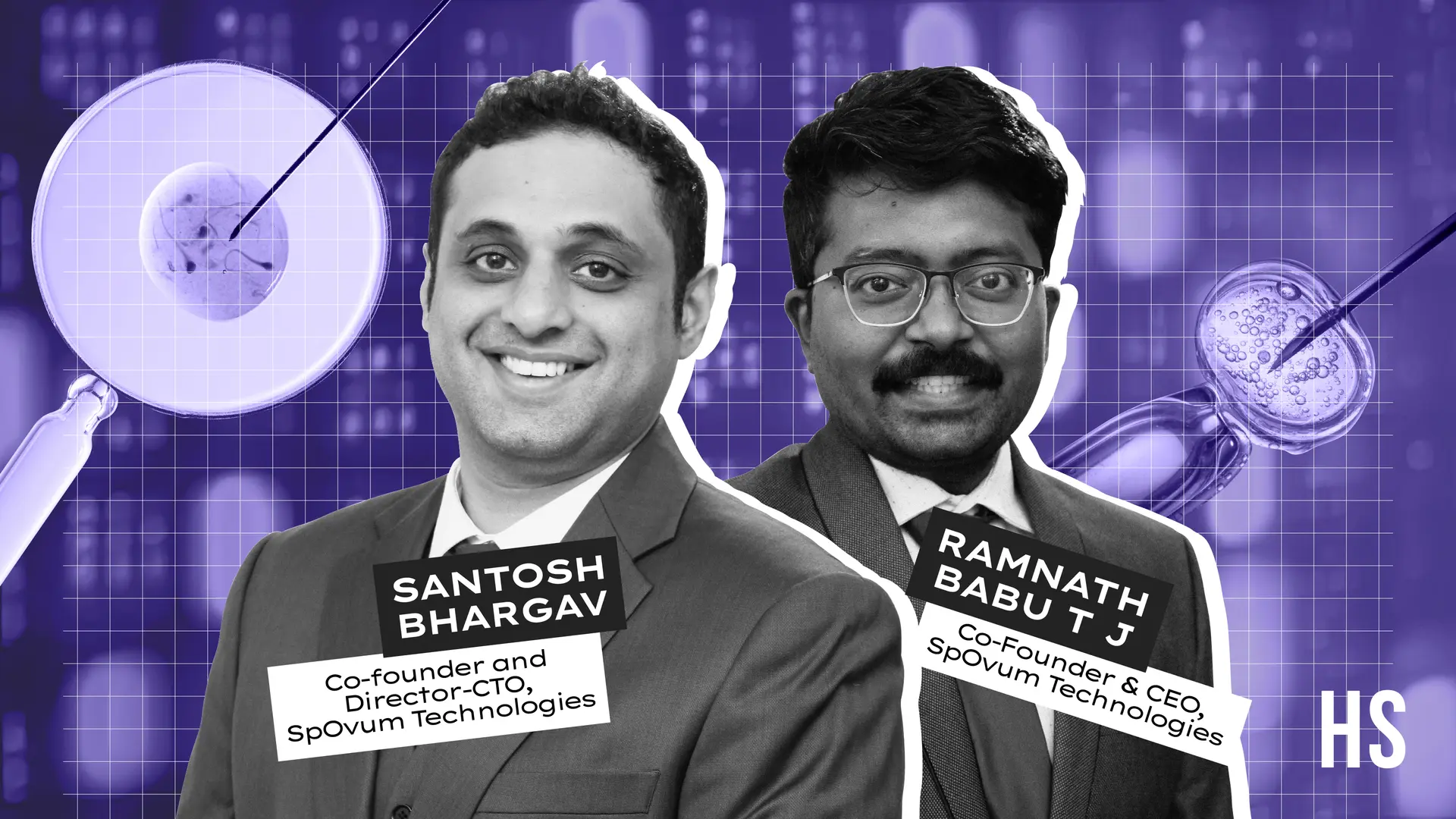
Ramnath Babu TJ and Santosh Bhargav DB with PhDs from the Indian Institute of Science (IISc), Bengaluru, met at the institution and bonded over shared interests in design, biomechanics, and innovation. Both are mechanical engineers, Babu from NIT Trichy and Bhargav from NIT Durgapur.
“As engineers, we were surprised to find how heavily manual and analog most fertility clinics still are, even in 21st-century India,” Bhargav outlines the pain point behind SpOvum Technologies, a deeptech startup building a combination of hardware-software technologies in the field of Assistive Reproductive Technologies (ART).
For Indian clinics and patients
With the market flooded with imported tools that didn’t address local challenges, the founders knew that they had to build something innovative and aligned with the needs of Indian clinics and patients.
“We also noticed alarming subjectivity in critical processes like embryo or oocyte selection, which varied widely between embryologists and directly affected success rates—adding to the emotional and financial strain for families,” explains Babu.
From the very beginning, SpOvum’s vision was clear—wherever the process was knowledge-based, it would use AI to capture, store, and apply that knowledge for better, data-backed decisions.
“Wherever the process was manual, we would bring in automation to augment the humans, reduce human error and improve precision. The goal was to create a system where quality wasn’t dependent on individual expertise alone but embedded into the tools, systems and processes themselves. Yet, in this process, we are not eliminating the human factor, as it is very much needed for the process to run smoothly,” he adds.
SpOvum offers a suite of AI-integrated, automated-driven solutions to improve outcomes and accessibility in IVF care. These include:
RoboICSI Device - The flagship product automates sperm injection with precision micro-manipulation, minimising ovum trauma and enhancing fertilization consistency.
Time-Lapse Imaging Incubator - This incubator captures continuous embryo development, enabling informed embryo selection without disturbance and personalized treatment plans.
ART Dashboard - A unified platform that consolidates patient data, lab metrics, and clinical notes, offering real-time insights and AI-powered strategy recommendations.
AI Decision Support - Subjectivity in gamete/embryo selection is reduced with AI tools trained on large datasets, helping clinicians make explainable, consistent, data-driven decisions.
Modular Lab Automation - These systems automate repetitive lab tasks and standardised processes, minimising human error and freeing clinical teams to focus on care.
Clinics, especially in smaller towns, can adopt the systems and processes without high upfront costs, paying per use, making it affordable and scalable. SpOvum also offers digital training, along with local service teams to support installation, operation, and long-term success in using our technology.
At its Bengaluru in-house facility, every product is designed and manufactured along with clinicians, prototyping, testing, and iterating to the highest safety and regulatory requirements.
Reach and impact
While its products and services are available pan-India, Babu emphasises its commitment lies in serving Tier II and III cities, where access to fertility care is often limited.
“In these areas, fertility clinics can be few and far between, and patients often travel long distances seeking care. Here, advanced IVF tools are most needed. We have partnered with 30 clinics across four states, providing them with the technology and helping them improve patient outcomes,” Babu elaborates.
SpOvum operates on a B2B model where clinics purchase its hardware and subscribe to its AI-enabled software modules. Beyond the technology itself, it provides comprehensive training and ongoing support.
“Many of our partner clinics have reported a significant increase in IVF success rates, from an average of 35% to over 50% after adopting our platform. These numbers represent so much more than clinical metrics: there are stories of couples who finally get to hold their child, of families fulfilled, and of dreams realised.
Additionally, our solutions have streamlined lab operations and reduced human errors, creating a more efficient and reassuring environment for patients and staff alike,” says Babu.
Since its launch two years ago, SpOvum has achieved about 3X year-on-year revenue growth, shares Babu. On the global stage, it competes with players like Cooper Surgical, Vitrolife, Cook Medical, and Merck, amongst others.
“Our strength lies in our breadth and depth of the solutions offered, and the deep integration between the solutions. Together, they provide a holistic 30-degree perspective on all the data to inform data-driven decisions at scale. As a result, our solutions are not only tailored to Indian clinics but are also more affordable considering term costs,” Bhargav says.
The company’s journey began with support from LifeCell and since then, it has bagged government grants through MSME.
“In the next 18 months, we aim to expand our presence to over 100 clinics across India, ensuring our technology is within reach for every couple seeking fertility care. We’re also working on rolling out AI-powered decision-support tools to further democratise access and help clinics achieve better outcomes,” Babu says.
The founders recognise the immense responsibility that comes with using AI in fertility treatments.
“Our AI models are trained exclusively in anonymised, ethically sourced data, ensuring patient privacy and compliance with the highest standards of clinical ethics. We are stringent followers of the ART ACT by the Indian government. Most importantly, every automated decision is explainable and always leaves the final call with the clinician. In such a sensitive field, we believe that transparency and ethical rigor are non-negotiable,” explains Babu.
One of the inherent challenges they faced is the cautious nature of the ecosystem. This risk-averse mindset, while understandable given the stakes, often slows down the adoption of innovations, Babu notes.
“On the development side, the capital required—whether in terms of money, talent, training, time, or regulatory preparedness—is significant. Every iteration must undergo rigorous testing, ethical scrutiny, and validation across diverse clinical conditions. It’s a demanding process, but a necessary one,” he adds.
Its multidisciplinary team is growing rapidly and is soon to be 100 strong. SpOvum has professionals with over 30 to 40 years of experience across IVF, medical devices, quality systems, product realisation, and embryology, spanning reputable global organisations.
While India remains its primary focus, the potential to transform fertility care worldwide has led the company to the East African market.
“We are also eyeing expansion into other regions of the world,” he adds.
(The story has been updated to correct typos.)
Edited by Megha Reddy