



Forging futures: Meet Rani Chennamma team of women welders at Praj GenX
Praj Industries’ GenX facility in Mangaluru has trained and deployed 50 women as welders. Known as the Rani Chennamma team, they handle critical equipment like pressure vessels, distillation columns, and storage systems for the energy transition and climate action (ETCA) sector.

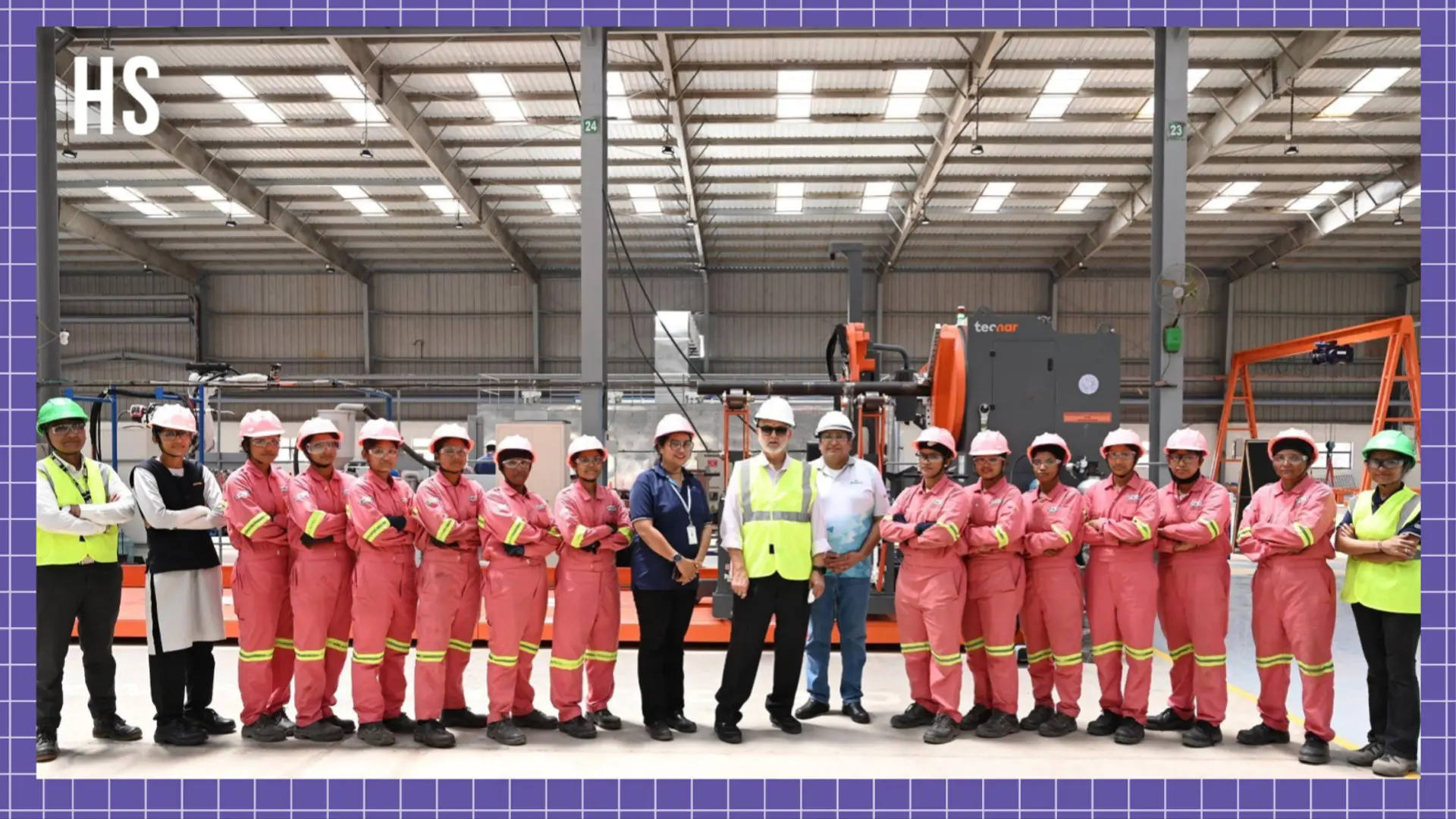

In a significant move toward gender inclusion in heavy manufacturing, Praj Industries’ GenX facility in Mangaluru has trained and deployed 50 young women as welders.
Praj GenX Ltd is a wholly-owned subsidiary of Praj Industries Ltd. and specialises in the conceptualising, engineering, and manufacturing modular solutions for the energy transition and climate action (ETCA) sector.
Named after Rani Chennamma, the 19th-century queen of Kittur, a princely state in Karnataka, who valiantly fought the British, these women are now welding critical equipment like pressure vessels, distillation columns, and storage systems for the hydrocarbon sector.
Many are the first in their families to enter industrial work. In a field where every weld must meet exacting safety standards, their precision is vital.
HerStory spoke to five women welders to understand what it means to step into a male-dominated industry, how they mastered a high-skill trade, and what drives them to challenge stereotypes every day on the shop floor.
Suchitha
Suchitha
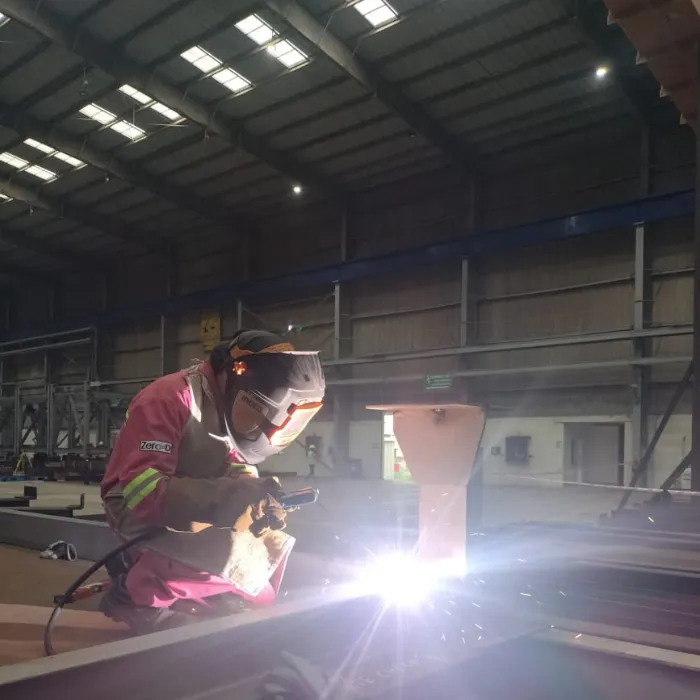
Thirty-four-year-old Suchitha from Uchhila, a village near Udupi in Karnataka, was working in a small printing press, making stickers for cylinders when she heard Praj was looking to train women as welders in its Mangaluru facility.
A BCom graduate, Suchitha had little luck in finding a clerical or “accounts” job. She says they were either far away or did not offer much in terms of a “package”.
A mother of two, with her husband away in Dubai, Suchitha stays with her parents.
“I came in for an interview and was selected. I started work nine months ago. After three months of training on the job, and clearing the exams, I am fully into the job,” she says.
Motivated by YouTube videos of women welders in Canada and the US, Suchitha and the other women knew that they were doing something different and breaking stereotypes. Suchitha works in the Quality Control department as a welder.
“Initially, for two-three days, I was not comfortable with the work and questioned my decision,” Suchitha admits. “After learning the work, I became confident and motivated,” she adds.
Suchitha works an eight-hour general shift and receives all the benefits under the Factories Act.
At the end of nine months, Suchitha feels at home at Praj. “My family is proud of me. I want to grow in my career and become a 6G welder (6G welding refers to a welding position where the pipe is fixed at a 45-degree angle). In the future, I want to work abroad,” she says.
Anisha
Anisha
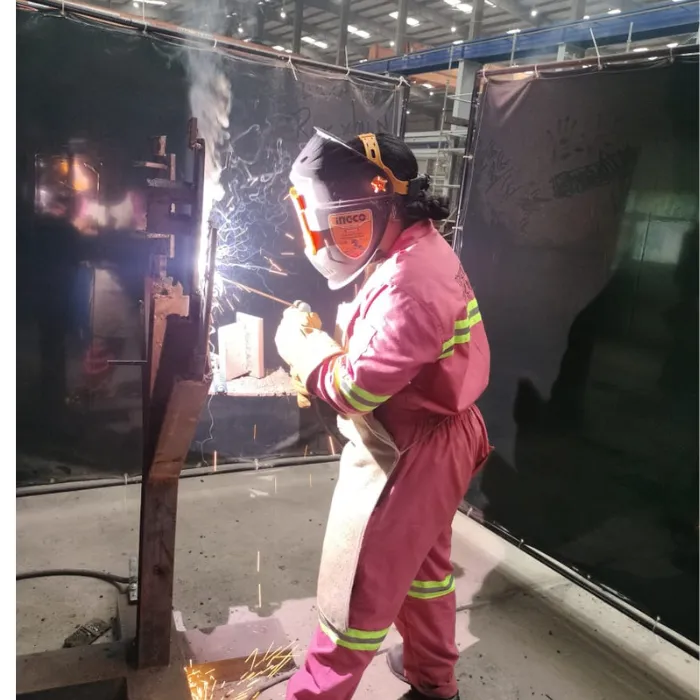
Anisha (26) from the nearby town of Padubidri completed her BCom course and worked for a year in photography before joining a local factory as a helper.
She heard about a job opening at Praj through her brother’s friend and visited the company directly to learn more about the position.
“I was scared of electrical sparks, but still curious about it. My brother and mother asked me not to go. But I thought to myself, “This is the second batch. There are already 25 girls working as welders.” I decided to go for it,” she says.
Anisha has been working as a CNC operator for six months on the cutting and drilling machine. CNC welding automates conventional welding methods through the use of computer-controlled machines, ensuring greater precision and efficiency.
“I took it up because it was challenging,” she smiles. “If someone had told me earlier, I had to run a welding machine, I wouldn’t have done it. After training, I became confident. For 15 days I was scared. Later I got trained to become a CNC operator and now work on the Cortex machine for cutting and drilling,” she explains.
Despite her family and neighbours’ misgivings, Anisha is proud that she is doing work that not many women prefer to do.
“I say we are at a level higher than what most people would do,” she laughs.
Anisha is interested in learning more about repairing machines and wants to work abroad.
Sinchana
Sinchana
When Sinchana was called for an interview, she imagined tasks like window repair and welding work at roadside shops. Despite the skepticism, she went for the interview. There, she saw several videos of what her work could entail.
Sinchana had worked as an accountant in Bengaluru, but she wanted to return to her hometown.
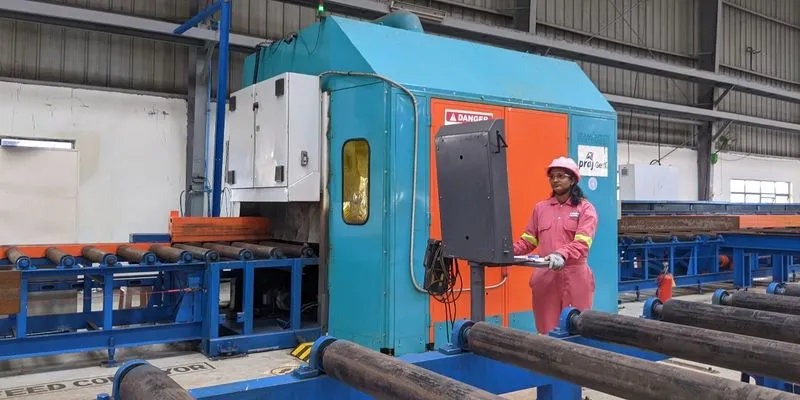
When she understood the work at Praj would be challenging and interesting, she took it. Sinchana works as a CNC operator and programmer, working in bigger machines like laser cutting.
“Plasma cutting is a bit tough. We also have to lift heavy things, but for that, we get support from our male colleagues. This job has helped me become independent and financially secure,” she says.
After three months of training, she completed 3G level and then worked on the Technar welding machine, passed that level, GMAW and SAW and coping machine.
“Since I had a diploma in Computer Science with some knowledge of programming, they put me in programming,” she says.
Sinchana admits she was irritated with the dress and the helmet, but as time passed, she became comfortable. “I am happy with the support and want to continue working here,” she says.
Prajna
Prajna
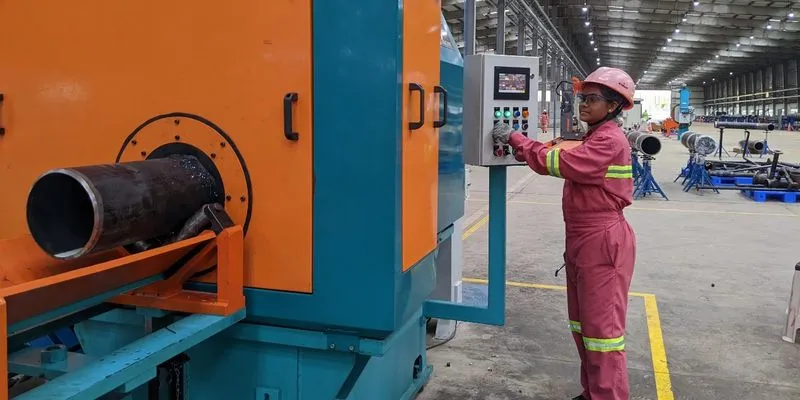
At 21, Prajna is one of the youngest in the welding team at Praj. Hailing from Udupi, she completed her diploma in civil engineering from Bengaluru. She worked briefly at an engineering site in Mangaluru when her sister told her of the “welder” job opportunity at Praj.
She had a basic knowledge of welding, having studied a chapter on it in her course. She joined six months ago and is a CNC operator.
“I work on the chamfering machine (it is used to remove sharp edges from materials, creating a beveled or sloped surface). Initially, I found the heavy lifting challenging. Earlier, I took other’s help especially the men, but now I am independently doing my work.
“I want to get more experience and certifications here and then look for opportunities abroad. I also want to study further. After that I want to fly,” says Prajna.
Sowmya
Sowmya
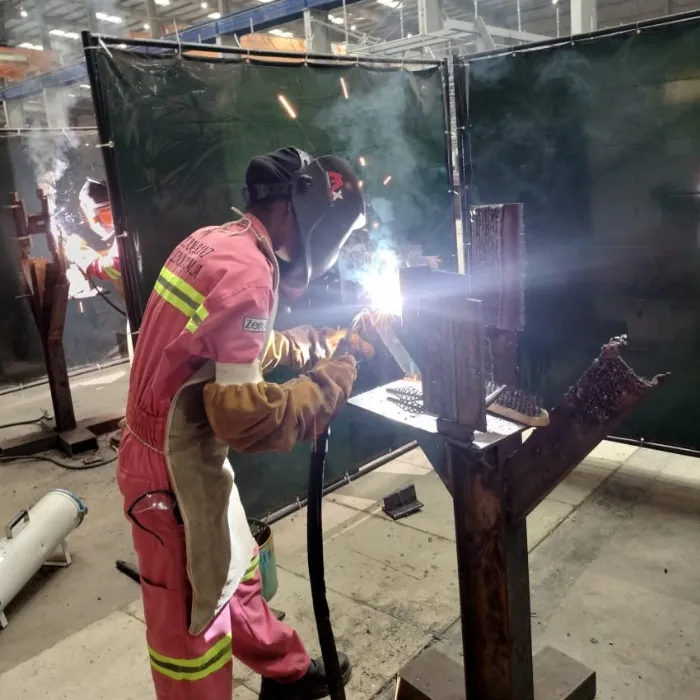
A welder from the second batch, thirty-five-year-old Sowmya, was a data entry operator at a call centre for ING Vysya Bank. An arts graduate, Sowmya heard of Praj from a friend.
“I was a bit scared in the beginning because welding is always thought of as a man's job and includes fire. But when I attended a gathering of the first batch of women, all my doubts vanished. After training, I gained confidence and started work with enthusiasm,” she says.
She works as a welder in SMAW and FCAW, both arc welding processes that utilise a flux-coated electrode to create a weld.
“One of the most challenging parts is the smoke. But the personal protective equipment keeps us safe. I am happy with the benefits and facilities, and I work on the general shift,” she says.
Sowmya's mother dissuaded her from taking up this work in the beginning, but has now come around to the idea of her daughter doing “something different”.
Welding a new revolution
Abhijit Dani, the Chief Business Officer and a whole-time director at Praj GenX Ltd outlines the Rani Chennamma initiative at the Praj GenX facility and plans for expansion.
“While developing this facility, we also worked extensively on our diversity and inclusion programme. We asked ourselves, can we have women working on our shop floor doing highly-skilled work. This is non-traditional, particularly in our industry where work is considered heavy,” he says.
We also had to confront traditional mindsets and biases that women are not suited for this kind of work.
Dani believes that having just a technical background doesn’t create skills, and you don’t have to be an engineer to understand welding.
“With basic theoretical training, you can explain what welding is, what kind of materials are involved. Everyone understands concepts like temperature, pressure, and current,” he says.
Initially, there were people who said women couldn't learn welding, but the core team firmly believed it was possible. He reveals there was initial bias about whether women would succeed. Another fear was that they would quit when they saw the scale of work—the equipment is huge and can be overwhelming. But as the first two batches of 50 successful women forge ahead, there are plans to add more to the workforce.
Dani says all efforts are being made to make the women comfortable on the shop floor.
“We made changes, starting with basic infrastructure like changing rooms and restrooms, and added additional security. We brought in more neutral policies. We created extensive awareness among the workforce about POSH (Prevention of Sexual Harassment), which we now call UCHIT—a gender-neutral policy,” he says. There is also a creche on the premises.
“The men working here had never worked alongside women on the shop floor, so we had to guide language, gestures, body language,” he adds.
Women are also provided with specially designed pink uniforms and different helmets. Dani emphasises on equity for women, rather than call them benefits. The women earn the same salary as men, received stipends during training, and, once qualified, were placed on the same level. The facility tracks different areas to ensure success of the programme.
“We have appointed technical mentors and others who take care of them from various perspectives, including their health. We check how the women are doing because this initiative is very close to our hearts. We always ask: are they able to sustain? What's their motivation level? I also meet them frequently on the shop floor to check how things are going,” he says. It’s not just about doing work, but doing it efficiently.
Beyond the hard numbers of attendance monitoring, they have also implemented a policy of one day of menstrual leave as per their requirements. This is particularly for women working on the shop floor, though it's not openly declared like other companies do.
“These 50 girls are working on robotic machines and welding. The next batch of 50 will focus on electrical, instrumental, and insulation work.”
As Praj GenX plans to expand this initiative, the message is clear: women are proving that they have a place and a future on the shop floor.
(The story has been updated to correct a typo.)
Edited by Megha Reddy