



Meet the all-women team leading high-tech processes for India’s first bullet train
An all-women-led team from L&T’s Vadodara factory is manufacturing over 9,000 precast noise barriers every month for the Mumbai-Ahmedabad High-Speed Rail project—India’s flagship bullet train initiative. Meet the team making it happen.

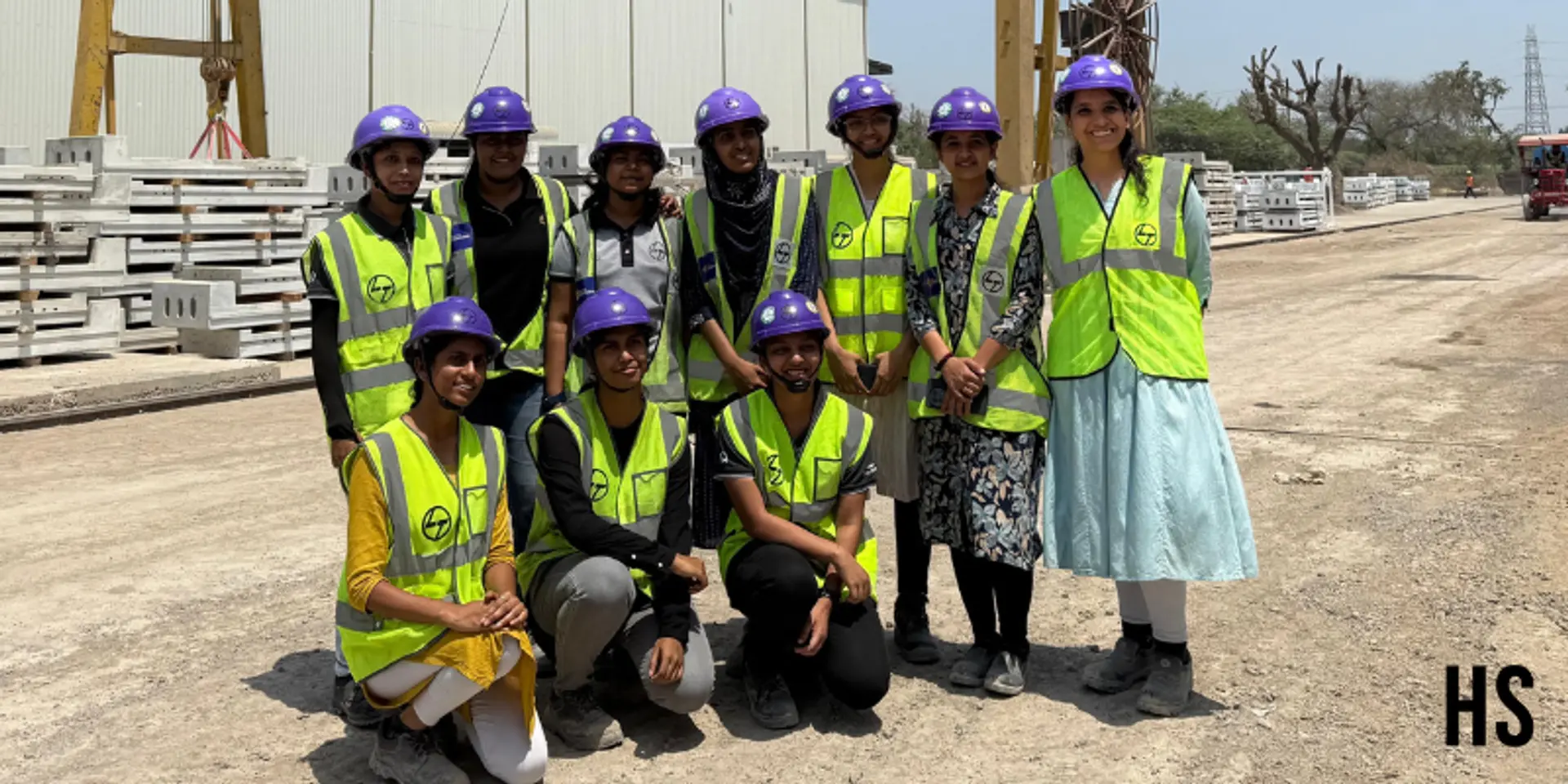

At L&T’s Vododara factory, an all-women-led team of engineers are overseeing a high-tech, precision-driven process—from mold prep to final dispatch—for the Mumbai-Ahmedabad High-Speed Rail project, India’s flagship bullet train initiative.
The team is manufacturing over 9,000 precast noise barriers every month and also breaking stereotypes in a sector where women make up less than 20% of the workforce.
Recruited directly from engineering colleges as graduate engineer trainees, these young women have risen to the role of senior engineers after a training period. Today, they are leading crucial functions like planning, quality control, production, and dispatch.
From operating concrete casting machines to promoting sustainability with gas-fired vapour generators, they are setting new benchmarks in both infrastructure and leadership.
Also called the MAHSR Bullet Train project, India’s first bullet train will cover 155.76 km in Maharashtra, 4.3 km in Dadra & Nagar Haveli, and 348.04 km in Gujarat with 12 stations along the route. L&T is executing 92% of the civil works i.e., 468 km of viaduct and nine stations, 100 % of electrification, and a substantial portion of track works. Once operational, it will reduce the travel time between Mumbai and Ahmedabad to under three hours.
HerStory spoke to four from a team of seven women who are breaking new ground in India’s engineering and manufacturing landscape.
From campus to the shop floor
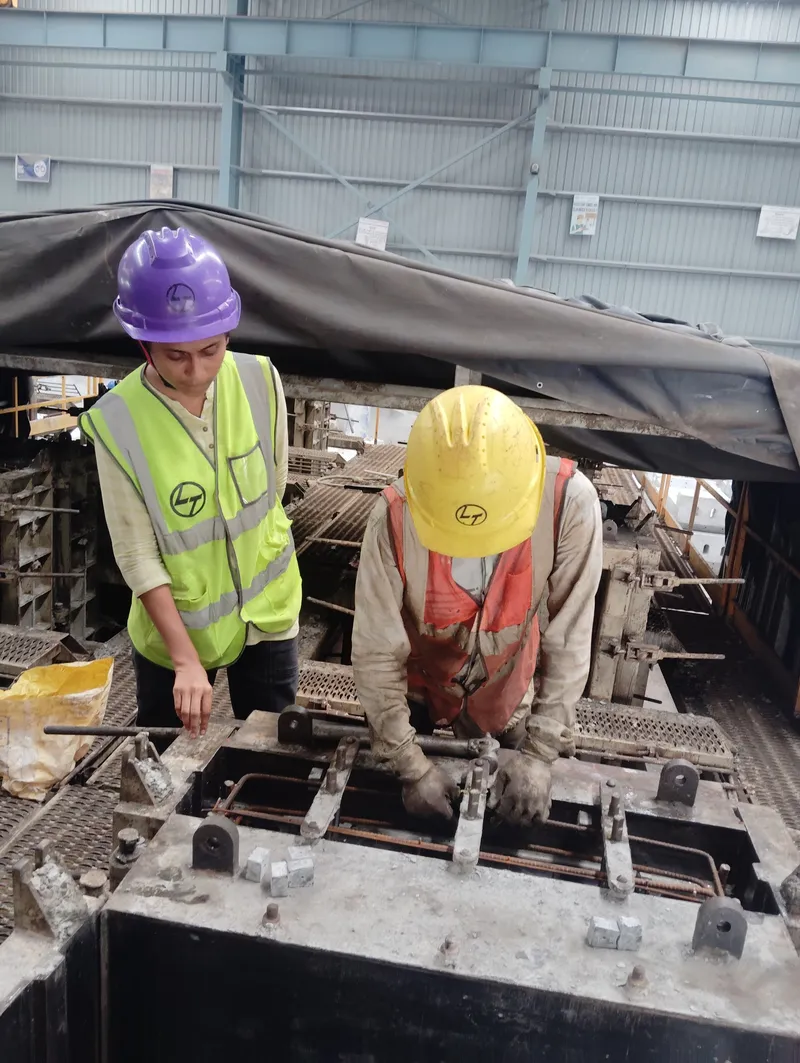
Sravanthi at work
Their journey began in 2023, when they were recruited directly from their college campuses to join L&T’s Mumbai-Ahmedabad High Speed Rail project. At the time, none of them anticipated the magnitude of what lay ahead.
“I never imagined this,” says Adithiya R, a civil engineering graduate from Coimbatore Institute of Technology, Tamil Nadu, reflecting on the scale of working on the bullet train project.
“This was a big opportunity for me and we learned everything here. In college, we learned only the theoretical aspect of processes, but here everything is practical, and is more exciting,” she says.
Sumayya PS, a BTech Civil Engineering graduate from Mar Athanasius College of Engineering in Kerala, admits it was difficult at first because it was their first experience at a site. But the excitement of working in such a prestigious project trumped everything else.
“Civil engineering involves building something from scratch. We can see things take shape. Also, here, we are working on a project that is going to be useful for others,” she says.
It was not until she was posted on site did Fidha Rasheed know that she was going to be part of India’s first bullet train project. She completed her engineering from NSS College of Engineering in Palakkad, Kerala, and jumped straight into what she calls “a great learning opportunity.” “I feel proud,” she says.
Rangu Sravanthi, who completed her BTech from Jawaharlal Nehru Technological University, Hyderabad, believes a civil engineering degree will help her serve the nation by participating in infrastructure projects like the bullet train.
Commanding core functions
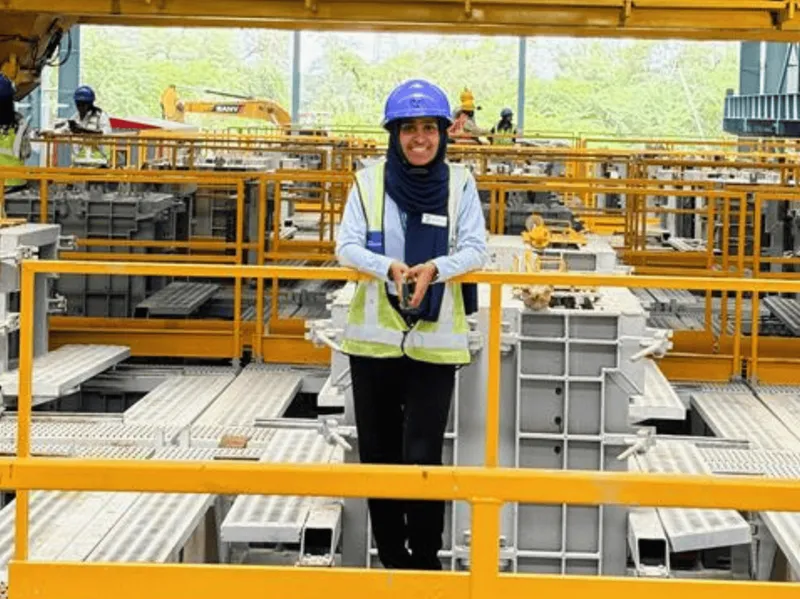
Summaya at work
Each oversees a specific domain, taking ownership of critical processes.
Summaya, who serves as the quality in-charge, explains, “My role is to inspect all incoming raw materials. And only after passing all the tests, these are used. I have to check the concrete properties, do the slump test and temperature. Only after obtaining the standar values, can we proceed with concreting.”
Her meticulous attention to detail ensures that every component meets the exacting standards required for high-speed rail infrastructure.
Rashid, dispatch in-charge, manages the complex logistics of finishing and dispatch, tracking trailers and ensuring panels reach various sites safely and on time. “I ensure that the panels reach the sites with utmost safety and quality,” she says.
Sravanthi, the production in-charge, starts each day with a “toolbox talk”–briefing sessions where she communicates safety protocols, daily targets, and operational procedures to the workforce.
“I take care of planning in the noise barrier factory. I arrange all the resources and raw materials used for production. I also take care of workforce management issues,” says Adithiya, the planning-in-charge.
L&T implemented a structured onboarding programme that included technical training on precast operations, safety protocols, equipment handling, and project-specific software. Experienced mentors, both male and female, were assigned to guide them through real-time problem-solving.
“Soft skills, leadership development, and confidence-building sessions ensured holistic growth. As precasting is fast gaining ground in India’s construction industry, we have established a separate cell of precast works to train new engineer recruits through a structured six-month program with both theory classes and exposure to hands-on training at site,” says Koneru Bhavani, Executive Vice President & Head–Heavy Civil Infrastructure at L&T.

Technology as an enabler
Automated concrete placing systems, advanced cranes, and precast mould systems have reduced physical strain in the workplace. “Digital dashboards gave them real-time insights, helping shift the unit from manpower-heavy to skill-intensive operations,” says Bhavani.
The technical aspects of their work involve cutting-edge technology and processes new to India. As Sravanthi points out, “We are using Japanese technology here. And since everyone is new to this project and technology, we are learning everything on the job.”
The factory operates with 200 molds for producing noise barrier panels, requiring precise coordination and planning. Adithiya manages this complex operation.
Overcoming challenges
Acceptance, especially by the workmen in the factory, was not immediate. The young women had to prove themselves in an environment where female leadership on the factory floor was unheard of.
“In the beginning, the workmen took time to adapt to us. Now, we work as a team,” Adithiya notes.
Sumayya admits that she encountered similar initial resistance. “There was this notion about why girls were entering this field. But after knowing us better, they became supportive. We also learnt a lot from them,” she says.
For Rasheed, the language barrier added a layer of complexity. “Communicating with the workmen was a problem because we spoke different languages. Also, they were not used to seeing women working on site. It was difficult for them and for us. But now, we have created a wonderful working environment, and the work flows seamlessly,” she says.
Measuring success beyond numbers
For L&T, the success of this initiative extends far beyond production figures. “We assess success on multiple fronts—retention rates, skill growth, quality compliance, innovation contributions, and the team’s influence in challenging gender stereotypes within the organisation,” Bhavani explains.
“The precast unit has become more than just a manufacturing facility—it's “a symbol of transformation, where precision, safety, and productivity align with empowerment and diversity,” she adds.
Team cohesion, confidence in taking autonomous decisions, and their ability to train others have been standout indicators.
“This initiative is building an inclusive culture in a hitherto male-dominated industry,” she shares.
The initiative has also become a proof of concept for integrating gender diversity at scale in infrastructure. Following its success, L&T is exploring similar units in other verticals—track laying, digital monitoring, asset management, and quality control.
While the bullet train promises to transform India’s transportation landscape in the coming years, these young women are already laying the tracks for future generations of women engineers to dream bigger, lead boldly, and build the nation’s future.
(The story has been updated to correct a typo.)
Edited by Megha Reddy