


Mahila Housing Trust is building a women-led climate movement
In low-income households, climate change comes as sweltering nights under metal roofs, flooded homes, rising electricity bills, and lost days of work. Through a participatory model of training, leadership, and climate-resilient technologies, MHT has built a network of grassroots women changemakers.

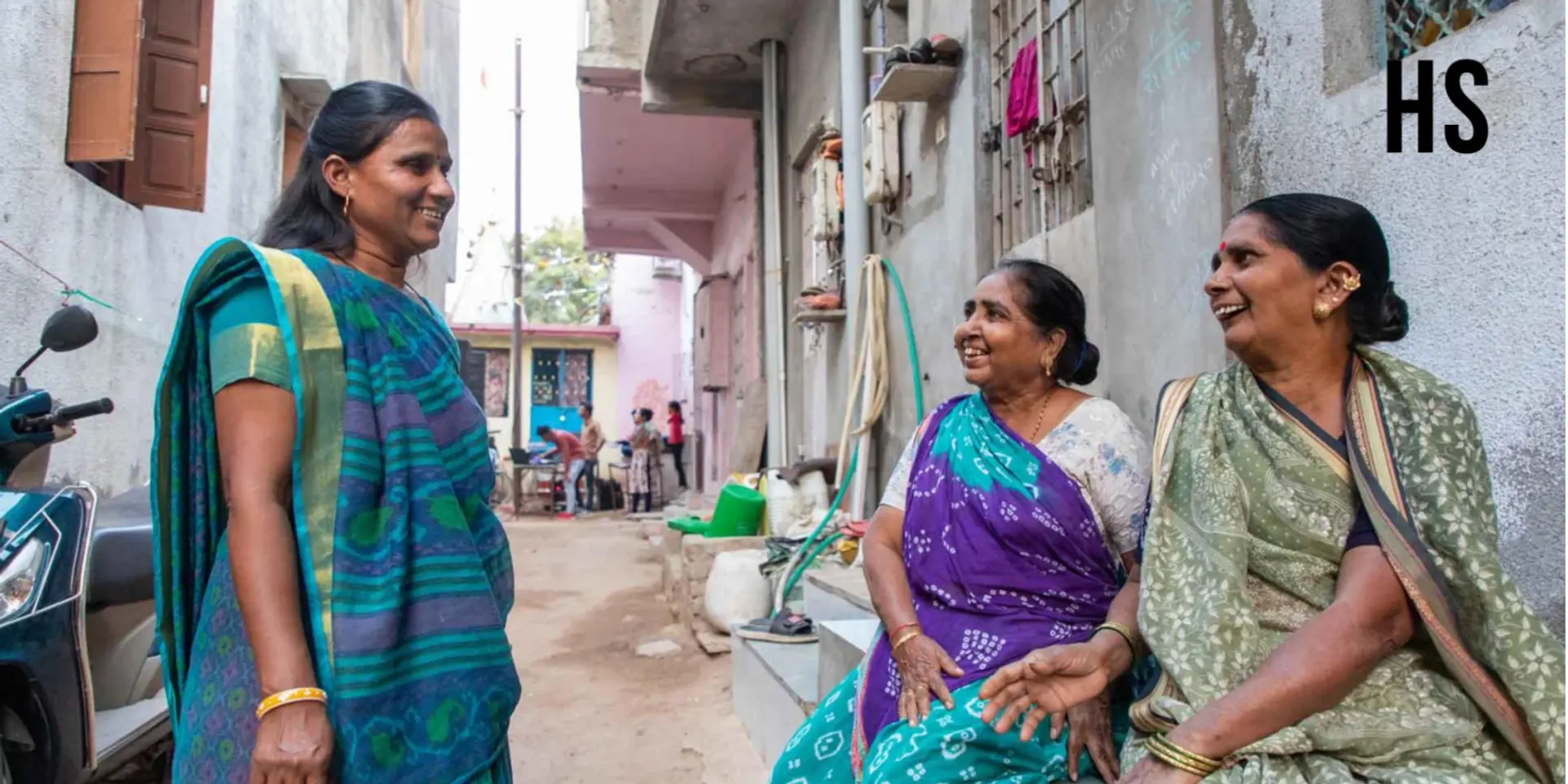

In the sweltering tin-roofed lanes of India’s urban settlements, climate change is not a distant threat but a lived experience. For decades, extreme heat, erratic rainfall, and flooding have had the worst impact on marginalised communities with poor housing and limited infrastructure.
For women in these neighbourhoods, the stakes are even higher. They shoulder unaccounted care work and their homes double as workplaces. Their work also increases during heatwaves or floods, and yet, they often remain excluded from decisions that shape their environments.
This was the setting in which Mahila Housing Trust (MHT) began working. They picked poor urban settlements in cities like Ahmedabad, Bhopal, Surat and Jaipur, and began training women to become climate leaders.
“Initially, many women believed climate change was an act of God,” says Bhavna Maheriya, Programme Manager at MHT. “They didn’t see it as something they could influence. Our work began first, with changing that narrative.”
Based in Ahmedabad, MHT was founded in the 1990s with a focus on secure housing and basic services for poor women. But by 2010, the organisation began explicitly aligning its work with climate adaptation.
“When women don’t have piped water or toilets, they’re forced to walk long distances, in unsafe conditions, or wake before sunrise to defecate in the open,” says Maheriya. “These are gendered burdens and we could not overlook the role rising temperatures or monsoon disruptions played in compounding these issues,” she adds.
The shift became strategic with the Global Resilience Partnership Project in 2015, following which, MHT piloted affordable heat-resilient technologies such as solar-reflective roof paint, modular insulated roofs, bamboo panels, ventilation systems and green roofs. The impact was visible; indoor temperatures dropped by 4–7°C, families saw reduced electricity bills, and women found it easier to work, rest, and care for children indoors.
Yet, these changes weren’t just infrastructural, says Maheriya. “We recognised the issue couldn’t be addressed top-down, but hinged on community ownership—starting with women.”
A training and leadership model rooted in participation
MHT’s process begins with a scoping visit to a new urban settlement, typically comprising around 250 households. Through multiple visits, the team builds trust and conducts focus group discussions to understand residents’ lived realities; for instance, do they have water and drainage connections? Do they experience frequent heat stress or flooding? Is there safe electricity?
Out of these discussions, 10 - 12 women are usually identified as potential participants. “Initially, only a few turn up,” says Maheriya, “but once the first few attend training and gain confidence, they bring others.”
The training covers 10-12 modules, using participatory techniques such as games and simulations. The women learn to understand city systems, write letters to local officials, analyse the impact of climate hazards, and actively advocate for change.
Eventually, they democratically elect a Community Action Group (CAG)—a collective of local women who take up leadership roles. The most active CAG members are then trained further as Vikasinis or grassroots leaders who mobilise their neighbourhoods and interface with municipal systems.
“These women begin to command respect,” says Maheriya. “They know how to raise complaints, lobby for services, and explain climate interventions to their neighbours. For many, it’s the first time they’re seen as decision-makers, not just at home, but in the public sphere.”
“This boosts their self-esteem.”
Heat-resilient housing remains one of the key interventions promoted by MHT.
In Surat, Savita Pandey, a small shop owner, battled scorching heat while operating shop under a tin roof. “During summer, I had spells of dizziness, vomiting and fever and shut shop in the afternoons,” she recalls. After MHT supported her in installing a bamboo-insulated roof, the change wasn’t just about giving her comfort but an uninterrupted livelihood.
“Now, I can comfortably sit inside my shop throughout working hours,” she says.
Likewise, in Bhopal, Vimala Prajapati, a tailor, says her daily income has increased from Rs 150 to Rs 450 after her home received solar-reflective paint with the help of MHT, allowing her to work continuously indoors.
The credibility of these interventions is further reinforced through peer-led exposure visits. Once a technology is piloted, other CAG members from nearby settlements visit, observe the results first-hand, and interact with beneficiaries.
“No amount of data from us is as convincing as a neighbour’s lived experience,” says Maheriya.
Dipikaben’s house of dreams
One of the most powerful examples of MHT’s climate-resilient housing approach comes from Dipikaben Mallik, a CAG member from Ahmedabad’s Bhagawatinagar slum. Dipikaben rebuilt her home using PUF panel roofing for insulation, solar lighting, and a raised plinth to protect against flooding. She also constructed a first-floor extension to future-proof her home.
“I am able to advise others in my community who are planning to improve their homes,” says Dipikaben.
The design, supported by MHT and the SELCO Foundation, has since been replicated by other families nearby as well.
Funding that reflects commitment and ownership
MHT’s work is sustained through a mix of international donor support, local government partnerships, CSR funds, and beneficiary contributions.
Each household typically pays 20 - 25% of the intervention cost. “Ownership is key,” Maheriya notes. “If something is given free, it may not be maintained. A little contribution changes the way people value it.”
So far, close to 3,700 women have been trained as climate leaders, and 35,000 households have adopted various climate-resilient technologies across ten Indian cities. Additionally, over 28,000 energy audits have been completed, leading to cumulative savings of Rs 5 crore and a reduction of 105 tonnes of CO2 annually, according to MHT data.
In 2021 MHT’s women-led, community-embedded, and deeply participatory approach gained international recognition, receiving the Ashden Award for Cooling in Informal Settlements, and in 2019, the UN Global Climate Action Award for gender-responsive climate action. Their work was also spotlighted at COP26, where they shared the stage with global leaders and environmental thinkers.
For Maheriya, the most lasting impact is not just thermal comfort or lower electricity bills—it is the restoration of dignity. “These are women who often have no say in their own homes. But as CAG members, they’re called ‘President’ or ‘Treasurer’. They speak in meetings. They’re listened to.”
MHT’s model continues to evolve, integrating digital literacy, mobile-based data collection, and even insurance solutions for climate risk. “But our foundation is always built on putting power and knowledge into the hands of women who know their communities best,” says Maheriya.
Edited by Affirunisa Kankudti