



Stay curious, embrace lifelong learning and strive for excellence, says Asha BV of Philips India
In our Women in Tech series, we feature Asha BV, Senior Director of Global Software engineering at Philips India Limited. She talks about her role in its Sleep and Respiratory Care (SRC) business, integrating AI and ML to solve healthcare challenges, and more.

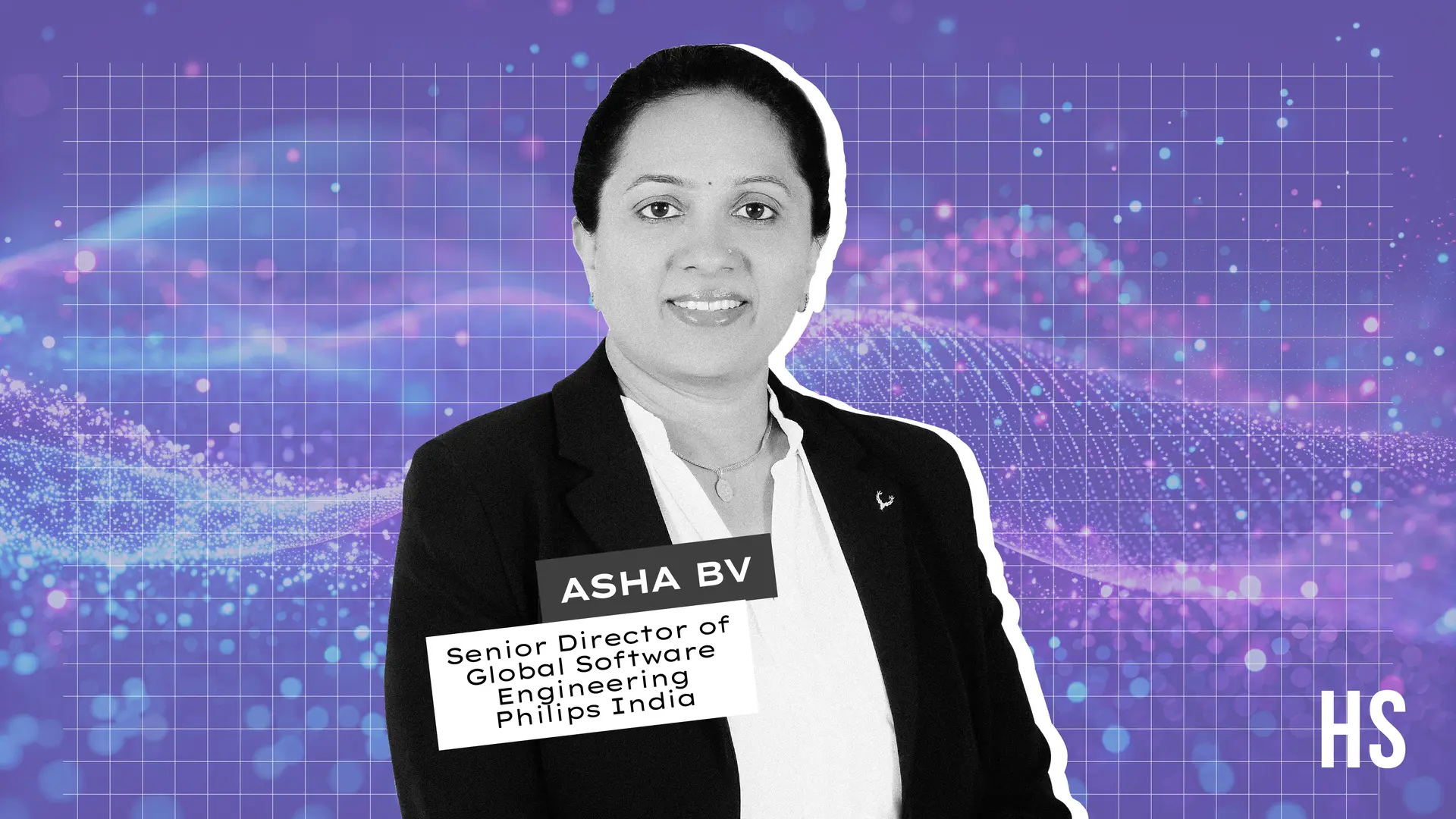

As Senior Director of Global Software Engineering at Philips India Limited, Asha BV leads the global software portfolio for the Sleep and Respiratory Care (SRC) business unit, managing teams across Bengaluru, Pune, and Pittsburgh. She also serves as the Site Leader for SRC Bengaluru, enabling and supporting systems engineering, quality management, and organisational operations.
Asha’s professional journey began at Bosch, where she was recruited off-campus following her Bachelor’s degree in Electronics and Communications.
“I started my career in the automotive powertrain domain that allowed me to deeply understand vehicle performance from basic accelerator, brake, and clutch functionalities to engine systems,” she recalls.
Later, her role expanded with stints in Germany, where she was notably the only female engineer on an entire engineering floor. After Bosch, Asha transitioned to Philips Innovation Campus Bangalore (PIC-B), taking on a global software leadership role in the Sleep and Respiratory Care business.
In an interview with HerStory, Asha shares insights from her 25+ years journey in technology, solving healthcare challenges at PIC-B and leading a diverse team of over 4,500 professionals.
Edited excerpts:
HerStory (HS): Could you walk us through your formative years and explain how you discovered your passion for STEM?
Asha BV (ABV): I was born and raised in Bengaluru, where I completed my education. Engineering happened by coincidence, influenced by the prevalent trend among peers. However, as a class topper, I quickly developed a genuine passion for engineering, specifically in electronics and communication. The potential of technology to drive innovation and positively impact society deeply intrigued me.
HS: How is PIC-B integrating AI and ML to solve real-world healthcare challenges in India and globally?
ABV: We use AI on a daily basis to complement how we work to make sure we are at our productive best. We also use AI across software engineering: designing, developing and deploying. Also, we integrate AI and ML significantly within our product solutions, such as our sleep diagnostic solutions, which are designed to assist clinicians in the assessment of sleep apnea, aiming to support diagnostic accuracy. Additionally, we utilise technology that can help in selecting appropriate therapy masks, which aims to enhance patient comfort and satisfaction.
HS: How do you prioritise focus areas for innovation across the healthcare continuum?
ABV: Innovation at SRC is driven by two core principles: “Do the right things and do things right,” and the approach of “Now, Next, and Future.” This helps us balance immediate business priorities while simultaneously planning and investing strategically for future market leadership and innovation.
HS: What are some of the biggest opportunities and challenges in leading such a large, diverse team of 4500+ professionals?
ABV: Leading a diverse team offers immense opportunities to leverage varied talent and perspectives for holistic and impactful solutions. However, large teams also face challenges in change management, aligning everyone to a unified vision, and effectively communicating strategic priorities across various organisational levels. At Philips SRC, I have been able to marshal the team across the world towards a shared purpose, enabling the team to focus on driving impact with care by strengthening our commitment to advancing sleep and respiratory care solutions.
HS: How do you ensure that the solutions developed here address diverse healthcare needs in both developed and emerging markets?
ABV: Our approach is global yet mindful of local nuances. We actively gather market insights from around the world and tailor our solutions accordingly. In emerging markets like India, beyond technological innovation, we focus on creating awareness and education around healthcare issues such as sleep disorders. Product availability, features, and performance may vary by market, and are subject to applicable regulatory requirements.
HS: What have been your biggest successes and challenges?
ABV: I have been able to take on roles that were traditionally not considered by women. Early in my career, I worked as an independent contributor at a global level, working towards significantly bridging the gap between engineering and quality assurance. As a quality champion, I was instrumental in establishing strong value for the enterprise that the role, which was historically outside India, was moved to India.
At Philips, I am looking at contributing to strategic initiatives within the software organisation of SRC. This involves equipping the team to navigate the complex global regulatory landscapes with an intrapreneurial as well as solution mindset.
HS: What are the biggest challenges faced by women in tech?
ABV: Women frequently face societal expectations, balancing family and career, maternity impacts, and self-doubt regarding their professional capabilities. This internal self-questioning, despite their competence, often hampers their career progression.
HS: Have you faced any gender-specific challenges in your career?
AVB: As a person, I am assertive in seizing opportunities, which has helped me in staying competitive and progress through my career. I would also attribute my success to the motivation from family and friends as well as mentors and coaches in the companies that I was associated with. In short, I was accepted the way I was. Having said that, such a disposition is not common. Women do face challenges, and some are strongly impacted by it. I strongly believe that such challenges emphasise the need for proactive communication and advocating for oneself.
HS: What steps is PIC-B taking to build an inclusive and diverse workforce, especially for women in tech and leadership?
AVB: PIC-B actively promotes gender inclusivity through targeted programs like mentorship, financial independence training, mental wellness, leadership development, and forums like "Sakhi" and "Men as Allies."
Under the ERG – India Philips Women Lead – we have strategic interventions that would help women employees at various levels. For example, sessions to strongly align ‘vibrant millennials’ with the company’s purpose; work-life integration skills or return-to-work sessions for ‘ascending professionals'. There are tailored programs for ‘Mid-level leaders’ and ‘adept allys’ like Men as advocates.
In addition, we also run programs specially catering to women in technology, helping them develop their skills and advance into technology leadership roles.
HS: What would you tell young professionals aspiring to reach leadership roles in tech?
ABV: Stay continuously curious, embrace lifelong learning, and always strive for relevance. Passion and genuine interest in your work are critical. Adopt an agile mindset, remain assertive without fear of judgment, and actively seek opportunities for growth and innovation.
HS: What are your future goals?
ABV: My immediate goal is to contribute to my business area's continued development and future readiness. Personally speaking, I want to play a pivotal role in the emerging future that will be dominated by digital solutions.
Edited by Megha Reddy