



How two sisters are using AI to transform women's healthcare in India
The Aaroogya AI Foundation, led by sisters Priyanjali and Shyanjali Datta, is pioneering women’s healthcare through AI-led integration for underserved women (users) with human intervention of Community Healthcare Workers (CHWs).



Sisters Dr Priyanjali and Shyanjali Datta grew up in Meghalaya watching their family navigate a healthcare system that seemed designed to fail women. Their personal struggles would lead to the Aaroogya AI Foundation, an AI-native nonprofit organisation formed in 2017.
Shyanjali Datta was born with locomotor disabilities and faced multiple surgeries from when she was only 15 months old. The first surgery itself was unnecessary due to a misdiagnosis. "It over-complicated my condition that I had to live with throughout my life," Shyanjali shares with HerStory.
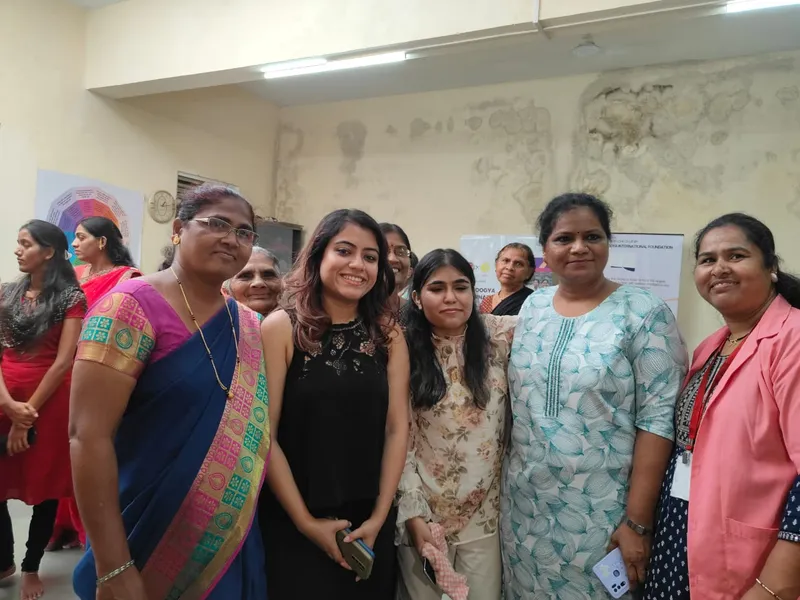
Priyanjali (in black) and Shyanjali (floral shirt) on ground in Pune
The family's struggles took another serious turn when their mother was diagnosed with essential thrombocytosis, a rare genetic condition.
"We spent months researching and reaching out to Johns Hopkins University for clinical trials, but not much was done for women's health," Priyanjali explains. Their mother has been taking daily chemotherapy pills for eight years to suppress her immunity and prevent platelet overproduction.
These experiences planted what Priyanjali calls "hammers in my mind", leading her to think extensively about healthcare's systemic failures, particularly for women.
While studying dental surgery at ESIC in Delhi, she also saw firsthand how healthcare remained "highly disorganised, reactive, fragmented, and completely disjointed, especially for women." She saw underprivileged women arriving at the hospital in advanced stages of breast cancer, having sold their homes and land for treatment that came too late.
"During my education, I noticed that healthcare is fragmented, and in the last few centuries, women hardly got the opportunity to share their perspective, and it was never part of the research," she remarks.
At 19, while in her second year of college, Priyanjali began researching artificial intelligence applications in healthcare. "What we see in generative AI today is maybe 5% of artificial intelligence, but AI has existed since 1958. I found artificial intelligence can solve these issues at its root,” she explains.
Shyanjali joined the venture when she was just 13, shaped by her own experiences and challenges with the healthcare system.
She was frustrated with the limited medical information online, and the low connectivity in Shillong didn’t help either. She decided to work with her sister to build competent systems for healthcare.
This was long before ChatGPT revolutionised AI. "I remember she was using papers and pens to create the first back-end logic, like the mathematical equations to create the first gen AI," Shyanjali recalls with pride.
Shyanjali started at Aaroogya as a social media intern, moved onto the role of project manager, and along the way, fell in love with UX and UI design. When OpenAI launched, she started studying it rigorously. Currently, she is CEO of Aaroogya.
Scaling healthcare impact through AI
Priyanjali started Aaroogya along with Dr Dhruv Kacker, a Johns Hopkins alumnus, who she had met at ESIC (he now serves as adviser of Aaaroogya) and conducted door-to-door awareness campaigns in Meghalaya in 2016, before officially incorporating the nonprofit on August 3, 2017.
The first initiative was to teach women breast self-examination, provide awareness about sexually transmitted infections, menstrual cycles, PCOS, endometriosis, and cervical cancer.
"With Meghalaya being a women-driven community, it was a little easier because there was more acceptance," Priyanjali notes about the early outreach efforts with ASHAs (community health workers) and Anganwadi workers.
The breakthrough came in the western UP belt near the Yamuna river tributary, Hindon, where they covered almost 800 villages. This experience convinced the sisters that AI could scale their impact exponentially.
As CEO, Shyanjali Datta has led the development and rollout of MyHealthline app, an AI-powered health companion that is available in local languages and accessible to women with limited literacy. It operates through a two-tier assessment process that empowers both community health workers and the women they serve.
The trained community health workers go door-to-door in underserved areas, where they introduce the app and also provide basic health awareness.
The initial user experience starts with a comprehensive General Assessment (GA) that covers multiple health conditions. "During the GA, we take questionnaires on every health condition. For example, three sets of questions would be about mental health, three sets of questions would be about breast health… then three sets of questions about UTI, three sets of questions about PCOS, and so on," Shyanjali explains.
Going beyond simple questionnaires, the system incorporates image analysis of blood tests and radiographs, sometimes using thermal cameras for more accurate assessment. "Images talk better in AI than textual input," Priyanjali says.
Once the assessment is complete, both the community health worker and the woman access the Active Integrated Wellness Dashboard (AIWD), Aaroogya's core intellectual property. This dashboard translates complex medical data into intuitive, accessible information with minimal technical jargon.
The dashboard presents risk scores in easy-to-understand terms. "If I scored eight out of 10, it means I am at high risk of a certain condition. And we also see which condition"
"Our core IP is an active integrated wellness dashboard that brings nutrition together, mental health together, gynaecological health, hormonal health, sleep, every specialisation together to make an integrated wellness plan for the woman,” she adds.
Based on the general assessment results, women can proceed to condition-specific evaluations. For instance, if PCOS is flagged, the system conducts a specialised assessment.
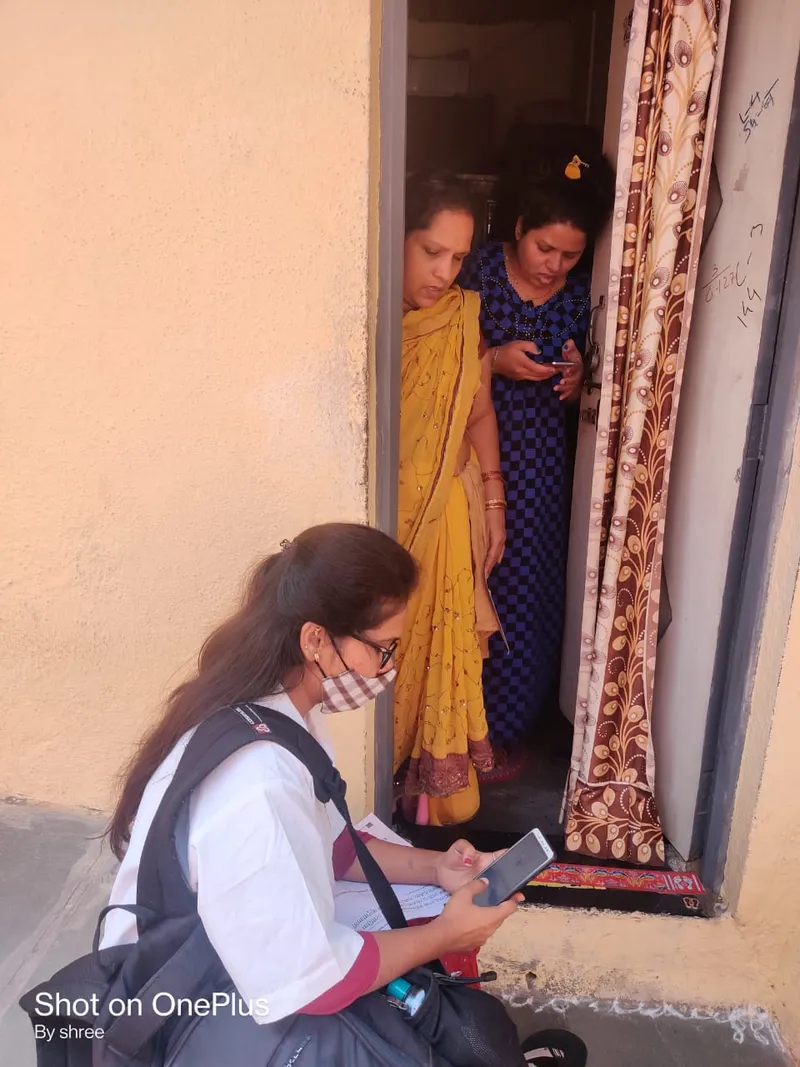
A community worker in Pune
The platform captures both primary and secondary symptoms through images and detailed questioning.
Empowering community health workers
The system transforms community health workers from basic awareness providers into equipped health advocates. The AI amplifies their capabilities.
The platform strives to maintain ethical boundaries throughout the process. "We never say that you are at higher risk of PCOS. What we say is, if you are at higher risk of PCOS, we would like you to connect with some doctors and health specialists. And these are the diagnostic recommendations you can go through,” says Priyanjali.
The system then facilitates connections with healthcare providers, prioritising government hospitals where available, and helps women navigate existing healthcare schemes like Ayushman Bharat. Community health workers assist those unable to access healthcare independently, while the platform helps users maintain their health IDs and previous medical records.
Interestingly, this two-pronged approach ensures the platform serves as an educational tool and an early warning system.
In Maharashtra's Pune district, the nonprofit’s flagship project has achieved remarkable scale with the highest count of AI doorstep screening for women. It has served 30,000 women in Pune in the last five years.
In 2019-20, with support from Millennium Alliance, it expanded to East Africa and Uganda, licensing its technology to partner organisations through government support. Key early supporters included Nudge Foundation, which incubated the platform in its third tech cohort, and Cisco, which provided the first significant funding.
Rather than building a traditional NGO, the sisters developed a licensing business model, partnering with organisations and providing training.
A next-generation platform
Priyanjali stepped down as CEO in 2021 to pursue other career opportunities. While she continues as adviser, Shyanjali is leading the development of the next-generation platform: Aaha, an agentic AI system.
The new platform will be voice-first and conversational, supporting all Indian vernacular languages while reducing cognitive load and medical jargon.
Aaroogya’s work has been featured by Stanford University, and more recently, the Gates Foundation selected it for a documentary series on impact leaders, highlighting women doing innovative work in India.
Nonetheless, there were diverse challenges in the journey.
“When we started with the AI product, everyone, including people from college, asked, ‘What is this utopian concept? Why are you wasting your time?’ It didn’t help that her peers went to Stanford and Harvard for their master’s while she was tagged as “someone doing crazy, stupid stuff.”
For Shyanjali, leadership brought emotional challenges. “I was questioning myself, how will I run the organisation where I'm being too empathetic? Sometimes being too emotional also leads to not making strategic decisions,” she admits.
So far, the foundation has screened 135,000+ women across India and East Africa, detected 1,759+ early-stage cases (cancer, PCOS, diabetes) and trained 4,000+ women health workers to become AI-powered agents of care.
The sisters have set ambitious targets: training 100,000 community healthcare workers by 2030 and reaching 500,000 women across India, Africa, and other countries through their agentic AI system.
Edited by Kanishk Singh