



How Dipa Ghindani is exploring the frontiers of science as part of Harvard’s Capasso Group
From a small town in Maharashtra to Harvard University, Dipa Ghindani’s story is a journey spanning continents and multiple disciplines. As part of the renowned Capasso Group at Harvard, she is working on advanced materials and nanotechnology.

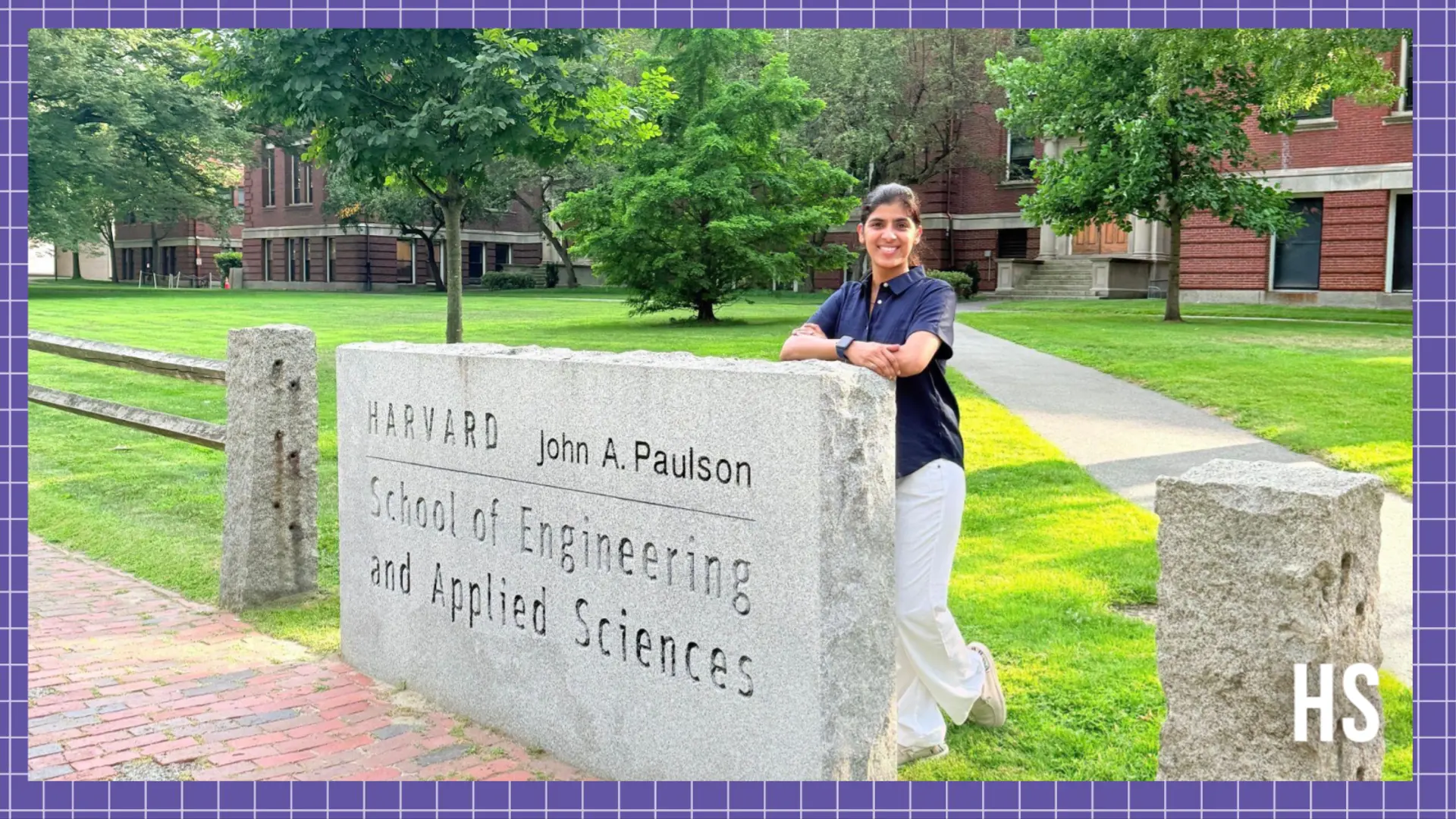

Growing up in the small town of Badnera in Maharashtra’s Amravati district, Dipa Ghindani was curious about everything around her. Her father, a shopkeeper with a love for books, encouraged her endless questions. Her mother, a designer, brought in a keen sense of creativity and adventure. Her older brother cheered her on, and answered even her silliest questions.
“I grew up in a family where curiosity was celebrated. My persistence, curiosity, and sense of wonder came from that supportive environment,” recalls Ghindani.
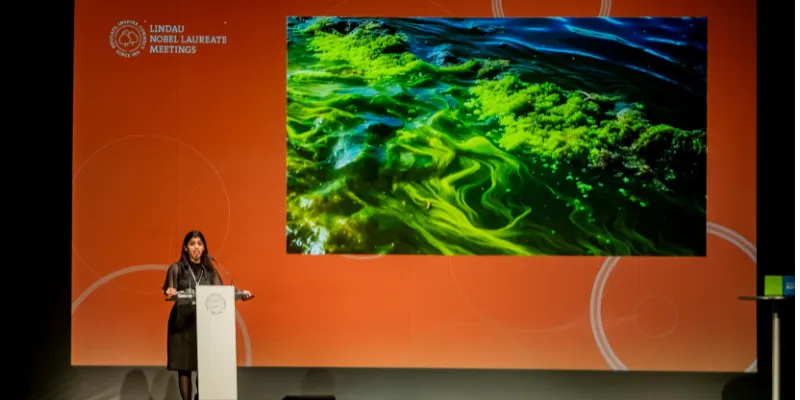
Dipa delivering a talk at the 2024 Lindau Nobel Laureate Meeting. (Photo courtesy – Patrick Kunkel)
This curiosity would take her places, as she completed a master’s thesis at IIT-Bombay, research at Tata Institute of Fundamental Research, a prestigious fellowship in Germany, and a PhD from Tampere University, Finland. It also took her all the way to Harvard University in 2023, where she joined as a post-doctoral fellow with the world-renowned Capasso Group led by Federico Capasso, one of the most celebrated physicists of our time, also known as the ‘modern-day Einstein’.
Steps towards a career in STEM
Ghindani fondly remembers that learning at Manibai Gujrati High School was never by rote. The teachers took students to museums, played educational films, and sparked a love for science through experiments. This inculcated in her an early and continuous love for science.
She then completed a degree in electronics and communication engineering at Amravati University. Her work on solar panel efficiency led her to IIT-Bombay for her master’s project where she was exposed to advanced labs and hands-on research.
“I realised that I was particularly interested in how light interacts with matter, how it is having this quiet conversation with matter,” she explains.
This fascination took her to one of the country’s premier scientific institutions, Tata Institute of Fundamental Research (TIFR). “I immersed myself in micro and nanostructures and learned the value of persistence and curiosity in solving complex problems. I became an experimentalist,” she says.
She went on to win the Best Project Award at TIFR’s prestigious Visiting Student Research Program.
Following this, Ghindani bagged the Helmholtz Fellowship in Germany where she did a groundbreaking project on tunable terahertz metasurfaces. She developed a novel ‘Pattern and Peel’ technique to create microstructures on flexible films. It was the first demonstration of its kind.
She then moved to Finland for a PhD at Tampere University, where she had to work through nine months of winter in a year. The Finnish people, nature all around, and the overall environment encouraged her to become an independent thinker.
She spent long hours in the cleanroom working on nano-antennas as small as 50 to 100 nanometres and fell in love with photonics that continues to this day.
In 2023, she joined the Capasso Group at Harvard University, where she works on nanophotonics and tunable metasurfaces. Her research focuses on metalenses—ultrathin flat lenses made of carefully designed nanostructures that can bend and focus light with high precision, eliminating the need for bulky curved glass optics.
These next-generation lenses could transform devices such as AR glasses, smartphones, and compact imaging systems.
“We are looking to replace millimetre-thick lenses with structures just a few microns thick,” she explains. “It’s like giving light a new language.”
Apart from this, she is also working on projects in high speed communication and quantum cascade lasers. A post-doctoral fellow, she is also writing proposals for grants.
Ghindani has published more than 20 research papers and has also applied for patents. She has presented at international conferences including CLEO and Meta. Last year, she was one among 600 researchers and scientists selected from all over the world to attend the 73rd Lindau Nobel Laureate meeting in Germany.
“We spent one week with Nobel laureates, and I was one of 14 to present my work in front of them. Of the 14, they selected a few to join the Baden-Württemberg International Program where we visited different labs of different universities in Germany,” she explains.
“It was one of the most extraordinary experiences. We spent a week with 40 Nobel laureates. The laureates said they keep returning to meet young scientists and learn from us. That humility was inspiring,” she adds.
Science, setbacks, and resilience
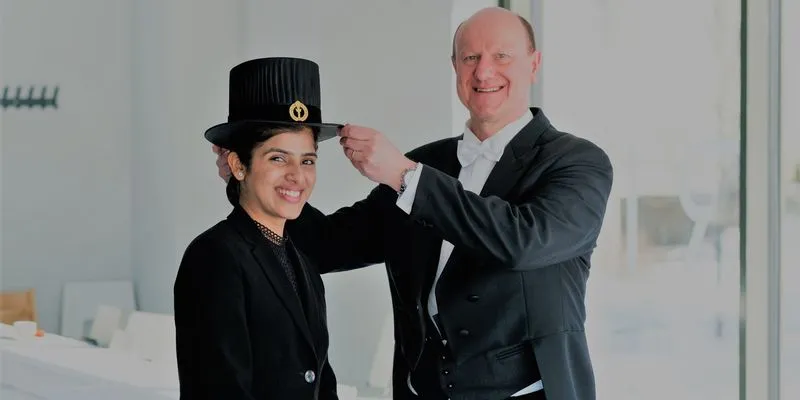
Dipa’s PhD defence, Finland (2023). (Photo courtesy – Okko Sorma)
Admissions to prestigious universities and international recognition has not come easy for Ghindani. Hers has been a journey of trial, error and persistence. She remembers spending months redesigning experiments and failing hundreds of times before finally creating a working tunable photonic device during her PhD.
“Our projects are like our babies. When something finally works after months of failure, the joy is indescribable,” she says.
As a woman in STEM, Ghindani is aware of the structural barriers in science. At TIFR’s Terahertz Lab, she was the only woman among 12 men. She believes attracting women into science today is not a challenge, but retaining them is.
“I feel science must be structured to nurture and retain talent, not just welcome it,” she says.
To this end, she advocates for longer contracts, flexible timelines, good parental leave policies, and reliable healthcare.
“Creating a supportive peer environment helps talented scientists to thrive without being held by systemic hurdles. Early exposure to STEM is missing in schools and colleges. Girls should have visible role models and encouragement,” Ghindani notes.
She borrows a quote from writer Chimamanda Ngozi Adichie to drive home this point. ”Don’t tell your girls to shrink themselves.” “In science and in life, we must teach them to be bold, to be brave, and claim space,” she emphasises.
Ghindani has always been clear that she would return to India to continue her work in science. She is also excited about taking her initiative forward—Gyanastra Foundation, a non-profit that supports underprivileged students in Maharashtra. Run with her own savings and with the help of six volunteers, the foundation supports 1,100 children with education, nutrition, and other opportunities that can unlock their potential.
In closing, she has a few words of advice for young women who want to pursue a career in science.
“Stay curious and patient. Science is about having the courage to ask questions, not knowing the answers. Every experiment that fails teaches you something valuable. Also surround yourself with people who inspire you and respect your goals.”
(The story was updated to correct some typos.)
Edited by Swetha Kannan