



How LxmePay, India’s first UPI for women, aims to turn everyday transactions into wealth-building tools
On Dhanteras, HerStory takes a look at how LxmePay helps women spend mindfully, budget effortlessly, track expenses, save, and grow their money.



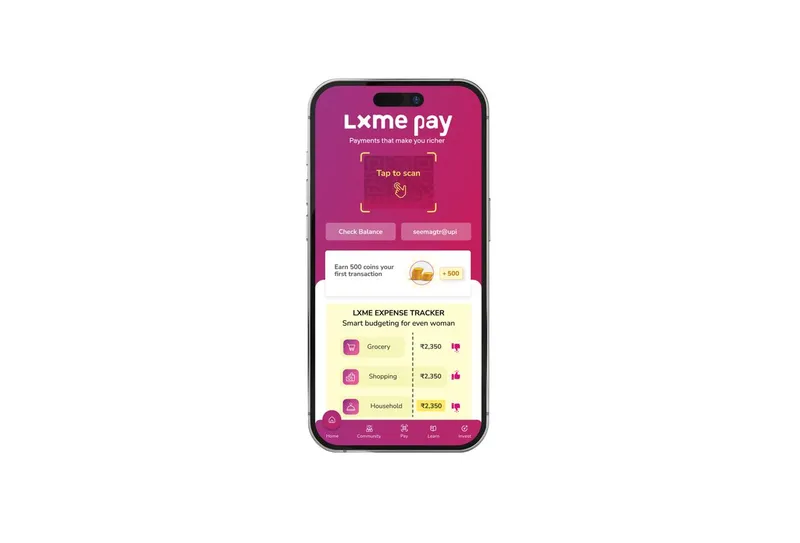
Last week, Lxme—a Mumbai-based financial platform for women—launched LxmePay, India’s first Unified Payments Interface (UPI) built exclusively for women.
Since the launch of UPI in 2016, payments in India have become swift and effortless. On the other hand, though, it has made overspending and losing track of expenses common.

Ridhi Doongursee and Priti Rathi Gupta
More than just a payment tool, LxmePay aims to turn everyday transactions into opportunities for financial growth and smarter money management for women.
Unlike conventional UPI platforms, every transaction on LxmePay earns users digital gold, helping them build long-term value rather than fleeting cashbacks. Even receiving money from another LxmePay user contributes to this growing wealth.
The platform empowers users to spend mindfully, budget effortlessly, track expenses, save, and grow their money.
HerStory spoke with Priti Rathi Gupta and Ridhi Doongursee, Co-founders of Lxme, to understand how LxmePay will help women in their financial journeys.
Edited excerpts:
HerStory [HS]: You started Lxme as a fintech platform for women in 2021. What is the growth trajectory it has seen over the years?
Priti Rathi Gupta [PRG]: We started in a space where we didn't have any historical reference point, but we knew we had a problem to solve, and we wanted to solve it.
Over the years, over 1.5 million women have downloaded the Lxme app. We have about 800,000 women engaging on the platform.
Today, if anybody knows the financial behaviour of women in India, I think it is us because we have seen them engage, and we built the platform based on their feedback. Women are a part of everything we do, and not just finance or money.
For example, you will see a feature called Vision Board on the app—a very non-intuitive way to look at a finance app—but a very intuitive way of getting women to start thinking about converting their goals and dreams to a financial goal. And, it is one of the most used tools on the app.
HS: What led to the launch of LxmePay?
PRG: Today, 200 million women are making UPI payments in India, but less than a million are investing their money. Also, a large number of women, cautious of making any financial transactions digitally, were using UPI. This opened up the funnel for us.
In marketing and management principles, it's always said you go where the customer is. Women are spending their money using UPI, and we will embed this solution in their everyday behaviour, from payments to budgeting.
HS: What features will attract women to LxmePay?
PRG: With LxmePay, we are helping a woman form a trust with payments and spending. We are also empowering her savings on two fronts. One, when she spends, how can we get curated offers for her? Most payment apps give scratch cards that one never uses.
Here, we thought, what does a woman love? She has a huge affinity for gold. So, we said, “Why don’t we enable her to save via small amounts of gold instead of a cashback?” It collects for her and also increases in value over time.
Everything on LxmePay has been built keeping in mind what women want. The payment page is structured to make it more time-efficient.
Second, every time she pays, a budgeting tool captures and places it into categories of needs, wants, and savings, where she can add limits and monitor her spending category-wise.
We have had women from the first few thousand users give us feedback like, "I didn't realise I was spending so much on food delivery." It's only when you put it together that you realise how much you've spent.
Even the campaign that we just launched says that it's not a transaction. LxmePay is enabling you to say, "How can I become my own Lakshmi?" And we really care that you do that.
Ridhi Doongursee [RD]: We are all in such a rush, and UPI has made payments so easy that we don’t know when the money flows. So, we are scared of how much we have spent, where we spent it, and what our bank balance is.
We don’t have time for hisab kitab (accounting), and at the end of the month, we are sometimes short of money. On LxmePay, women get insights on daily and monthly trends and personalised nudges like, “You spent this much, this is where you can save, starting with Rs 100.”
HS: What role do partnerships play in reaching women at scale?
PRG: We have seen that the entire ecosystem understands that reaching women is a huge need and potential. We have had a fabulous response from corporates. NPCI was keen that we launch this as the first UPI for ‘her’.
Banks have been very keen, and we decided to go ahead with Axis Bank because they understood the opportunity and the impact. We have partnered with some large merchants, the best in the category.
We have also realised that many people want to take their products to women, and we are the ideal platform for this.
HS: Who is your target audience for LxmePay?
PRG: Firstly, because it's a UPI payment, every woman is a target. Its features work for every woman—affluent, middle-income, low-income—whether she’s 25, 35, or 45 years old.
From our perspective, we have divided the world of women into two parts. First, for women already using UPI payments, we've built this entire value proposition so that they know it's not just about payments. This is their tool for “everything money.”
Second, for women who are still using a bank correspondent network or a bank account but don't use a UPI payment.
Women are earning money, and even today, it is saved in dabbas and rarely in the bank because they think they may not have full agency over it. But if a woman saves money in the right avenues, even if it is a debt mutual fund, where she has access and only she can redeem it, her ability to borrow more and better increases.
RD: When we released a report on women and money, over 90% women said they save money, but they invested in non-inflation beating instruments.
A woman who starts her career earning Rs 3-4 lakh a year and sees her income grow by 10% each year stands to lose nearly Rs 5 crore over her lifetime if she simply saves her money instead of investing it. The difference between letting savings sit idle and investing in inflating-beating financial instruments can be staggering for middle-income women in India.
That money for 80% of India is life-changing for them and the next generation.
Our target is to ensure India has a savings economy. Indian women are fabulous at saving, budgeting, putting money aside in gold, fixed deposits, chit funds, or in the cupboard. We want to ensure that the money is invested in the right instruments.
HS: It’s very early days, but what would success look like for you in terms of numbers with LxmePay?
PRG: Like I said, 200 million women are doing UPI payments. I think the sky is the limit. But we are also very conscious of the fact that when we say it's a UPI for her, we want to make sure that she's optimising her journey as well on the app. We definitely want close to two million women to be transacting on the app, doing UPI payments over the next two years.
Edited by Suman Singh