



7 myths about gender-based violence India urgently needs to unlearn
The 16 Days of Activism Against Gender-Based Violence begin with a reminder that India’s biggest barriers to women’s safety aren’t just laws or systems, but the myths that continue to endanger and invisibilise women across socioeconomic backgrounds.

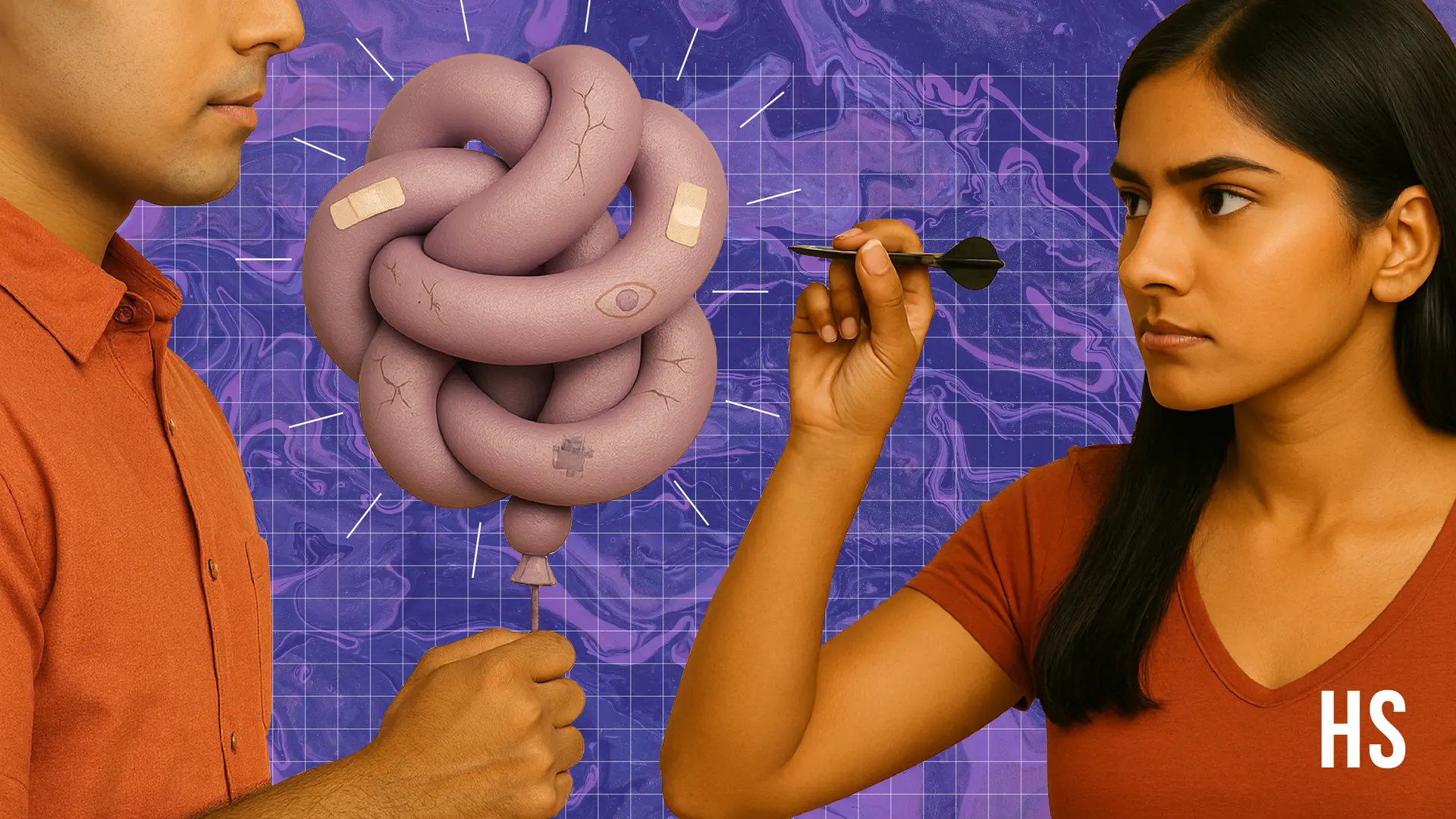

(TW: This article talks about suicidal ideation, marital rape, and domestic violence.)
Violence against women in India is often reduced to visible bruises, private quarrels—something branded as “family matters.”
However, the last decade of research from medical journals, feminist scholars, mobility studies, digital-rights groups, and national surveys shows why this idea isn’t just reductive but perpetuates critical blind spots in understanding, reporting, and bringing justice to crimes against women in India.
Countless studies show that violence isn’t only physical; it lives in psychological injuries, caste hierarchies, threats, coercion, surveillance, digital humiliation, and in marriages where consent is assumed rather than respected.
Yet, the public conversation stems from myths that flatten this complexity. Below are seven such persistent myths, and what evidence actually shows.
MYTH 1: “Violence is always physical.”
Violence is often interpreted through bruises, wounds, or visible assault. But decades of evidence show it is far broader.
A 2021 study from Assam published in the International Journal of Research and Analytical Reviews (IJRAR) clearly states, “Violence against women does not mean only physical violence. It includes sexual, emotional, psychological, and financial abuse.”
Emotional manipulation, threats, deprivation of liberty, coercive control, denial of money, forced dependency, and sexual violence—all qualify as harm.
IJRAR reports that 40% of survivors experience poor mental health, with violence leading to depression, PTSD and anxiety. Some also reported having suicidal thoughts or attempted suicide.
A 2024 Lippincott Williams & Wilkins Journal study further confirms that non-physical forms of intimate partner violence carry similar psychological burdens as physical assault.
When policies, healthcare systems, or society recognise only physical injuries, countless women experiencing invisible violence remain unsupported and unheard.
MYTH 2: “Good families don’t do this.”
The idea that violence happens only in “bad,” “broken,” or lower-income households is one of the most harmful cultural myths. Research and survivor testimonies repeatedly show that abuse cuts across class, caste, religion, education and “respectability”.
A review of Indian mythologies and household narratives on Round Table India illustrates how cultural stories often create a fiction of purity around “respectable families,” masking the violence within.
Academic work on intimate partner violence (IPV) reinforces this. Sathe et al.’s 2024 study on IPV and mental health found that women from educated, professional, and higher-income families reported significant rates of emotional and sexual abuse.
Violence thrives not because of socioeconomic status, but because of power hierarchies, besides fear and stigma around reporting.
This myth persists because women in socially “respectable” homes face immense pressure to maintain appearances. It isolates survivors who fear they will not be believed, or worse, accused of damaging family honour.
When society assumes “good families” are incapable of harm, it creates a culture where violence hides in plain sight.
MYTH 3: “Dalit women lie for attention.”
This stereotype is a documented pattern across courts, police stations, and media discourse. Research shows that Dalit and Adivasi women underreport violence, not exaggerate it.
A 2024 study in BioMed Central Women’s Health found that women from the Scheduled Castes experience some of the highest rates of intimate partner violence, shaped by both gender and caste hierarchies.
Dalit women’s collectives such as the All India Dalit Mahila Adhikar Manch, along with analyses by the National Commission for Women and the Human Rights Law Network, show that the police frequently dismiss their complaints as “baseless,” “revenge,” or “for attention,” reflecting deeply rooted caste biases.
Feminist legal scholars from Project 39A and the National Law School of India University have documented how courts question Dalit women’s motives, framing allegations as “exaggerated” or “politically motivated,” especially in sexual-violence and caste-atrocity cases.
Media backlash in cases like Hathras, Jalore, and Unnao further reveals how Dalit survivors are accused of “cooking up stories” or “inventing caste angles.” These narratives delegitimise real violence and silence marginalised women whose testimonies already face institutional disbelief, weaken accountability, and reinforce caste power, making justice even more inaccessible.
MYTH 4: “Harassment in public spaces is just ‘eve-teasing’.”
Public harassment is often trivialised as harmless mischief, but contemporary feminist research defines it as “public-space sexual harassment (PSSH)”.
Studies by the Institute for Transportation and Development Policy - India, Azim Premji University Mobility Studies, and others conducted between 2023 and 2025 highlight how PSSH is not an isolated nuisance but a structural barrier to women’s mobility, safety, mental health, and workforce participation.
Research has shown that PSSH restricts women’s freedom of movement and limits their capability to access education and employment. It further demonstrates that women routinely avoid buses, metro stations, public parks, markets, and colleges due to harassment fears.
Calling harassment “eve-teasing” diminishes the seriousness of stalking, touching, verbal aggression, and sexual intimidation. It normalises unsafe streets and shifts responsibility onto women to avoid danger rather than demanding accountability from perpetrators and institutions.
MYTH 5: “If she really wanted help, she would report.”
Silence is frequently misread as consent, cowardice, or exaggeration. But research shows that reporting violence is extremely difficult for women in India. A study of married women cited on ResearchGate found that only 14% of women who experienced physical or sexual violence sought help from any source.
Barriers include fear of retaliation, economic dependence, stigma, community pressure, caste and religious hierarchies, threats to children, and mistrust of police. These barriers multiply for Dalit, Adivasi, migrant, and minority women.
Workplace harassment follows similar patterns. Multiple studies show that women hesitate to report Prevention of Sexual Harassment (PoSH) violations due to fear of job loss, employer retaliation, opaque internal committee processes, and a lack of safe mechanisms, especially in the unorganised sector and among gig workers.
This myth shifts responsibility away from perpetrators and institutions and onto survivors. It ignores structural failures, discourages victims from seeking support, and allows violence to continue unchallenged.
MYTH 6: “Online abuse is harmless.”
Digital violence is often dismissed as “trolling,” but evidence consistently shows it causes profound psychological and social harm. A Hindi–English aggression corpus study on arXiv—an open-access repository for scientific research—demonstrates the prevalence and severity of online harassment in Indian digital spaces.
A 2024 paper by Sharda S., Vaidya R. and Rao G. on technology-facilitated gender-based violence documents severe emotional trauma among women targeted through stalking, doxxing, threats, impersonation, and intimate-image abuse. The Equality Now (2024) India report shows that victims experience panic attacks, chronic anxiety, suicidal thoughts, school dropout, and social withdrawal.
Experts at the National Institute of Mental Health and Neurosciences have also highlighted the mental health crisis caused by digital sexual exploitation among teenage girls.
Online abuse does not just remain online. It goes on to restrict women’s mobility, silences them, affects employment, and can escalate into offline harm. Dismissing it as harmless leaves women without protection in one of the fastest-growing arenas of violence.
MYTH 7: “Marital rape isn’t real rape because consent is implied in marriage.”
India remains one of the few large democracies that still retains the marital rape exception—a colonial-era clause stating that sex by a husband with his wife over 18 years of age is not rape. This legal loophole reinforces the belief that marriage grants permanent sexual consent.
Data from the National Family Health Survey (NFHS-5) shows that nearly one in three married women has experienced sexual violence from her husband.
Studies by the Centre for Enquiry into Health and Allied Themes, the International Centre for Research on Women, and the United Nations Population Fund document forced sex, physical restraint, threats, coerced pregnancy, and denial of contraception—all of which align with globally recognised definitions of rape.
A 2024 study in the Indian Journal of Community Medicine reports high rates of depression, post-traumatic stress disorder (PTSD), anxiety, and suicidal ideation among survivors of marital sexual violence.
The following national helplines can be contacted for support, emergency assistance, or guidance in cases of violence: National Commission for Women’s 24x7 helpline: 7827170170, Women’s Helpline (Police) – 1091, Cyber Crime Helpline – 1930
Edited by Suman Singh