



Producer Aditi Anand on gender, caste, and why cinema is India’s national language
Film producer Aditi Anand, who leads Neelam Studios and Little Red Car Films, is riding high on the success of her Tamil film, Bison. Her body of work ranges from acclaimed mainstream titles to socially rooted cinema.

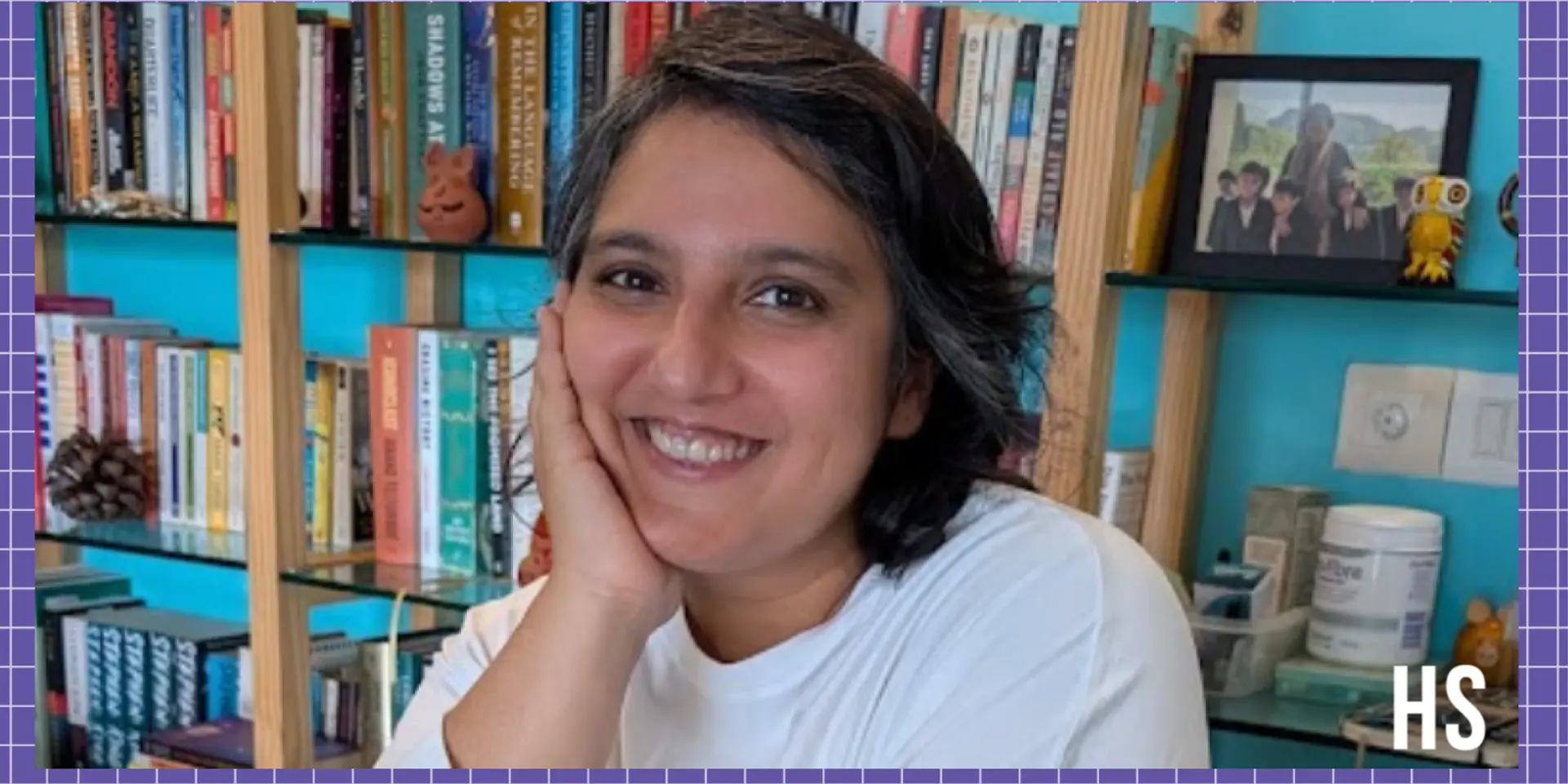

Aditi Anand grew up watching Main Khiladi Tu Anari over 600 times. She had no other choice—her family owned only two VHS cassettes, the other one being Born Free. There was no cable TV, and entertainment was limited.
She jokes that her parents stopped watching films when Amitabh Bachchan stopped being angry. Anand initially wanted to join the army, then become a war journalist, but fate had other plans.
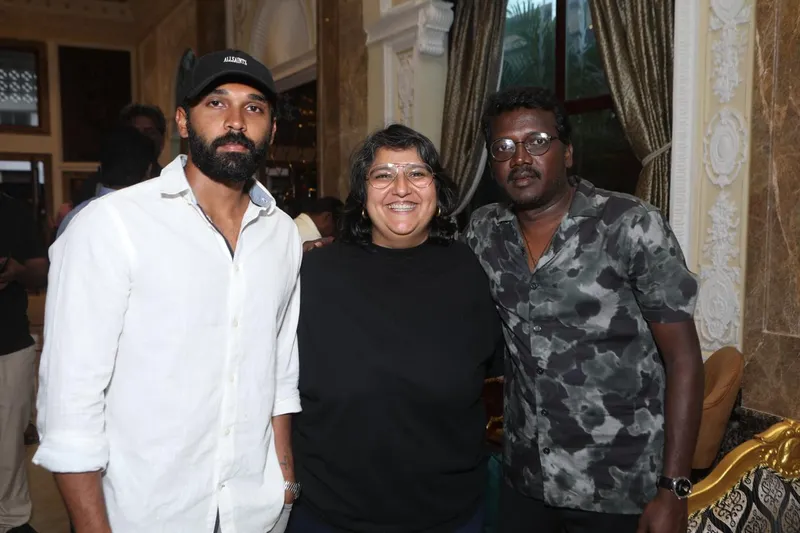
Team Bison - Aditi Anand (middle) with Dhruv Vikram and Mari Selvaraj
As a student of history at Miranda House, Delhi, she hoped to tell stories of India’s history outside academia. Since documentaries had not gained the popularity they enjoy now, she ended up at Whistling Woods International in Mumbai to study films.
“It was not hard to be bitten by the big screen bug when you are in Mumbai. I realised that the kind of films that I liked to watch were not the kind of films that I would be able to direct because I like very visual films. I wanted to be involved with stories and building projects from the ground up. A producer’s role is powerful because you have that opportunity,” she tells HerStory.
The first few years were rewarding. Anand worked on films like Tere Bin Laden and Paan Singh Tomar that were well-received. The Extraordinary Journey of the Fakir, with actor Dhanush, did well internationally but crashed and burned in India. She established Little Red Car Films, which engages in service production for international non-fiction projects.
The turning point
Purely out of obligation to its producer Dhanush, Anand went to watch Rajnikanth-starrer Kaala, directed by Pa. Ranjith.
One scene changed everything.
"Towards the end, there's the scene with the colours. Ranjith managed to tell the entire history of an important political movement in that one sequence,” Anand describes. She messaged the director saying she loved the film. He replied immediately, she met him the next day, and soon, Anand started working in Tamil Nadu.
But the turning point had quietly taken shape long before Kaala came along.
Just before she watched Kaala, there was an incident in Delhi. A bar ran an event by an independent musician called "Bhangi Jumping" (bhangi is an offensive casteist slur).
“That's a word used commonly in Delhi that goes unnoticed. But I started seeing the commentary responding to it, and the pushback revealed such obvious casteism. As an urban Indian, you feel you have grown up in a post-caste world, but once you start noticing the ubiquitous nature of caste, it's everywhere,” she explains.
Anand wanted to associate with Pa Ranjith because he was “flipping the narrative”, and with Neelam Publishing, Neelam Social, and Casteless Collective, he was also a cultural ambassador.
Through Ranjith, she met director, screenwriter, producer and lyricist Mari Selvaraj.
“What I admire about both directors is that they are never closed off to allyship. Many cultural mastheads of movements are so closed off to allyship that it cuts off any possibility for engagement. These directors allow allyship to be part of their cultural growth. You can see self-reflexivity in their films, including Bison,” she elaborates. Bison is Anand’s recent film as producer, directed by Selvaraj.
She co-founded Neelam Studios with Pa Ranjith, a creative home for their joint projects.
"For me, it comes down to the filmmaker and their voice. Commercial success is a factor of many things, including luck. But you need something truly authentic because cinema-going audiences can smell inauthenticity instantly. You need someone with a powerful, emotional voice who can create content where audiences see themselves or part of themselves on screen,” she reiterates.
When Bison became a commercial success, suddenly everyone wanted to know how she balanced creative risk with commercial reality.
Anand rightly points out that cinema is an emotional medium, and as a producer, balance isn’t just creativity versus commercial, it’s about balancing risk.
“Someone told me recently: when you start making a film, you have to be willing to lose that amount of money. You need to understand what amount you are willing to lose, and that's where you start. Then you earn it back,” she says.
Experience in Indian cinema
Anand describes her experience in Tamil cinema in two silos: one as a student of cinema, producer, and citizen that has been "fantastic” and the other as a woman and female producer, "terrible." When she went to a meeting along with a male assistant, the investor only spoke to him the entire time.
"There is so much respect for men that it crosses into worship. You either enter the realm of worship or you don't get respect at all. I think it’s bad for the Tamil film industry because it's holding it back from certain voices and stories. Apart from Sudha Kongara, how many female filmmakers are there? How many female writers are there?” she asks.
She is proud that the Bison set was run by two women, the first assistant director and the executive producer.
When asked whether Indian cinema operates in silos, with Malayalam leading experimentation and Hindi prioritising commercial viability, she points to deeper factors like culture, infrastructure, and market size.
"You won’t see the experimentation in Malayalam cinema, in Hindi. Telugu films have a huge screen density and good infrastructural support for theatres. In Malayalam, you can make a wonderful film with great production value in one and a half to two crores. Marketing costs are so low. In Hindi, I'll spend three-and-a-half to four crores to get a 300-print release, which is nothing. In Malayalam cinema, 40-50 lakhs gets you very good marketing and distribution,” she explains.
Also, Mumbai used to be the home of family films. "Now Hindi films can no longer succeed as family films because families can't afford to come to theatres. So Hindi cinema is trying to reinvent itself as a single male hero industry,” she adds.
Anand spent 20 days on the Bison set and felt inspired enough to think of direction. “But I want to find my voice. I haven't yet found it. I need to find it,” she says.
Fight well fought
Apart from being a film producer, Anand is also a LGBTQ+ rights activist; she and her partner Susan were among the petitioners in the equal marriage case before the Supreme Court.
Though the court rejected the demand for a constitutional right to same-sex marriage, Anand says sometimes it’s not about the win, but about a fight well fought.
“I think because we lost, something more powerful will happen: culture is going to pull the nation, pull the courts into the future. Culture will pull the executive forward. I believe that in spite of the very loud voices, the vast majority of Indians treat marriage as such a sacred construct that there is more positivity for equal marriage than against it. India is unique in that respect,” she asserts.
Anand admits that “we have miles to go when it comes to queer representation in cinema.”
“People like me in the film industry will have to get it together, have the guts and bravery to tell our own stories. I don't think anybody else will do it for me. If I want to tell the story of hope, it's a story I have to tell because this is what I can tell from my heart,” she says.
When asked what drew her to cinema, she returns to the beginning: "I never came to films to make films. I came because cinema is powerful and can change the world in small ways, at least to have conversations. Cinema is India's national language in a way, it really joins us as a country."
Edited by Jyoti Narayan