



How a village craft became a livelihood for hundreds of women in West Bengal
In Nanoor, a small village near Santiniketan, kantha embroidery was once a domestic practice shaped by reuse and necessity. Tajkira Begum transformed it into a women-led enterprise carrying memory, dignity and income far beyond the household.

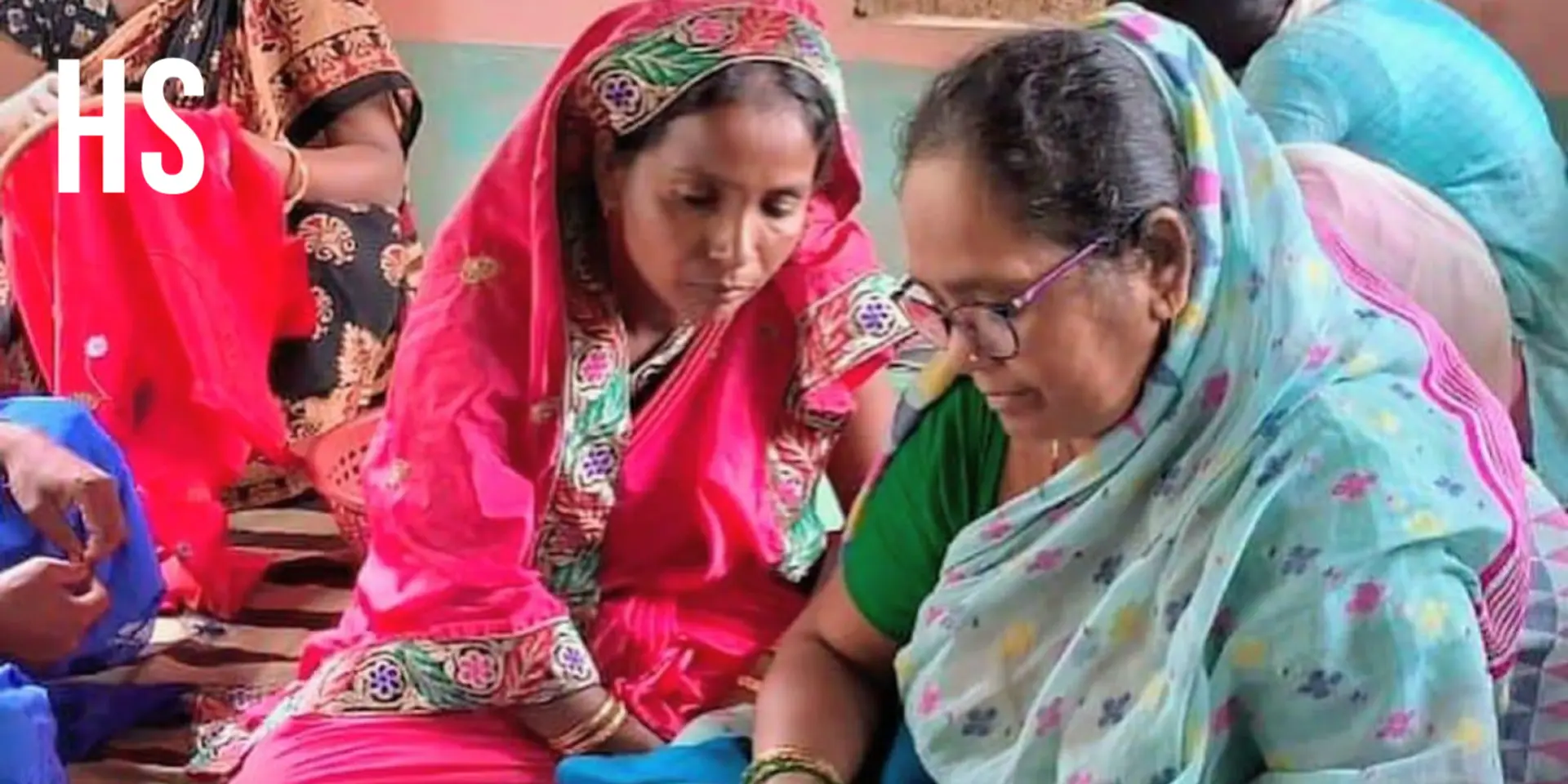

Tajkira Begum learned kantha embroidery the way many girls in her village of Nanoor in West Bengal did—by watching other women. She was about seven years old when her mother and grandmother began letting her sit beside them, needle in hand, as they stitched together layers of old, worn cloth. “There were no lessons, no talk of skill or livelihood. We did what we had been doing for generations, quite naturally,” says Begum.
This traditional form of hand embroidery practised across parts of West Bengal and Bangladesh, is known for its simple running stitch worked over layers of fabric.
Historically, it emerged from reuse of worn saris, dhotis or cloth scraps layered together and stitched by hand, often by women inside their homes. The motifs were drawn from everyday life: flowers, animals, folk symbols, religious imagery, or scenes from nature, stitched slowly over weeks or months.
Begum grew up in Nanoor, near Santiniketan, and has lived there all her life. Married within a few kilometres of her village, her world remained familiar and close-knit. In those years, kantha was not something you sold, it was instead part of domestic life - a way of reusing what little you had and preparing for winter. Old clothes were never thrown away. Two or three layers were stitched together into quilts that kept families warm, laid out when guests arrived, or given as parting gifts.
“There was a custom,” says Begum, “that when a girl got married, she should know some handwork. She had to take three or four kanthas with her as part of her wedding gifts.” The finest kantha in the household was carefully preserved and set aside for special occasions.
Today, that same domestic craft sustains a women-led social enterprise involving more than 300 women artisans from Nanoor and surrounding villages, producing kantha-embroidered dupattas, stoles, wraps and home furnishings for urban Indian and international markets. What began as survival stitching inside homes has become a collective livelihood rooted in skill, memory and shared labour.
Back then, poverty shaped everything, says Begum. “Meals were uncertain, and even cooking rice once a day was difficult. Many people ate only one meal.” Kantha existed even within this scarcity as an art tradition that was followed naturally.
The turning point came in 2002, when a self-help group was formed in the village with the support of Banglanatak.com, an organisation working on rural livelihoods and craft-based enterprises. For the first time, women could access small bank loans ranging from Rs 5,000 to Rs 10,000. “Before that, we were barely managing,” says Begum.
Through the SHG came training programmes supported by government departments, and what changed was not the art of kantha itself, but where it was applied. The same stitches women had always used on old cloth were now worked onto new fabric. Artisans were trained to adapt traditional motifs to contemporary products, and household quilts slowly gave way to dupattas, stoles and wraps. These pieces began travelling beyond the village to nearby towns and cities.
“With the money we earned, we could buy books for our children and manage household expenses,” says Begum. “Our generational craft gave some relief, stability and breathing room for families that were poverty-stricken. We didn’t know this could be possible.”
For Begum, the work also opened up a world she had never imagined. “At first, it was very difficult,” she says. “I had never travelled much before, even within India.” Through exhibitions and markets, she found herself travelling across the country, and then abroad to Paris and Japan. The journeys were new and daunting, but also exciting.
“We slowly understood pricing,” explains Begum. “We learnt that the same product has different value in different places. A stole that sold for Rs 900 in the village could sell for Rs 1,200 in a city, and even more abroad.” This understanding did not come from formal business training, but through watching, listening and experience. “Earlier, even earning Rs 5,000 a month felt like a miracle,” she says. “Over time, we became more confident.”
As women began earning, the village itself began to change. “There was a time when it was believed that women could not earn,” says Begum. With time, even modest incomes shifted that belief. Families could keep children in school, debts reduced and most importantly, women’s labour, which was once invisible, began to be taken seriously.
“Earlier, even buying sweets or ice cream for our children was impossible,” she says. “Today, these small joys have become possible.”
Visitors to Nanoor now include buyers, researchers, and craft practitioners from India and abroad. But for Begum, the most meaningful change remained close to home. “In a village where there was once nothing, doctors and teachers emerged, as children got educated,” she says.
Kantha, she believes, has never been a static art. It has always adapted - first to poverty, then to new opportunities. What matters is that it remains rooted in women’s lives. “The work gave us dignity, stability, and the ability to help one another,” she says.
Today, the stitches Begum learned as a child - meant once only for home - sustain families, educate children, and anchor an entire community. “The best kantha is no longer kept aside only for weddings,” she says. “It travels, carries our stories, and returns value.”
Edited by Affirunisa Kankudti