



Why girls’ hostels will matter in higher education in India
In the Union Budget 2026–27, Finance Minister Nirmala Sitharaman announced a girls' hostel in every district. We examine how this move could transform how young women pursue higher education.


In this year’s Union Budget, the share of the gender budget has risen to 9.37%—up from 8.86% last year. The Gender Budget Statement (GBS) reports an allocation of Rs 5 lakh crore for women and girls, a 11.36% jump from last year’s Rs 4.40 lakh crore.
In public finance terms, this signals not just spending for women, but spending designed through a gender lens. And, this lens is clear in one significant announcement made by the Finance Minister.
"In higher education, STEM institutes' prolonged hours of studying and laboratory work pose some challenges for the girl students. Through VGF (Viability Gap Funding) or capital support, one girls' hostel will be established in every district," she announced on Sunday in the parliament.
According to the All India Survey on Higher Education (AISHE) report 2021-22, women’s participation in higher education has witnessed significant growth, with female enrolment rising 32% from 1.57 crore in 2014-15 to 2.07 crore in 2021-22.
This progress is especially evident in fields like medical science, social science, and the arts, where women are now leading the charge in enrolment. In 2021-22, out of the total enrolment in UG, PG, PhD. and M.Phil. levels, 57.2 lakh students were enrolled in the science stream, with female students (29.8 lakh) outnumbering male students (27.4 lakh).
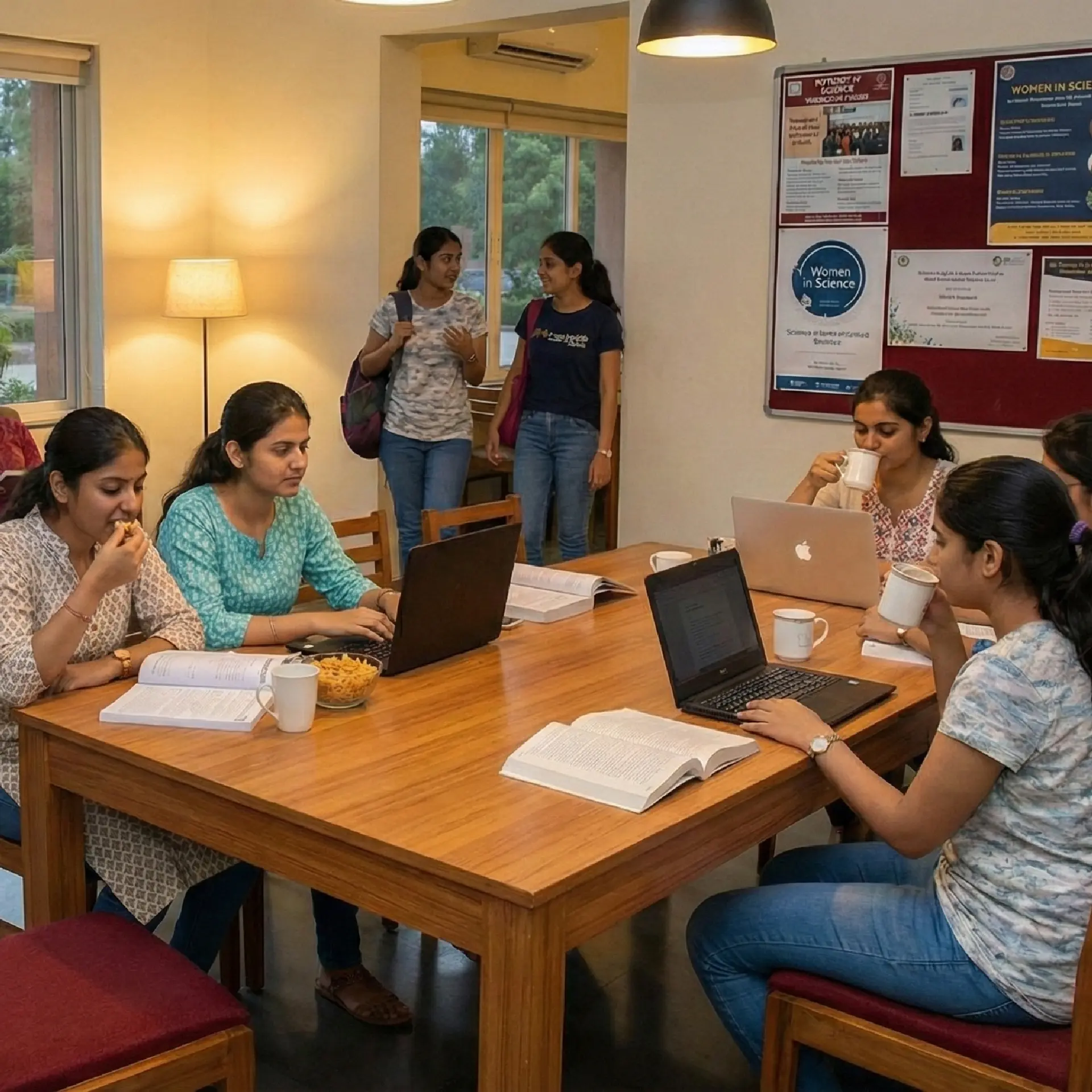
Earmarking a girl’s hostel in every district will help sustain this momentum, ensuring that girls do not drop out of their courses due to accommodation and safety concerns.
Last week, the Economic Survey highlighted that women continue to remain underrepresented in Science, Technology, Engineering, and Mathematics (STEM) disciplines, constituting 43% of enrolments in 2021-22.
STEM institutions are typically concentrated in cities—engineering colleges, polytechnics, research universities, and tech parks—which means pursuing these courses often requires migration.
Migration, for young women, is rarely just an academic decision; it is a logistical and social negotiation. Most families, especially those from rural areas, may not support a daughter moving to another district or state to study engineering or medicine. Here’s where girls’ hostels become a STEM enabler, reducing the need for long commutes, providing safe accommodation, making outstation education acceptable, and giving girls more time and opportunities to focus on their academics, including research, for longer periods.
India has 800 districts, and a girls’ hostel in each of them would require thorough planning and execution for them to be safe and secure, to attract girls to leave their homes for higher education.
This initiative can address deep regional and social disparities, improve enrolment and retention, and enable greater participation of young women in higher education—especially in emerging and technology-driven sectors.
In the end, the girls' hostels are not just safe places to stay in, but they become reasons for girls to stay on in education and contribute to India’s growth story.
Edited by Suman Singh