



You need to be your own fortress, your own rescue: Soha Ali Khan tells women
At SheSparks 2026, actor and author Soha Ali Khan spoke about authenticity, ageism, the invisible labour of womanhood, and why every woman needs to be her own fortress.

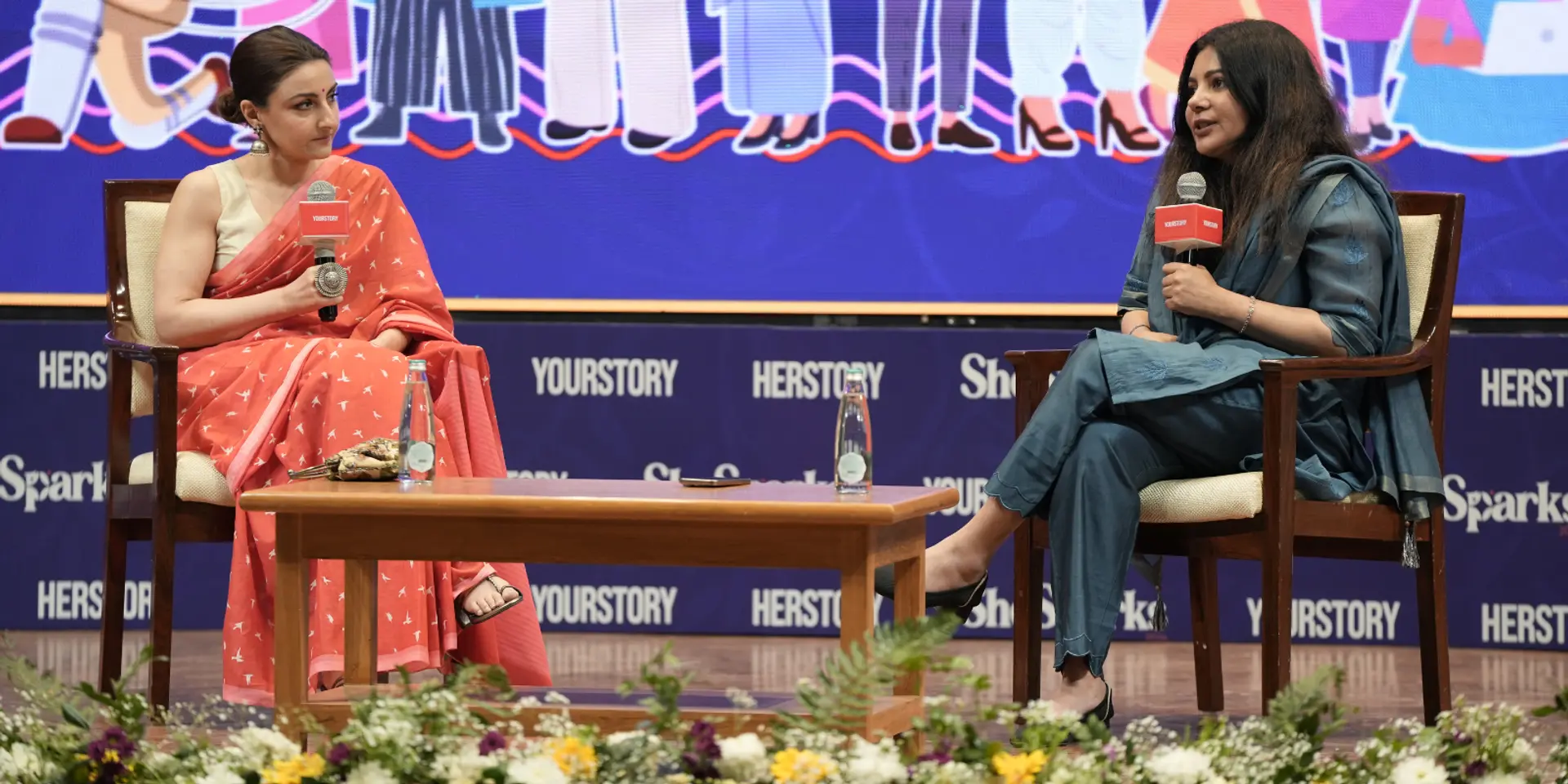

When Soha Ali Khan walks into the room, something settles. There’s a quiet poise about her that lights up the stage. It’s the ease of a woman who knows what she’s doing and is not afraid to speak about it.
The daughter of cricketing legend Mansoor Ali Khan Pataudi and actor Sharmila Tagore, and the younger sister of actor Saif Ali Khan and sister-in-law to Kareena Kapoor Khan, she is part of one of India’s most celebrated families.
But what strikes you most as she begins speaking is how she acknowledges and respects that legacy while carving her own path and choosing to be original.
“To be original requires some kind of inner strength and fortitude, because I grew up in an era where there was no social media. I feel today’s world is even more challenging because there is a lot of pressure to conform. In the desire to do that, sometimes we dull our own inner shine. And it takes a lot of courage and fortitude to be able to say that's not me. And this is who I am.”
Khan was speaking with Shradha Sharma, founder and CEO of YourStory, at SheSparks 2026, the platform’s flagship event for women, held on Saturday at IIT-Delhi.
The weight of a famous legacy
For most people, growing alongside superstars would come with a certain kind of pressure. But for Khan, education became an anchor.
“When you know you are not going to be the Indian captain for 10 years, or a national award-winning actor to work in more than three languages, I think the pressure comes off immediately,” she said.
“You focus on being happy and doing the things that derive a sense of enjoyment and pleasure from. I hope that people find that inner resilience to stand up against a crowd that’s saying “do this,” “do that,” and actually follow your heart,” she added.
What gave her an anchor, she said, was education. Khan studied at Oxford and holds a master’s degree from the London School of Economics.
“My family looks up to me for the pedigree I have because of my educational background. My mother didn't go to university. My father went to Oxford but was always on the cricket pitch. My brother didn't go. These are not things that held them back, but they appreciate those experiences that I have,” she said.
On ageing
Khan has been unusually outspoken about ageing and has resisted cosmetic surgery in an industry where it is often quietly expected. She is also conscious of how rare that stance is.
“It’s something I struggle with every day (ageing), because I have vanity. It is not like anybody is going to say, “it’s amazing to have wrinkles on your face, or dry skin or insomnia, all the things that come with ageing,” she admits.
She draws a firm line at cosmetic surgery. The reason is personal—everyone says she looks like her mother, and she has her father’s nose and profile.
“I don’t have him in my life anymore. But this is something I remember. I feel proud that he’s a part of how I look. I don’t want to change that. I feel it’s important to be comfortable with who you are, and to love yourself first, before you look for validation from anybody else.”
But she also admits it’s a struggle.
The invisible load
Khan doesn’t hesitate when she says she is most relaxed at work because there she has only one thing to focus on: her job.
Outside of work, life is full. Between her daughter Inaaya, husband Kunal Khemu, in-laws, playdates, parent-teacher meetings, and managing her podcast, All About Her, there’s rarely a quiet moment.
“There’s a huge invisible load that I feel a lot of women still carry. It’s not to say that men are not present as parents, but I feel it is impartial to women and the work that we do,” she says. She is careful not to paint this as a case of victimhood.
The podcast, she says, was born from this need to name things that go unnamed. "The only reason I wanted to start All About Her was that I believe in the power of community. People coming together, having an unfiltered, non-judgmental discussion in a safe space." She pauses. "When somebody's not shutting you down, even if they don't agree with what you're saying—that's all right. We can't always agree."
When it comes to parenting, Khan is honest and always committed to doing better. Children, she points out, are sponges and absorb the texture of the household.
Her own visual memory of childhood is of her mother going to work. Her father stayed home. She had to ask him for permission on evenings when Sharmila Tagore was at a shoot. She grew up understanding that a working mother was a mother with dreams — not an absent one.
When Inaaya was small, and Khan had to leave for work, she used to apologise. Then she stopped. "I said: no. I'm going to work because I really enjoy what I'm doing. And I hope one day you find a job that gives you the freedom to do what you want.”
Khan spent the evening talking about circles—the people in your corner, the voices in your ear, and the community that uplifts you. She believes in all of it.
But underneath every circle, she says, is the belief in oneself, which remains important regardless of who surrounds you.
“Ideally, you should be your own fortress. You need to be your own rescue,” she says.
Edited by Megha Reddy