



Shivani Sharma’s book of poems Aparajita is a stirring portrait of women’s lives
Shivani Sharma’s debut work of poetry, Aparajita, was launched at SheSparks, YourStory’s flagship event for women. The poems, which emerge from observation and personal memory, take us through the intimate spaces of a woman’s life.

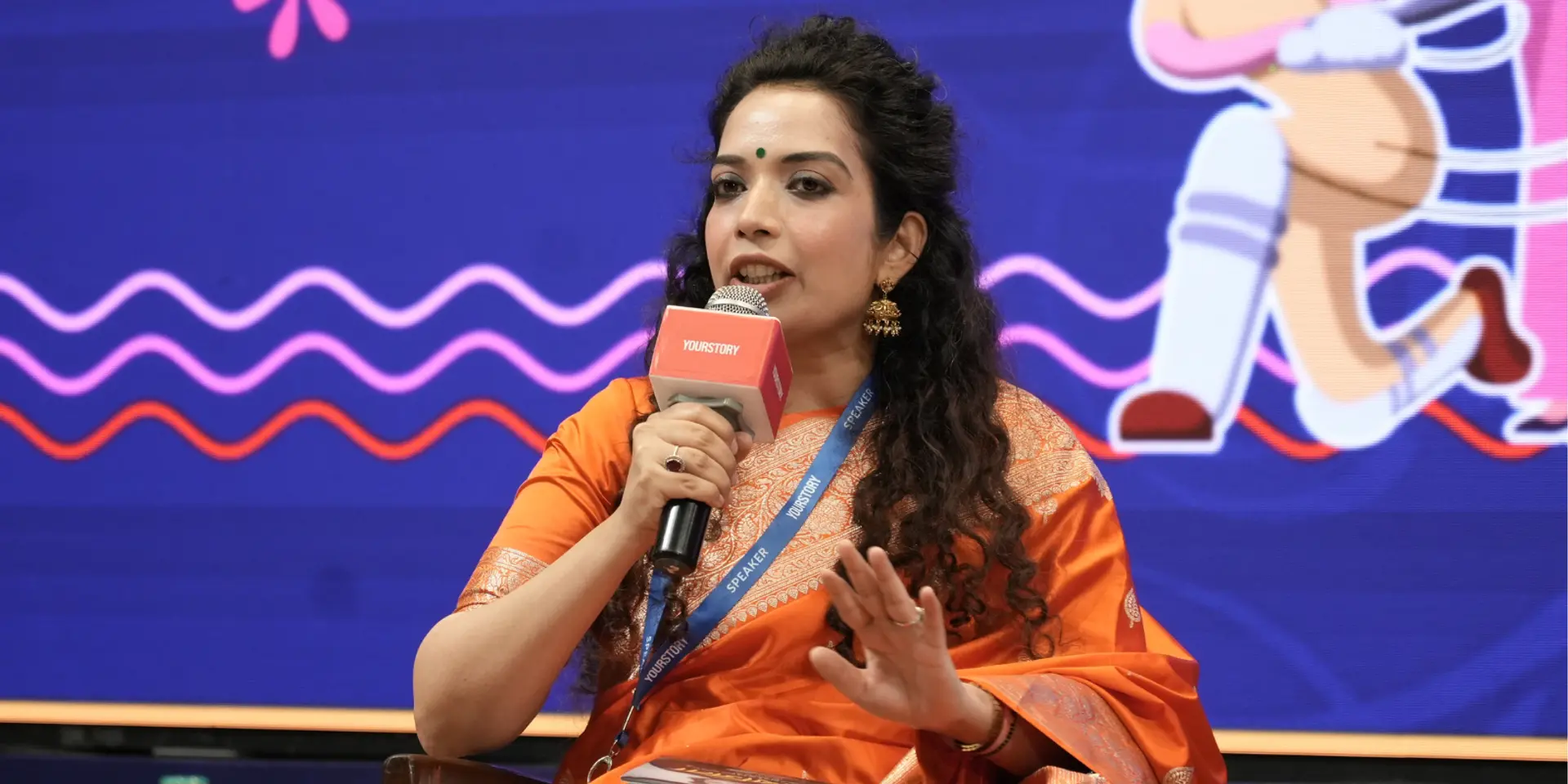

Shivani Sharma’s debut book of poems, Aparajita, depicts the quiet declaration of the many ways in which women endure, question, rebuild, and rise.
The poems take us through the intimate spaces of a woman’s life—the often unspoken tensions of sisterhood, the silent gratitude towards parents, and the emotional labour in everyday relationships.
Launched at the SheSparks 2026, Aparajita reflects moments and everyday images that are deeply personal for every woman. Yet they speak of a behanchara or a solidarity in sisterhood that binds women, even in moments of unspoken distance.
In an interview with HerStory, Sharma takes us through her writing experience, the poetry of silence, and the softness and strength of women in everyday life.
Edited excerpts:
HerStory (HS): Was there a moment or personal experience that became the emotional starting point for these poems?
Shivani Sharma (SS): Aparajita did not begin with one single moment. It began with many small moments that quietly stayed with me. A conversation with my mother, watching my father grow older, seeing women around me carry responsibilities without ever naming their exhaustion—these moments slowly gathered inside me.
For a long time, they were just feelings I carried. But one day I realised that these emotions had stories hidden within them. Poetry became the space where those unspoken emotions could breathe. So in a way, Aparajita didn’t start with an event. It started with an accumulation of life—memories, silences, relationships, and the quiet resilience of women that we often notice but rarely articulate.
HS: Many of your poems explore the emotional labour women perform within families. Did these poems emerge from observation, personal memory, or both?
SS: It was definitely both. When you grow up observing women closely—mothers, grandmothers, sisters—you begin to notice something subtle. They hold families together not just through work, but through emotional presence. They remember everyone’s needs, absorb tensions, soften conflicts, and keep relationships alive. Much of this labour is invisible because it’s done with love.
Some poems come from personal memory—moments that stayed etched in my mind. Others come from observing the women around me and realising how much strength exists in everyday acts that society often takes for granted. In many ways, these poems are a tribute to that invisible emotional architecture that women build within families.
HS: There is a tenderness in the way you write about parents and siblings. How did revisiting these relationships shape the writing process?
SS: Writing these poems felt almost like opening old photo albums of the heart. In a fast-paced life, we often don’t pause to reflect on the depth of those relationships. But when I began writing, memories surfaced- childhood moments, small gestures of care, things my parents did that I may not have fully understood at that time, happy memories, or even sad memories.
Revisiting these memories made the writing process deeply emotional. It allowed me to see my parents not just as parents, but as individuals who carried their own struggles, sacrifices, and quiet strengths. That realisation naturally brought tenderness into the poems.
HS: The poems seem to sit with silences as much as with words. How important is silence in your poetry?
SS: Silence is actually at the heart of many of my poems. In our lives, some of the deepest emotions are never spoken out loud. Families often communicate through gestures, pauses, and things left unsaid. I find that poetry has the unique ability to hold those silences. Sometimes what is not written carries as much meaning as what is written. I wanted the poems in Aparajita to feel like those quiet spaces in life—moments where a reader pauses and recognises something familiar within themselves.
HS: Your poems don’t shout or make grand declarations—they arrive gently. Do you see softness as a form of strength in women’s lives?
SS: Absolutely. Just like Shakti, she has a tender heart full of maternal instincts, yet she is ruthless on the battlefield. We all have Shakti within us. We often associate strength with loudness, confrontation, or dominance. But in reality, many women demonstrate strength through patience, empathy, and quiet endurance, and dominance when it becomes necessary.
Softness is often misunderstood as weakness. But I believe it is one of the most powerful forms of resilience. To remain compassionate, to nurture relationships, to continue caring despite difficulties—that requires immense inner strength. The women in Aparajita embody that kind of strength. They may or may not announce their power, but they are ready to transform the world around them.
HS: Aparajita can mean different things to different people. What does ‘being unconquered’ look like in everyday life?
SS: For me, being Aparajita does not necessarily mean winning battles or proving something to the world. It means staying true to your inner self despite life’s challenges. It means continuing to hope, to love, and to rebuild even after moments of disappointment or pain.
Many women I know are Aparajita in their everyday lives. They balance families, careers, expectations, and emotions while still holding on to their dreams and dignity. Being unconquered is not about never falling; it is about rising again with grace and courage.
Edited by Swetha Kannan