



Meet the sisters behind Mumbai’s local train app Yatri
Lakhi Sakaria Chowdhary and Reeva Sakaria have developed Yatri, the official app of Mumbai’s local train network, in partnership with Indian Railways. It offers real-time train tracking using source-verified GPS data, with live updates on locations, delays, platform changes, and disruptions.



In 2021, as Mumbai was slowly reopening following the Covid-19 pandemic, Lakhi Sakaria Chowdhary faced the same question as every other employer in the city. When could her team safely take the local train again?
The Mumbai local train network, which ferries close to eight million commuters every day and is regarded as the city’s lifeline, had come to a standstill during the lockdowns. With no reliable updates from the railways, commuters were left to rely on WhatsApp forwards and guesswork.
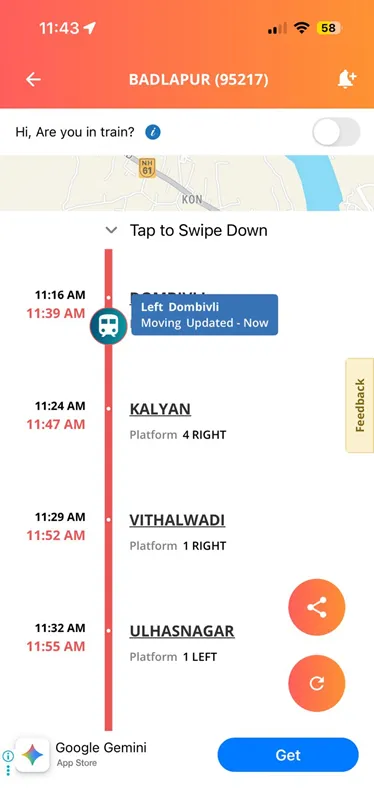
Yatri live location feature
The near-total absence of real-time information affecting millions of people led to the creation of Yatri, which is now the official app of the Central and Western Railways in Mumbai’s local train ecosystem.
Sisters Lakhi Sakaria and Reeva Sakaria developed the app, which emerged from the software division of CDP India Pvt Ltd, their family-run organisation with a 34-year legacy.
Lakhi had joined the company after a BTech in information technology and an MBA. She spent a decade developing software applications, predominantly in the B2B and B2G space for large corporations and government clients. Reeva spent a few years in consulting and joined Yatri as it began to take shape.
When Lakhi reached out to Indian Railways, they resonated with the problem commuters faced.
“They recognised the need for their own platform to disseminate critical information accurately and in real-time. We directed our app developers to build the app. And, Yatri officially launched in July 2022, after a year of development and testing,” says Lakhi.
The testing phase
Initially, as part of the testing, GPS devices were installed at multiple positions within the motorman cabin to minimise signal obstruction and reduce the risk of tampering.
Yatri conducted extensive testing of signal connectivity across different route patches to ensure consistent performance and implemented station arrival detection by creating virtual geofences around each station, combined with motion sensors in the GPS device to accurately track arrivals and departures.
“We undertook rigorous manual testing with a team of 15 members travelling on trains daily for a month to validate real-time accuracy and eliminate delays in live location updates,” says Lakhi.
Reeva points out that there are 3,000 trips every day, and delays occur for various reasons, so information needs to reach millions of commuters quickly.
“Take a stretch between Chinchpokli and Vashi. That corridor should run at 95 kmph, but ongoing construction brings it down to 30 kmph. A train early in the morning running at a third of its intended speed doesn't cause a delay immediately, but by peak hours, the effect has compounded across the entire line.”
Add derailments, track works, cancellations, and the complexity of the Central line, and the problem becomes clear: it isn't that trains are always late, it's that commuters have no way to know what to expect.
Yatri's answer is to pull data directly from railway control rooms and update only when the source does—a deliberate choice that trades immediacy for trustworthiness.
“We don’t want to be an app that disseminates incorrect information,” Reeva says. “If the control rooms haven’t relayed an update, neither will we.”
“We want commuters to open the app and know for certain whether their regular train is running, without any guesswork. And if it isn’t, they should be able to see 30 other options for the same route,” she adds. According to the founders, the accuracy rate hovers around 97-98%.
Lakhi emphasises that Yatri brings together everything a Mumbai commuter needs into one app.
“At its core is real-time local train tracking, powered by proprietary GPS devices installed across the network and fed directly from railway control rooms, so the information is source-verified and not crowdsourced. Commuters get live train locations, real-time delay alerts, platform change notifications, and disruption updates the moment they happen,” she shares.
Beyond real-time tracking, Yatri offers comprehensive schedule-based information across every major public transport mode in the city, including metro, monorail, buses, and ferries. So, whether a commuter is planning or navigating on the go, everything they need is in one place.
A commuter can enter their origin and destination, and Yatri maps the optimal end-to-end route across modes, including transfers and last-mile connectivity, making what used to be a mental juggling act completely effortless. Beyond trains, Yatri enables users to skip queues by booking metro tickets, and will soon offer bus ticketing on board.
Challenges of building at scale

Lakhi and Reeva
Beyond the technical challenges, Lakhi says the sheer breadth of the user base was a major consideration.
“Half the city’s population uses these trains—office workers, students, blue-collar and white-collar workers, semi-skilled workers, and individuals of all kinds. The app's UI had to be designed to serve every commuter type. That also meant accounting for low data connectivity and varying levels of digital literacy. We continuously improved the UI over time, relying heavily on user feedback,” she says. The app also offers multilingual support serving the entire spectrum of commuters.
With close to three million downloads, Yatri is now in six cities—Mumbai, Bengaluru, Delhi, Kochi, Kanpur, and Pune for public transport information. Its metro ticketing, powered by ONDC, is live in Mumbai, Bengaluru, Delhi, and Pune.
Yatri's revenue model includes B2B data licensing partnerships with platforms that need reliable, real-time public transport data to serve their users. For B2G (business-to-government), it is in active conversations with government bodies and transport authorities.
For the B2C segment, it is looking at in-app advertising, user subscriptions, and integrated ticketing across cities.
The feature nobody knows about yet
Yatri is working closely with the Railways’ security department and the Railway Protection Force (RPF) to introduce a safety feature that will benefit women.
“It is undergoing rigorous testing as we want to make sure response times are as low as possible. We have the live locations of all trains, which is a strong foundation. But a train has 12 to 15 coaches, there are footbridges, multiple platforms, and an enormous number of variables. Finding someone in distress is truly a needle in a haystack,” explains Reeva.
“We have been placing people in the most random locations across stations and measuring response times. Right now, the testing is looking very positive, so we're optimistic,” she adds.
Going forward, are the sisters hopeful that Yatri will bring in a change in commuting behaviour?
“Right now, if you want to plan a journey using public transport, you might use one app for ticketing, another for real-time train information, another for Metro, and another for bus. Our research shows that people lose 30 to 40 minutes daily navigating all of this—that's roughly six or seven days a year, and compounded over an adult lifetime of commuting, it's months of wasted time,” Reeva elaborates.
“We want to be one app that provides reliable, real-time information and ticketing across all modes of public transport across India. You enter your source and destination, and we give you the best route, let you buy a ticket, and you are done. We want to reduce the 35 to 40 minutes of logistics to two or three minutes,” she concludes.
Edited by Megha Reddy