



Meet the women entrepreneurs building for Bharat
These women entrepreneurs are working on improving credit access, market linkages, community participation, and income opportunities for underserved women, especially.

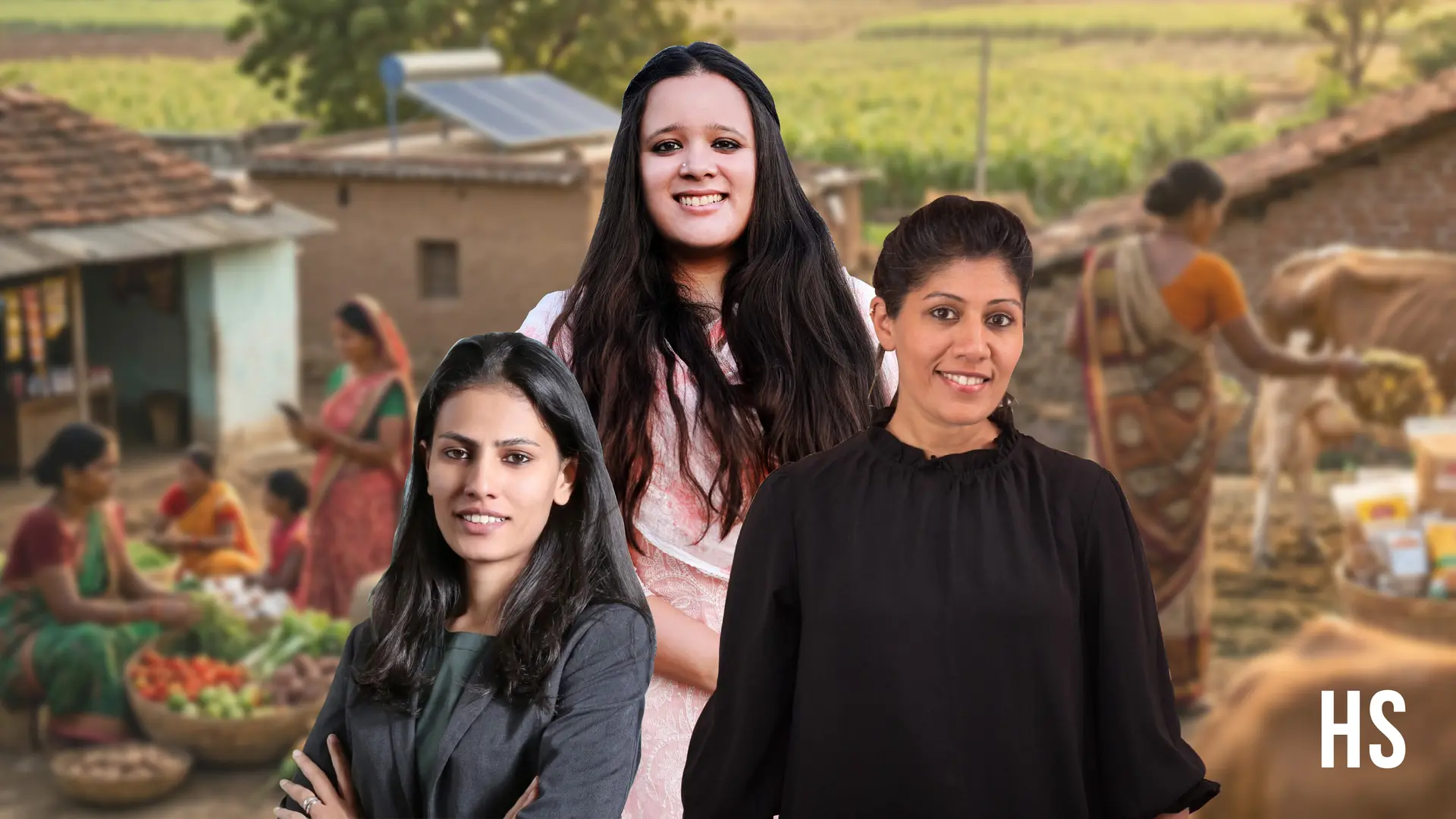

Across India, women entrepreneurs are quietly redefining what success looks like by focusing on participation and community impact rather than numbers and scale. Their startups are solving for credit access, creating market linkages, ensuring community participation, and generating income opportunities for the underserved, especially women.
Here are some women entrepreneurs who are going the extra mile to create and solve for Bharat.
Neetu Yadav and Kirti Jangra, Animall
India’s dairy ecosystem, an important driver of its rural economy, has largely remained fragmented and unorganised. Animall, created by Neetu Yadav and Kirti Jangra, aims to formalise a sector that has relied on informal networks and intermediaries. It began as a hackathon project, and later, the founders continued it as a weekend project in 2019, operating from a single room in Bengaluru.
Under the stewardship of Yadav and Jangra, Animall encourages farmers to buy and sell cattle online through a simple, vernacular-first interface designed for first-time smartphone users. Today, Animall has reached farmers across several states, facilitating transactions, simplifying processes, and building trust in the ecosystem.
Beyond cattle trading, Animall covers the entire dairy ecosystem and offers services such as insurance, financing, and cattle grading, ensuring fairer transactions and helping farmers make informed decisions.
Manjari Sharma, Farm Didi
During her time working on a project in Bihar, Manjari Sharma encountered a recurring question from women in self-help groups: “Didi, hum aur kya kar sakte hai?” (Sister, what else can we do?)
The women were already deeply involved in agriculture and household work, yet their economic participation remained limited. This insight eventually led Sharma to set up Farm Didi in 2021.
Sharma focuses on market linkage and business capability, areas in which women lack support. She works with women from self-help groups to produce traditional food products.
Farm Didi also handles branding, packaging, and distribution. The startup has efficiently translated home-based skills into viable enterprises.
The startup works with over 1,800 women across 45+ villages, creating a decentralised production network rooted in local communities. Beyond income, the focus is on skill-building, training, and confidence, enabling women to manage quality, packaging, and business processes.
Sharma has a clear goal to empower 1 million rural women.
Ajaita Shah, Frontier Markets
Ajaita Shah began her entrepreneurial journey in 2011 with Frontier Markets, a social tech commerce enterprise focused on solving the last-mile gap.
The platform delivers products and services directly to village households through an assisted-commerce model powered by rural women entrepreneurs, called Saral Jeevan Sahelis, who act as trusted intermediaries within their communities.
Born and raised in New York, Shah studied International Relations at The Fletcher School at Tufts University before turning her focus to rural India.
Over 35,000 rural women entrepreneurs use Frontier Markets’ Meri Saheli App as digital storefronts, delivering essential services spanning finance, clean energy, agriculture, healthcare, and consumer goods.
These women entrepreneurs have collectively generated over $100 million in rural commerce revenues, serving more than 4 million customers across 5,000 villages. Backed by global partners such as Mastercard Centre for Inclusive Growth, Acumen Fund, and TPG Rise, the company is working to empower 1 million rural women entrepreneurs by 2030, with the potential to reach tens of millions of underserved customers.
Nidhi Pant, Co-founder, S4S Technologies
For Nidhi Pant, the idea behind S4S Technologies emerged from interesting observations in agricultural markets. Pant noticed that farmers brought fresh produce to the mandis, but their unsold stock was spoiled by the end of the day.
This cycle of waste severely affected their incomes, making smallholder farmers risk-averse. Pant recognised that the real gap lay not in production but in post-harvest infrastructure. So she set out to build a solution that could help farmers retain value of what they grew. This led to the birth of S4S Technologies.
S4S Technologies provides a decentralised model of ‘factories on farms’, wherein solar-powered dehydration units allow farmers, many of them women, to process surplus produce into shelf-stable ingredients.
It combines renewable energy with localised processing and market linkage, enabling farmers to participate in value addition rather than remain dependent on volatile market prices.
Since its inception, the company has trained hundreds of women entrepreneurs and worked with thousands of farmers, enabling them to generate additional income from produce that would otherwise go to waste.
Edited by Swetha Kannan