



UE LifeSciences is betting on early detection of breast cancer through quicker, simpler screening
UE LifeSciences’ portable, radiation-free handheld device, iBreastExam, delivers breast screening results within minutes.

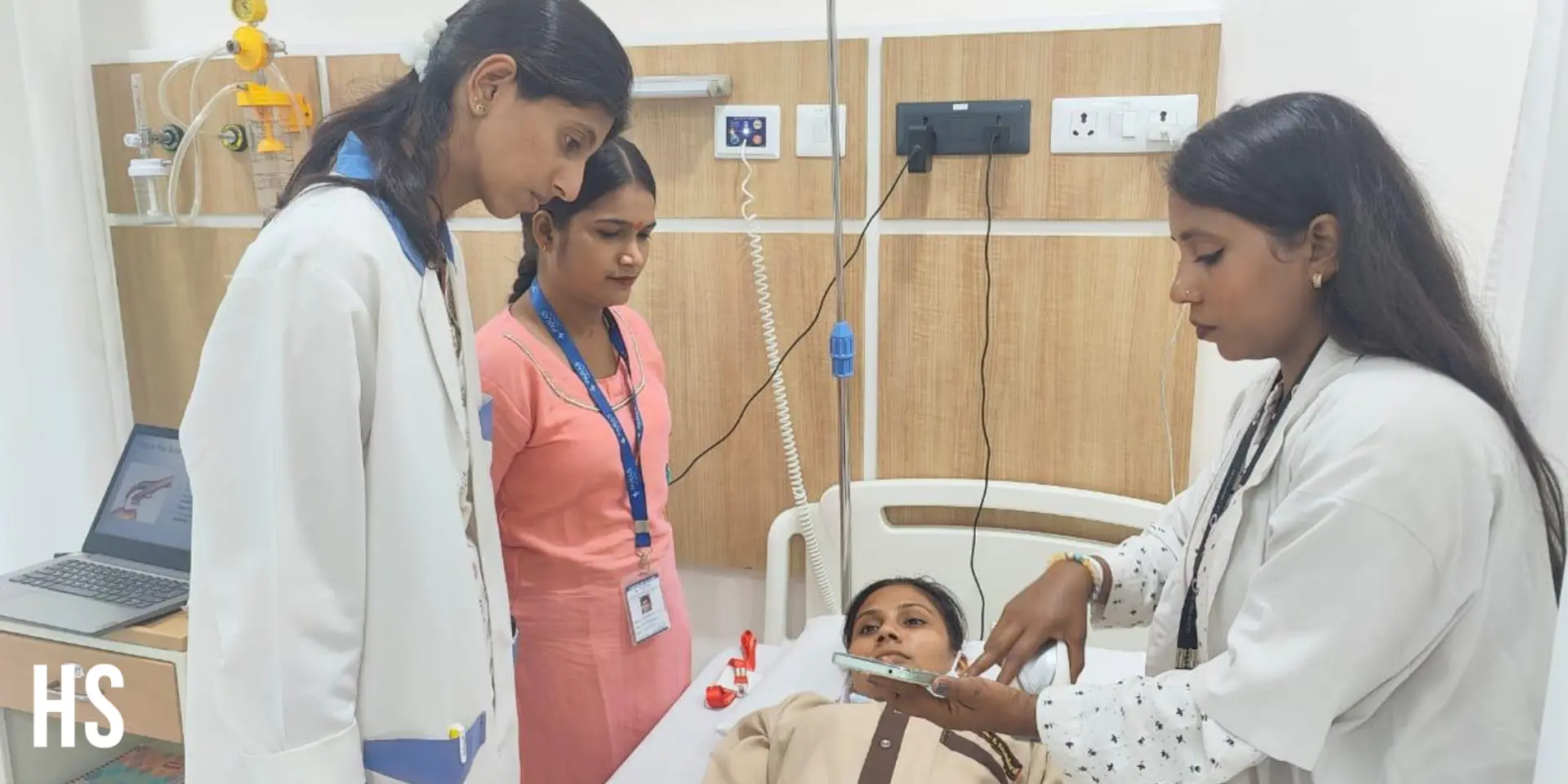

Gauri Navalkar Godse recalls the early days of iBreastExam, a breast cancer screening device, when the team travelled across remote parts of India to understand how women perceived breast cancer screening.
Their journeys took them to the Naxalite-affected regions of Gadchiroli in Maharashtra.
“We wanted to understand whether women would talk about it (the device), recommend it to family and friends. Because if women were willing to spread the word, it sent a strong signal that the device was working,” Godse tells HerStory.

Gauri Navalkar Godse
The team had expected resistance, given the conservative social norms in many rural communities. What they encountered, however, was more nuanced.
“Any kind of manual examination, someone touching them, was deeply uncomfortable. But the moment a device was used externally on the breast tissue, and it caused no pain, they were willing to get screened. This was consistent across Maharashtra, Rajasthan, and Gujarat,” explains Godse.
UE LifeSciences is the company behind iBreastExam, a tactile, sensor-based breast cancer screening device that is FDA-cleared, made in India, and designed to be as easy to use as a smartphone. The company was founded in 2010 and is headquartered in Mumbai.
Godse is the CEO of UE LifeSciences and heads its India operations. After completing a bachelor’s degree in medical microbiology and chemistry, she moved to the United States, where she spent over a decade.
She holds a master’s degree in business administration in healthcare laws and management from the University of Ohio. She also specialised in global business strategy at Harvard Business School. Then she worked with a firm that managed drug-release plans for leading pharmaceutical companies such as GlaxoSmithKline, Abbott, and Pfizer. She joined UE LifeSciences in 2014.
Godse traces the company’s journey from a university patent to enabling over 1.68 million scans.
The origin of iBreastExam can be traced back to the early 2000s when researchers at Drexel University in Philadelphia developed a tactile sensor technology capable of measuring changes in tissue elasticity. The inventor had solved a problem, filed for a patent, and moved on.
Drexel’s policy allowed external parties to purchase patent rights from inventors who did not want to advance their technology. Mihir Shah, a computer engineering student at the University, learned of this policy and brought Bhaumik Sanghvi on board as co-founder to start UE LifeSciences. Godse joined in 2014.
They realised how beneficial the technology would become and ended up buying the rights from Drexel. joined them later.
They focused on R&D, clinical trials, and product design before launching the device in the market after receiving US FDA clearance.
Shortly after, the team turned their attention to India because the scale of the problem in the country demanded it.
According to a study published in The Lancet Oncology, India’s breast cancer incidence rate increased from 13 cases per 1 lakh women in 1990 to 29.4 per 1 lakh women in 2023, with the mortality rate increasing from 8.9% to 15.5%.
The real question, Godse says is: what is preventing women from early screening and detection?
“When you talk about access, it’s not just about the availability of the modalities, it’s also about their limitations. Take mammography, for instance. There is radiation involved, which means younger women, especially those planning a family or who are pregnant, are excluded from screening,” she explains.
Beyond this, the mammogram process can be uncomfortable and intimidating, and because of all these, even the urban population does not get screened regularly.
“The iBreastExam was designed with these women in mind. We started with rural communities because they required maximum access, but the idea was to create reach for every woman. The vision was not to wait for them to come to a clinic or hospital, but take the device to them so that they can be screened in 5 to 10 minutes and get back to their day,” says Godse.
How iBreastExam works
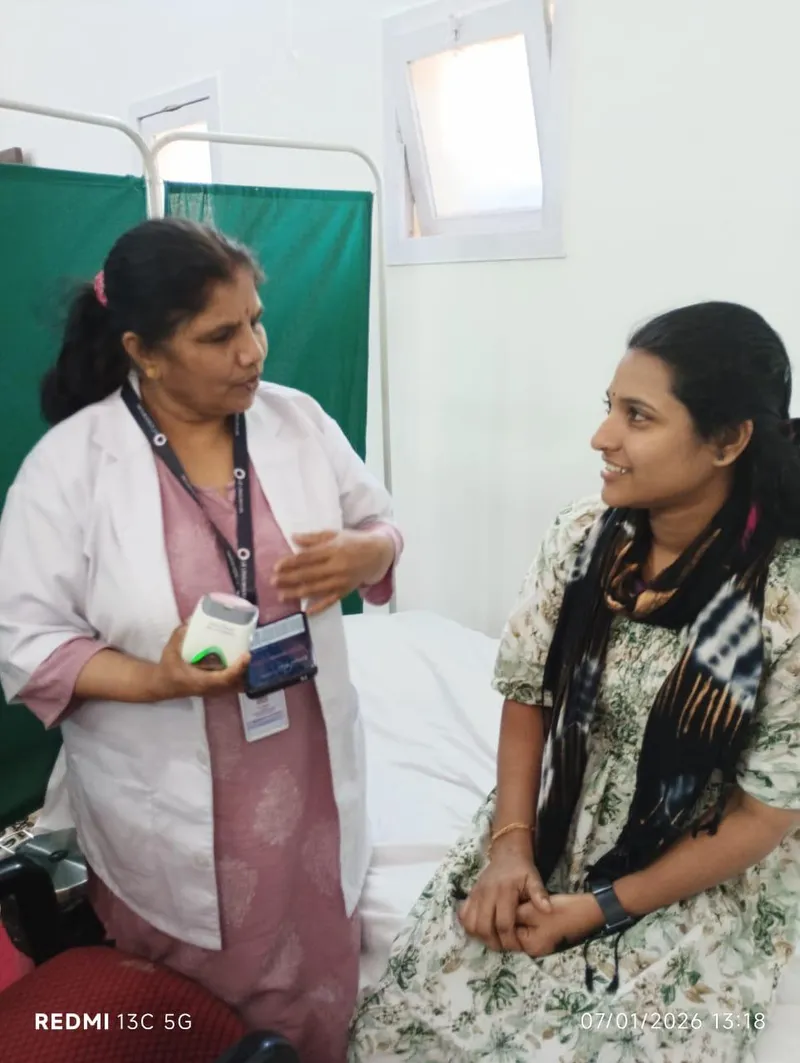
The operator explains how the iBreastExam works
The iBreastExam device uses dynamic coplanar capacitive sensors, the same technology used in smartphone touchscreens, to measure changes in breast tissue elasticity. If an area within the breast tissue is biologically stiffer or denser than the surrounding tissue, it is flagged as potentially abnormal. An embedded AI algorithm distinguishes between clinically relevant stiffness and normal tissue variation, tagging areas that warrant further investigation.
There is no radiation, compression or pain, and the results are available immediately. The device works without an internet connection, and crucially, does not require a radiologist to operate it.
Godse is careful to position iBreastExam as a primary screening tool, not a replacement for mammography and ultrasound, which has always been the gold standard.
“We screen every woman and funnel down the population showing breast tissue changes to then go for secondary screening through mammography or ultrasound,” Godse explains.
The screening device has one more advantage: it works equally on dense breast tissue. In the US, it is now legally required to inform women with dense breasts that mammography may not reliably detect lumps in their tissue.
When a woman shows a positive finding, the next step is usually an ultrasound, and if it warrants further investigation, a diagnostic mammography may be recommended.
Survival rates are a critical part of the story, says Godse. “Stage one or stage two of breast cancer, or even pre-malignant stage, carries a 90% survival rate. That rate drops steeply to 40–50% once you cross stage two. This is precisely why early detection is so important.”
iBreastExam was first deployed in the interiors of Maharashtra, Rajasthan, and Gujarat. In Gujarat, UE LifeSciences partnered with the Helping Hands Virginia Foundation to run door-to-door screening campaigns. Women would arrive in a village in the morning, hold a short awareness session, and screen the entire village throughout the day. The device, requiring no charging infrastructure, worked all day long.
The first women to be screened became the campaign’s most effective ambassadors. They told their neighbours that it was quick, comfortable, and done at home. That word-of-mouth changed everything.
“If you bring something to them that they feel comfortable about, they will get it done,” says Godese.
Success stories
UE LifeSciences’ public–private partnership approach is perhaps best illustrated by its breast cancer screening initiative in Goa, one of the state’s best efforts to promote early detection.
Rolled out in collaboration with the Goa government, the programme uses iBreastExam to extend screening beyond hospitals into communities, reaching women in semi-urban and rural areas where access to preventive care is often limited.
Through a mix of awareness campaigns and on-ground screening drives, the initiative has so far covered around 1.68 lakh individuals since 2021.
The Yuvraj Singh Foundation is among the organisations supporting the effort, alongside healthcare workers, local authorities, and other implementation partners.
In 2017, the company started working with the Medical Education Ministry in Maharashtra. Devices were installed in every government medical college and also in outreach camps. Women with positive findings are counselled and directed to nearby hospitals.
Godse narrates the story of a close friend who had stopped getting mammograms for five years because the experience was too painful and the anxiety too acute. She avoided it in the hope that nothing would happen.
“She started iBreastExam screenings at home every year. Last year, she was detected with a positive finding, fortunately, at a pre-malignant stage. She went through the full treatment, surgery, radiation and chemotherapy, and it was caught so early that her hair and skin were not significantly affected. Her friends saw this and realised that breast cancer caught early does not have to be devastating,” she explains.
The commercial model
UE LifeSciences sells the devices to hospitals and works with CSR funds to deploy them across states, with governments funding the screening programmes.
The company's new India distribution partner, Molbio, holds exclusive distribution rights nationwide and focuses on the private market. The goal is to make iBreastExam a standard part of routine check-ups at clinics of all kinds, not just in gynaecology or oncology centres.
Corporate screening programmes, at-home screening services, and hospital outreach programmes all purchase devices directly from UE LifeSciences.
The company holds the patent and manufactures the device in-house at its facility in Vile Parle, Mumbai. It operates as a research and manufacturing entity, while deployment happens through its network of partners.
UE LifeSciences has been largely bootstrapped, growing through demonstrated impact rather than venture momentum. Its cap table has been built carefully. Kiran Mazumdar-Shaw, one of India’s most prominent voices in healthcare and biotech, is an investor and supporter. Dr Ranjan Pai has also invested in the company.
“One of our core goals is to make breast cancer far less feared, so women see it as a highly treatable and curable condition. That mindset shift is what will stop women from delaying screenings,” concludes Godse.
(The story has been updated to correct a typo.)
Edited by Swetha Kannan