



Menopause, misinformation, women’s health—how Lisa Ray is rewriting the narrative
Actor Lisa Ray has co-founded NuHer, a midlife health clinic that provides expert, integrated care for women navigating perimenopause and menopause. She highlights the need for informed, empathetic support systems that help women understand and take charge of their midlife health.

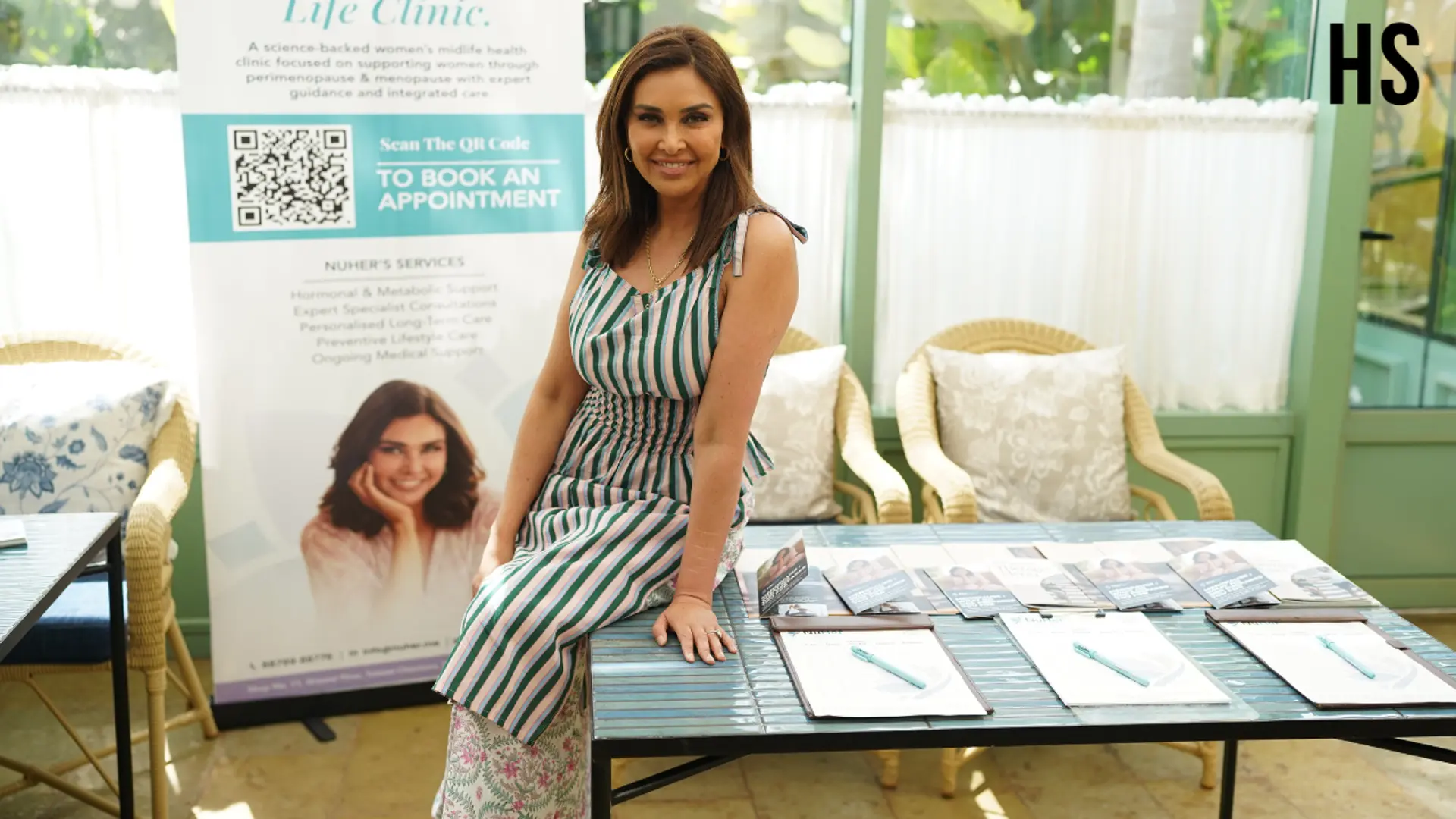

At 37 years, when actor Lisa Ray was diagnosed with multiple myeloma, she chose to be public at a time when most celebrities were not.
“I announced my diagnosis on the red carpet, which was cathartic for me, and gave me a sense of purpose during a tumultuous time in my life,” she tells HerStory.
The gaps in menopause awareness and care

What Ray did not publicly share at the time was that her treatment, a stem cell transplant, led to what is medically known as chemo-induced or medical menopause.
“Nothing had prepared me for this, and I was given very little medical support. It was mentioned almost as an afterthought, ‘You’ll go into menopause, you may want to think about freezing your eggs.’ After the transplant, I wasn’t advised to look at hormone therapy or ways to support my body through this radical transformation,” she shares.
She understands that the priority was to save her life, and she holds no bitterness. But she carried what followed, alone, for a very long time.
“I couldn't even admit it to myself on some level. OBGYNs were not particularly helpful. I didn't even know that an endocrinologist—a hormone specialist—was something I could go to. I didn't know such a person existed, despite being deeply educated about my own cancer.”
By then, Ray had normalised symptoms such as fatigue, mood swings, thinning hair, and dry skin. She later learnt that estrogen is not only a reproductive hormone, but also plays an important role in brain, bone, and heart health.
“I realised I was carrying more than my own menopause, I was carrying the shame of a generation. My mother had never prepared me for menopause. She prepared me for my period, but the mirror image of adolescence is menopause. It is equally natural, it does not mark the end of life, and it doesn't necessarily represent decline,” she points out.
The conversations that changed everything
About four years ago, as many of her friends were beginning to experience menopause, Ray recalls being on a trip with a close friend, Sujata Assomull, founding editor of Harper’s Bazaar India.
“She was struggling with perimenopausal symptoms but hadn't put a name to them. She thought she was going crazy: extreme mood swings and depression. When I mentioned perimenopause to her, she said it was the first time she'd heard the word,” she reveals.
Assomull and Ray started sharing their conversations around perimenopause and menopause on social media, which, she says, changed everything and also forced her to take a hard look at her own hormonal health. She met a doctor who “listened to her” and elected to go on hormonal replacement therapy (HRT) at 52 years.
“I had already started HRT,” she says. “Because I had educated myself. I reviewed my own tests, spoke with my gynaecologist, and understood what would be beneficial for me. And it made a tremendous difference.”
She pauses. “I thought: why didn't I do this earlier? But that's absolutely fine.”
According to the Indian Menopause Society, by 2026, more than 100 million women in India are projected to be undergoing or have completed menopause. Research indicates that over 80% of women between the ages of 40 and 60 experience symptoms such as fatigue, disrupted sleep, mood changes, and hot flashes. Yet, a significant number do not seek medical support, often dismissing these signs as stress or natural ageing rather than recognising them as part of a hormonal transition.
As Ray became increasingly vocal about menopause and women's hormonal health, her direct messages (DMs) began to fill up with responses from women describing similar struggles. Many said they had finally found someone speaking in a language they recognised.
“It tugged at my heart. But I am not a medical professional. I don't believe in one-size-fits-all. And I knew that what these women needed was not my smoothie recipe. They needed to be heard. And then they needed the correct, science-backed support,” says Ray.
Building NuHer

This year, Ray co-founded NuHer, a women’s midlife health clinic in Mumbai. Her other co-founders, Binoy Khimji, Zaheer Khan, and Vikas Shah, had been running NuHealth, a health initiative.
Their vision aligned and, along with a team of experts, including Dr Reina Punj, Dr Kajal Parikh, Dr Priyanka Mehta, Dr Anuya Manerkar, Priyanka Kapoor, and Parinaz Agha, NuHer began to address the growing gaps in care and awareness surrounding perimenopause and menopause.
“Medical care is given by OB-Gyns, gynaecologists, and an endocrinologist. After consultation, if a patient requires psychological or emotional support, she’s referred to our clinical psychologist. We are also onboarding a nutritionist and lifestyle coaches,” she explains.
“We are very intentional about who we bring in. My name is on this. There's so much information online that it can be overwhelming—each woman's journey is unique, and what she needs is a place where she'll be listened to and offered the right choices given her specific medical history,” Ray asserts.
The ultimate ambition, she says, is to build an ecosystem of trust.
Online consultations are available, and community building is an important part of NuHer’s plans. Ray wants to connect with as many women as possible to raise awareness.
Appointments can be booked through the website, which also features a menopause quiz. It starts with a confidential exploratory call with Dr Reina, after which any required bloodwork or investigations, along with a detailed consultation, can be planned.
NuHer will soon launch Nutraceuticals under the names 'Menostrong' and 'Menovita', designed to support women through the challenges of menopause and beyond.
Despite awareness programmes, Indian women remain ignorant and stigmatised by menopause. Why is there such a disconnect between the scale and the conversation?
It’s impossible to distill this country down to one community or culture, so there's a huge disparity in how information lands, says Ray. And then, there’s the shame, and women are not encouraged to talk about it.
Some women go through perimenopause and menopause without major symptoms, but she emphasises that we cannot dismiss the fact that low estrogen has an impact on a woman’s overall health as she ages.
In the last three months alone, Ray has been to Coimbatore, Amritsar, Ahmedabad, and Pune, giving talks on women's health.
She recounts a story from a recent talk she gave: a woman stood up at the end—educated, well-resourced, significant exposure—and said she had seen two of the best OBGYNs in her city. Both had told her,
"Menopause is natural, just accept it. Why would you want to do anything?”
“I nearly fell off my seat. And it should make every woman a little bit angry to hear that. But imagine that's an educated woman with resources who can now say, I'll find someone who listens. What about the woman with less exposure? In India, we are conditioned to give doctors enormous authority. Doctors are not gods, and they can miss the mark.”
“When you sit with a doctor, you are not only a patient, you are a client. If they are dismissing you, you are a customer. Go find another doctor.”
Ray also flags a deeper, systemic gap in how menopause is understood and addressed within India’s medical ecosystem.
“Many OB-Gyns are not up-to-date on menopause. Traditionally, they have been given about one hour of medical menopause, and beyond that, many are simply not staying current,” she says, with a directness that is not unkind but is entirely unequivocal.
The other side of midlife
There is one thing Ray wants to be sure does not get lost: the other side of all of this is extraordinary.
“I have never felt as strong, as empowered, as embodied, as confident as I have in my late 40s and 50s. That’s the part of the story we are not telling women. Midlife does not represent decline. It represents a woman stepping into her true power.”
“We become dangerous creatures,” she says, with evident pleasure. “You can’t fool us as easily anymore. We know what we like. We are not as easily manipulated.”
Moving forward, Ray wants to expand NuHer into a chain of clinics. But right now, the focus is on building awareness and education, and on creating a community.
Toward the end of our conversation, the question is put to Ray directly: if a woman in her mid-to-late 40s is not feeling quite herself—but doesn't yet have the language or the term for what she's experiencing—what should she know?
Ray doesn't hesitate.
“Not feeling like yourself is enough,” she says. “You know your body. You deserve to be heard. You deserve to see a doctor and have the proper examinations performed. Write everything down—the hot flashes, the sadness you can't explain, the anger, the dizziness. One of my symptoms was vertigo. I never knew that was perimenopause.”
And if the doctor dismisses you?
“When you sit with a doctor, you are not only a patient, you are a client. If they are dismissing you, being impatient, or treating you like a child, you are a customer. Go find another doctor.”
She pauses, then adds something she clearly feels is important to leave on record.
“Perimenopause is a call to action. Your body is not taking revenge on you. It is speaking to you. It is saying: “Please pay me some attention. I am important. I am you.”
“And I promise, if you listen, we are going to move into midlife in the most kick-ass, powerful way possible. You have become a Queenager,” she signs off.
Edited by Megha Reddy