



A father-daughter duo built Pinkishe Foundation to fight period poverty
Started by Khyati and Arun Gupta, Pinkishe Foundation is combining awareness, technology, and community partnerships to make menstrual health more accessible across India.

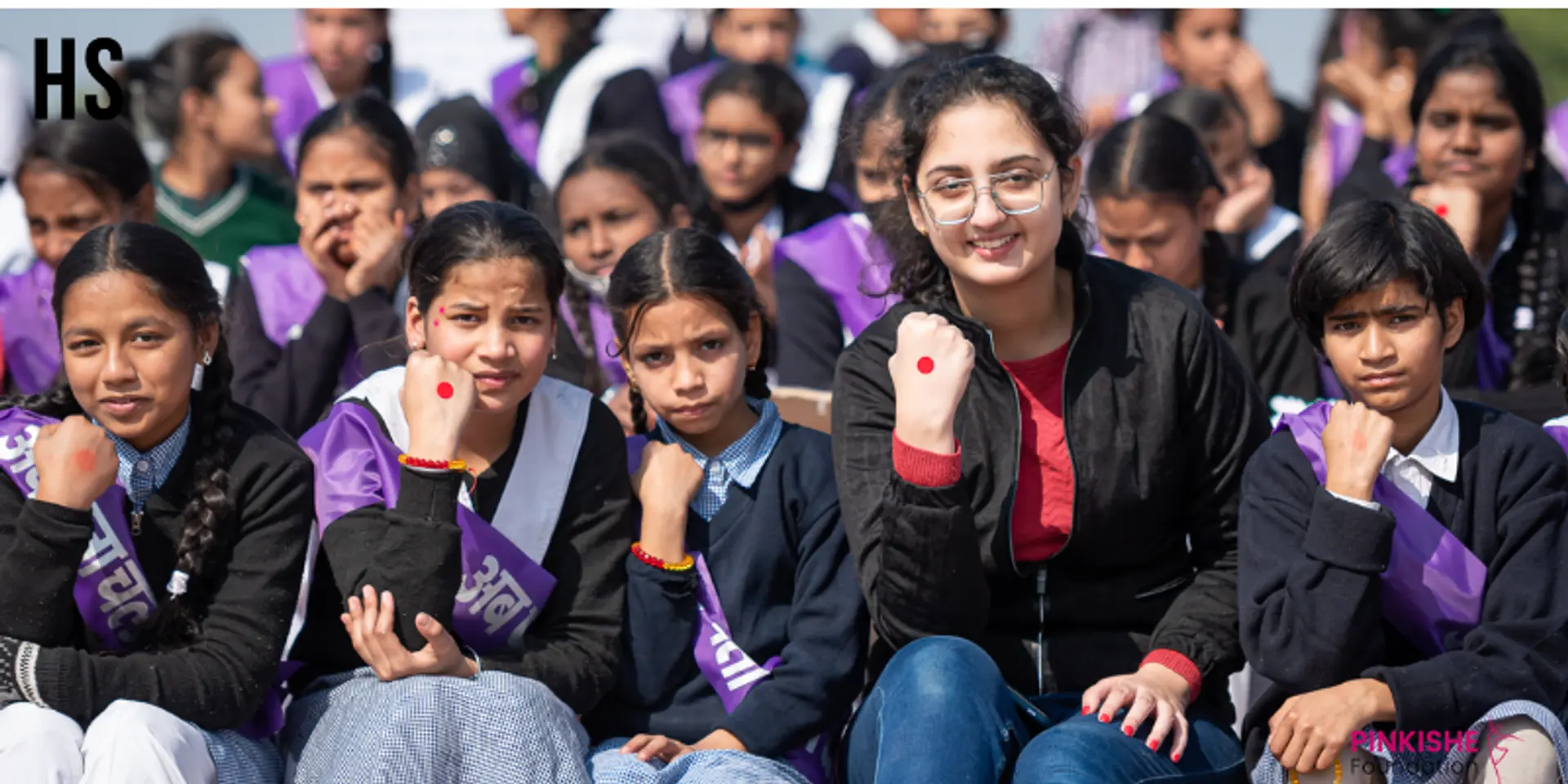

For most fathers in India, it is not an easy conversation when their daughter wants to talk about periods.
However, Arun Gupta did not flinch or fumble; instead, he chose to listen to his sixteen-year-old daughter, Khyati, who asked what they could do in their own capacities to address period poverty—the lack of affordable sanitary products.
Khyati had noticed a blood stain on the dress of her household help’s young daughter, Deepa. She asked the girl if she used a sanitary pad. The girl did not know what it was. Her mother explained that they could not afford them, so they used old cloth.
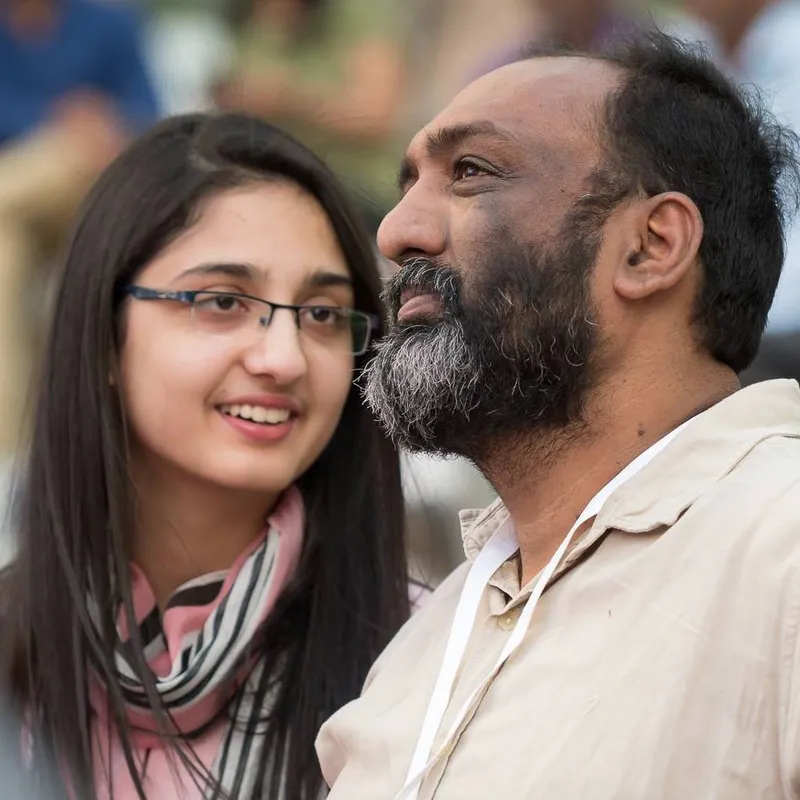
Khyati and Arun Gupta
"From my background, sanitary pads had always been available whenever needed. Knowing that for millions of girls and women in our country, sanitary pads are not even accessible and that they also lack proper knowledge around a process as natural as menstruation was very surprising,” she says.
In 2017, Arun and Khyati Gupta started the Pinkishe Foundation. Nine years later, the ripple effect is unmistakable: over 7,00,000 menstruators reached, 5,000+ awareness sessions conducted, 1,000+ schools covered, and 4.12 million sanitary pads distributed across 150 districts in all 29 states and union territories, powered by a network of over 100 grassroots NGOs and 50 corporate partners.
The power of Pink Circles
Arun, who had spent over two decades working with IBM and Dell before running his own business, could easily have listened politely and moved on.
"Rather than brushing me off, he chose to listen. He believed that we could do something about this, that we could build a life around this cause. That is very rare when it comes to children bringing up ideas,” says Khyati.
Initially, Arun took it as a kind of Gen Z one-off enthusiasm. But as the conversations deepened and the research mounted, something shifted.
"Once I saw the seriousness of it, I realised it would require full-time commitment. We didn't want to do this only in one place. The whole idea was to take on this problem at scale, to resolve it,” he says. He left his career and went all in, without any funds or blueprint, but with the urgency of the cause.
They started a Facebook group, and within six months, had two lakh members. In December 2017, they launched 50 branches across India, from Kashmir to Gwalior, Ambala, Chandigarh, Patna, and Gorakhpur, all entirely volunteer and women-led. They called these groups Pink Circles. It won the Facebook Community Accelerator Award.
“Volunteers would stand in front of pharmacies and ask anyone entering to donate a pack of sanitary pads. People were surprised at first, but they started donating. We took those to communities in nearby urban slums in Delhi,” he recalls.
When Kerala was ravaged by floods in August 2018, pads were collected from across India and sent in truckloads to Kerala. During the pandemic, they sought help from the police department to distribute pads.
Alongside pad distribution, Pinkshe developed educational materials by learning from doctors, researchers, and eco-feminist organisations. Volunteers were trained and took these sessions to communities every day, starting from scratch, explaining to young girls what menstruation was, why it happened, and how to manage it safely.
The initiative faced resistance in the beginning. Arun recalls being pushed out of classrooms by teachers.
“In Varanasi, men told me, “You are brainwashing our women. That’s why we built a women’s community, so that they could go and conduct the sessions,” he says.
Inside the Shakti Shala programme
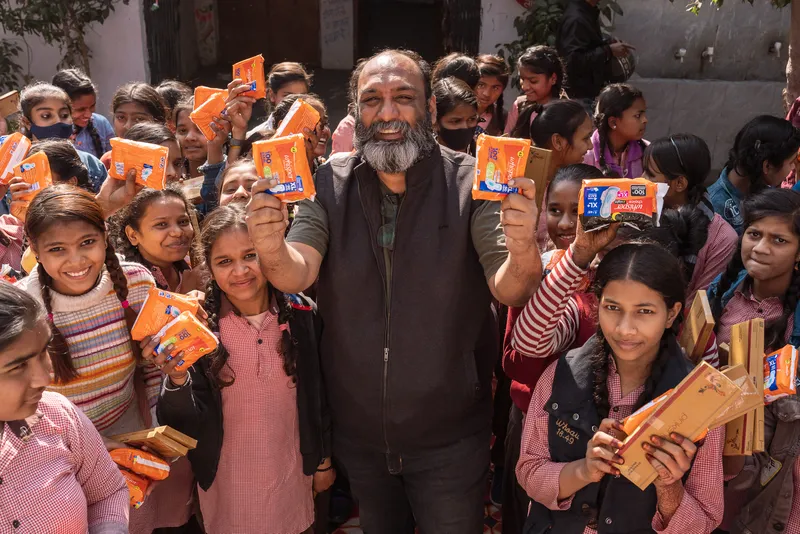
Arun Gupta as part of an awareness drive
Pinkishe’s flagship intervention, Shakti Shala, is a three-year district transformation programme that operates across six districts in four states: Telangana, Chhattisgarh, Uttarakhand, and Rajasthan.
Pinkishe works with the education and health departments, with a district nodal officer appointed to supervise the programme. The team identifies 70 to 100 government schools in each district and conducts a survey. A female teacher at every participating school, with support from the district administration, becomes a Sarthi, a guide committed to menstrual health and hygiene.
In each school, Pinkishe installs its IoT-enabled vending machine. A Pad Bank is also stocked with three months' worth of supplies, for which the Sarthi is responsible. Two girls from Class 9 and one from Class 11 are selected and trained to become Sakhis, or menstrual health management (MHM) champions. They take ownership of the machine: they refill it, monitor it, and are the first point of contact for their peers. An IVR helpline is also made available, so any girl in the school can call with questions or concerns.
On the community side, ASHA workers and Anganwadi workers are trained as menstrual educators. They conduct daily awareness sessions in the communities' languages, visiting multiple villages and schools in rotation. Posters go up in schools featuring the Sakhis, so the face of menstrual health in these communities is a local girl, not an outsider.
District support officers, employed by Pinkishe, manage logistics: supplying pads, maintaining machines, and ensuring that no school runs out of pads.
In the second year, Pinkishe introduces Nukkad Natak, plays designed to engage men and boys directly in conversations about menstrual health.
"We have also educated boys. I've seen that change in my own friend circle. Earlier, friends weren't comfortable discussing these topics with their fathers. Gradually, that level of comfort has been built,” Khyati says.
By the third year, two full cycles of Sakhis have been trained. The district administration has seen the data, seen the attendance numbers change, and seen the community respond. At this point, it becomes the district's responsibility to continue supplying pads and maintaining the infrastructure. Pinkishe moves on to the next district.
Stories of transformation
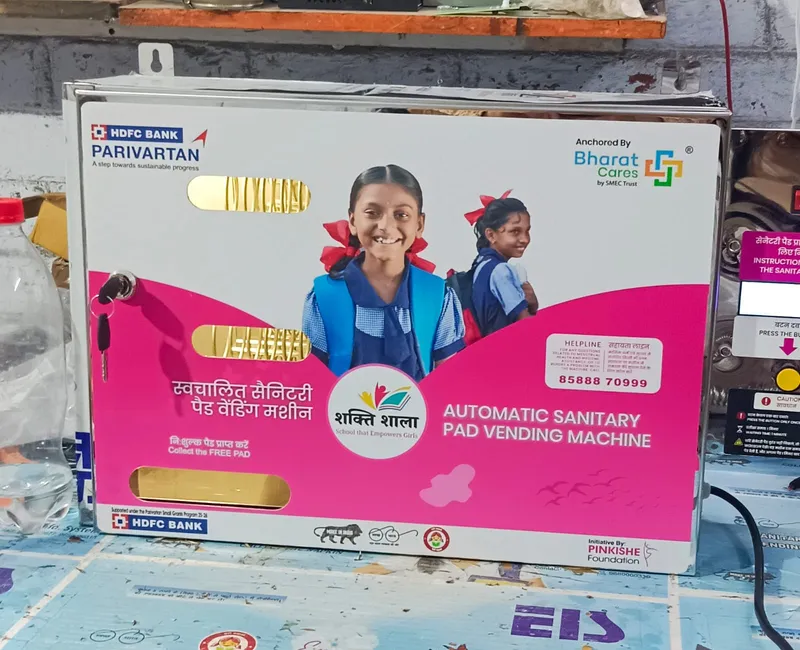
The IoT-enabled sanitary pad vending machine
In Telangana, Pinkishe works in Asifabad and Adilabad, tribal areas in the north of the state, with Asifabad designated an aspirational district.
“In one village in Adilabad, women on their periods were not permitted to remain in the village at all. When our team first arrived, they were asked before entering whether any of them were menstruating. One year later, the same village welcomed us without conditions,” says Arun.
The district newspapers in Adilabad also reported an improvement in school attendance rates due to the Pinkishe programme.
In Chhattisgarh, Pinkishe works in Narayanpur and Sakti districts. Narayanpur is the gateway to the Bastar region, a Naxalite-affected area where the organisation works with Indus Towers, covering 45 schools. In Uttarakhand, Pinkishe works in Udham Singh Nagar, a very large aspirational district where they have reached 75 schools.
“Here, a girl in a wheelchair travelled three kilometres to attend a Pinkishe session because she had heard about it and wanted to ask how she could manage her periods given her physical challenges,” says Arun.
In Rajasthan, Pinkishe works in Dholpur, another aspirational district, with funding support from HDFC and the district administration.
The next three districts being planned are Sarangarh (Chhattisgarh), Kondagaon (Chhattisgarh), and Kupwara (Jammu & Kashmir), where Pinkishe is partnering with the Indian Army. Khyati was in Kupwara for fieldwork just last week. Pinkishe has worked with the Army, CRPF, and BSF in many areas.
Across all six districts last year, through the Indus Towers partnership alone, Pinkishe reached 65,000 girls and 80,000 women with menstrual health and hygiene education. The goal is to cover all of 112 aspirational districts in the country.
The IoT-enabled pad vending machines have built-in SMS and WhatsApp alerts. Every time the pad stock falls to around 15, messages are sent automatically to the responsible teacher, district coordinator, and national coordinator, so everyone can act to refill the machine.
It also features a dashboard built by Khyati that provides comprehensive data on pad usage.
“We now have seamless, real-time data from all the vending machines across all locations. Initially, different questions arose. How many pads would a girl take in a month? Would there be theft? Would they take it for their families? Our monitoring shows that the average is around two pads a month per girl.
Pinkishe works with 50 partners, including Amazon, Indus Towers, Flipkart Foundation, P&G, BCG, Grant Thornton, Adobe, DE Shaw & Co, ZEE, PhonePe, UNIQLO, REC, Google, Meta, KPMG, Axis Bank, and HDFC Parivartan, among others.
Pinkishe is now registered on the National Stock Exchange’s Social Stock Exchange, with a listing expected in July.
“The moment you are listed, everything is transparent, and it signals the next level of credibility. The whole idea is to create an ecosystem where larger funds flow through this channel, more corporates recognise the issue and contribute, and the work becomes more systematic rather than fragmented,” explains Arun. Pinkishe plans to raise Rs 2.2 Crore to implement the Shakti Shala programme in 100 schools in the Sarangarh District of Chhattisgarh.
Khyati now holds a full-time job but dedicates time in the evenings and on weekends to Pinkishe. They have well-defined roles and work with a 25-member team.
In a landmark ruling in January this year, the Supreme Court directed the Union government and all states to provide free sanitary napkins and separate toilet facilities for girl students.
This is a huge win, says Arun.
“Over the next 10 years, we want every school in India to have menstrual health as part of the curriculum. Our vision is to reach a point where organisations like Pinkishe are no longer needed. That day is still not near, but we are completely committed to working toward it,” he concludes.