



The next decade will be focused on deep technologies, says Dr Manjula N, Govt of K’taka
From deeptech and quantum computing to women-led startups, Dr Manjula N, Secretary, Department of Electronics, IT, Biotechnology and Science & Technology, Government of Karnataka, discusses the state’s vision for the next decade of innovation.

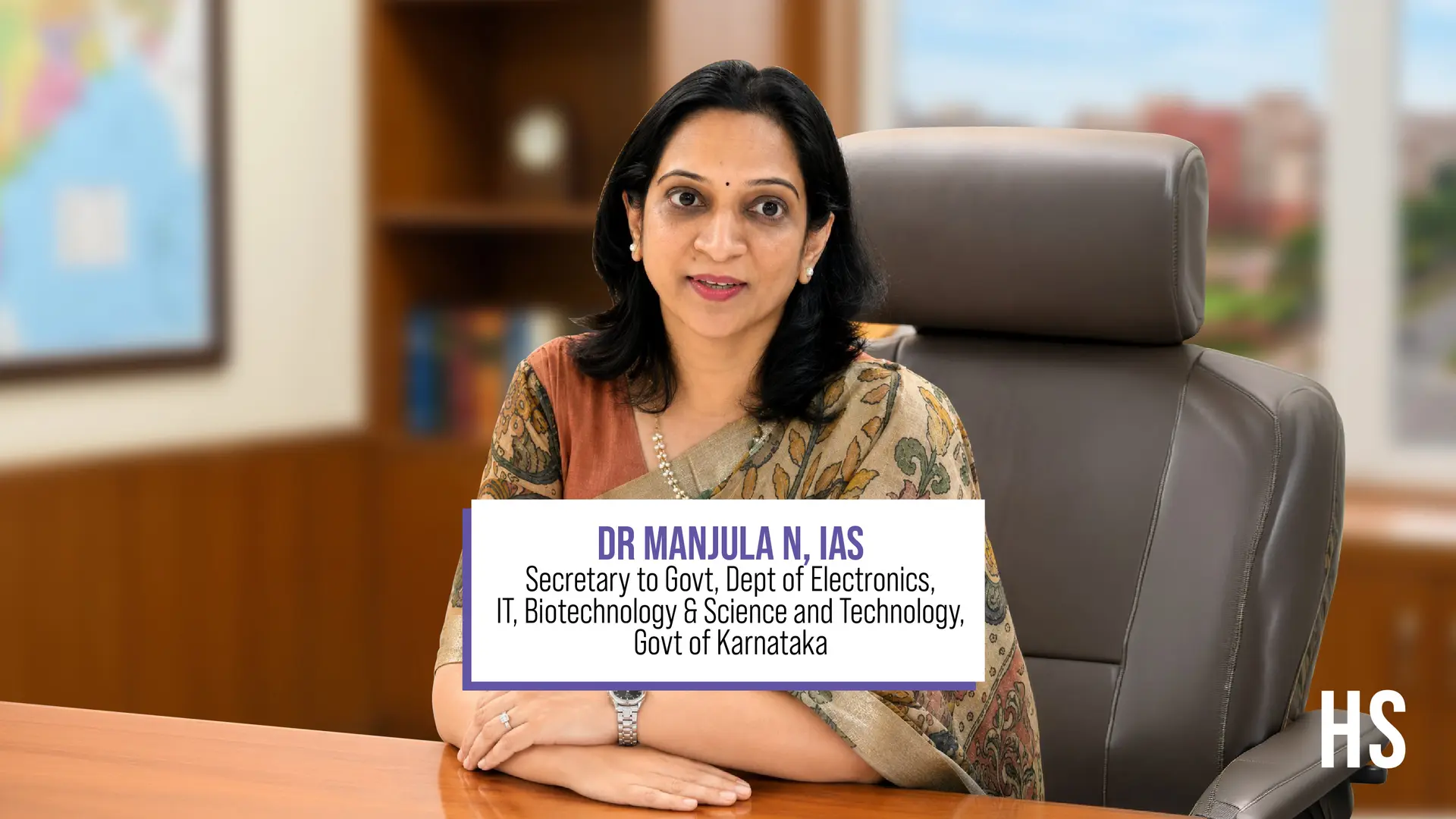

When Dr Manjula N looks at Karnataka’s technology ambitions today, she sees them through the lens of someone who has witnessed the state's transformation firsthand. Having studied in schools across multiple districts before completing her higher education in Bengaluru, the IAS officer has seen Karnataka evolve into one of India's foremost innovation hubs.
An officer of the 2002 batch from the Karnataka cadre, Dr Manjula has served across district administration, tourism, and municipal and infrastructure leadership.
Today, as Secretary to the Government of Karnataka in the Department of Electronics, Information Technology, Biotechnology and Science & Technology, she is helping shape the state’s next chapter—one centred on deep technologies, innovation-led growth, and opportunities that extend beyond Bengaluru.
In a conversation with HerStory, Dr Manjula speaks about Karnataka's deeptech ambitions, women in emerging sectors, skilling for the future, and why she believes the next decade will belong to innovation.
Edited excerpts from the interview:
HerStory: What shaped your early ambitions and decision to join the civil services?
Dr Manjula N (MN): My mother was very clear that I had to be financially independent. The emphasis was always on education: be there and do it yourself.
Medicine was one of the options, because when you are growing up, you don't realise your own potential. You just tread the common pathways. Eventually, I decided that I could do something on my own, and that's how I joined the civil services.
HS: Where did you grow up, and how has that influenced your view of Karnataka?
MN: I've studied in many schools across various districts of Karnataka and completed my higher education in Bengaluru.
I've seen those parts of the state when they were less developed and more rural than they are today. I can see how things have changed in this state for the better, making great strides in infrastructure.
HS: How would you describe your journey through different roles before your current position?
MN: Many projects, policies, and programmes are being implemented at the district, panchayat, and urban local body levels. That journey offers insights into how local governance works, showing both the good and the bad.
We've seen coastal areas like Udupi that introduced water supply and water metering two decades ago. At the same time, we've seen many panchayat programmes not yield the same results.
We have also seen how women representatives were earlier represented by their family members. But now, they actively participate in governance.
Each sector, tourism, higher education, and the Bengaluru Development Authority (BDA) has been a different experience. For instance, in tourism, we are a state with great assets spanning heritage, wildlife, adventure, and immense possibilities. Ultimately, we reach the apex at the secretary level, where all these learnings culminate in shaping the policies. It has been a great experience overall.
HS: In your career, how have you found decision-making changes within departments when it comes to technology?
MN: Take the case of the agriculture department. Technology can play a major role in managing crops, supply chains, and distribution, and in getting the right price at the right time. They have actually gone a step further by sponsoring a Centre of Excellence that we manage, which has rolled out many innovations in the field.
In the Health Department, various innovators have developed products that are now being tested in our primary health centres. There are diagnostic tools that are very economical, very easy to monitor with minimal staff and without any specialised equipment.
All the departments now understand that technology is the future. We have a large number of centres of excellence where we really see innovation translated into outcomes that are useful for society and for departments to adopt and scale.
We have more than 78 policies that we are rolling out in this department, and all of them view technology as the primary enabler—to make the economy better, people's lives better.
For technologies that can't be readily adopted or tested, we create a sandbox environment where they can be experimented with, validated, and scaled. So, the idea is deployment first, with regulation structured to facilitate it.
HS: What is necessary, beyond funding, to make Karnataka a truly deeptech hub?
MN: We are moving from a services facilitator to deep tech. We have announced that the next decade will be focused on deep technologies. It's not just funding—it's also creating the right ecosystem.
For instance, every sector has a role for AI. We are focusing on the right skills and talent to enable this adoption, as well as the right infrastructure.
We are pushing these initiatives beyond Bengaluru. The budget has announced an AI city in Mysore. And recently, there has been an announcement for an AI hub or AI innovation city in Bengaluru South—the erstwhile Ramanagar district.
Karnataka is today the GCC capital of India, hosting more than a third of the country’s Global Capability Centres, with over 900 units operated by 500–600 companies. What began as a hub for business operations has evolved into a centre for research, innovation, and intellectual property creation.
We are also strengthening our position in advanced manufacturing and semiconductors through initiatives such as the electronics manufacturing cluster in Mysuru. Recently, we approved a new facility by Aequs, a key supplier in Apple’s global supply chain, in Hubballi, further reinforcing Karnataka’s growing role in high-precision manufacturing.
HS: How do you ensure skilling efforts reach smaller towns?
MN: Our Local Economy Accelerator Program—LEAP—is focused entirely beyond the Bengaluru area. With an investment of Rs 1,000 crore over five years, we want to decentralise innovation, nurture emerging tech clusters, and create opportunities across Karnataka.
Through targeted funding, ecosystem-building efforts, and structured acceleration programmes in six key clusters, we expect LEAP to help generate more than five lakh jobs, foster deeptech innovation, and position these regions on the global innovation map.
NIPUNA is a partnership model in which the government covers 40% of the cost of skilling, with industry partners identifying candidates and training providers. Over 15 companies (including Capgemini) and 15,000 candidates are currently in the pipeline.
We now also have a partnership with Naukri.com, which enables potential employers to access the entire database of employment seekers—free of charge for the initial months. This is especially for GCCs, so they can identify potential candidates.
There is even a VLSI Design Skilling Curriculum, which is highly industry-ready and developed through one of our centres of excellence.
It's a multi-pronged strategy because we can't have one strategy for everything.
HS: What challenges do you foresee in this process?
MN: I don't foresee any major challenges, because when the government takes a step forward, I think everybody feels confident.
Our policies are not set by the government alone. We consult with all stakeholders—industry is one of the most important—and the policies are moulded based on their input.
Sometimes the industry also has its own hierarchies, which may cause time lags. But otherwise, I don't see any major challenge. In fact, many industries have housed themselves within academic bodies.
QPi AI, the first company in India to manufacture a quantum computer, has partnered with IIIT Dharwad, where the quantum computer has been installed. This gives students direct access, allowing them to learn and experiment with the technology firsthand. QPi AI is also supporting skill development, and we expect students to develop innovative solutions that can be deployed as part of our broader quantum and AI initiatives.
This year, we are planning for the government to be the first customer for many promising startup innovations, enabling them to be rolled out within the government ecosystem.”
HS: Are we preparing enough women for deeptech careers?
MN: We are seeing a good number of women-led startups.
We Escalate is an initiative focused on accelerating, mentoring, and connecting women-led startups with investment opportunities. The one-year, sector-focused programme will support 30 early-stage and growth-stage startups annually across two cohorts of 15 startups each, with a focus on sectors such as Biotech, AgriTech, MedTech/HealthTech, and Cleantech.
Through a six-month incubation phase followed by a six-month acceleration phase, the programme will provide structured mentoring, business development support, investor access, market validation, and deployment opportunities. The government will provide support of up to Rs 50 lakh per cohort, along with deployment grants for top-performing startups to help pilot and scale their solutions. Elevate Shakti offers a one-time grant of up to Rs 50 lakh for women-led startups.
Also, Women@Work is a partnership with companies such as Microsoft, Takeda, and Perki to increase women's participation in the workforce, particularly in regions beyond Bengaluru.
The numbers show that the share of women employees in the beyond-Bengaluru region has risen from 12 to 18% as a result of this.
This is a work in progress and a continuous effort.
HS: What will define Karnataka's tech story over the next decade?
MN: We are envisioning a decade of deeptech. There is a lot of interest in semiconductors, including manufacturing. We are the design capital—we have more than 70% of the country's chip designers here—and the world's fourth-largest innovation hub. In AI, we have more than 50% of the country's AI engineers.
We recently launched two centres of excellence, one in AI and biotech, and one in AI and quantum. We also launched the Centre of Excellence in space, covering satellite manufacturing, upstream and downstream technologies, and defence and aerospace-related technologies. IIT Dharwad has set up a special centre of excellence called Deftronics.
Beyond Bengaluru is another focus we will continue to have. All the deep technology support available in the city will also be emphatically supported in areas beyond Bengaluru.
The Global Innovation Alliance is one of our key platforms for connecting Karnataka’s startups with global markets. We have partnerships with nearly 40 countries to create innovation corridors, facilitate mentorship, and foster cross-border industry collaborations. Through this initiative, we also support startups in gaining international exposure by sponsoring their participation in global events such as VivaTech in Paris, helping them access new markets, investors, and partnerships. In fact, we have also supported 10 women-led startups from India in visiting VivaTech through the Indo-French Ignite x 2026, an initiative by SonderConnect.
Edited by Megha Reddy